

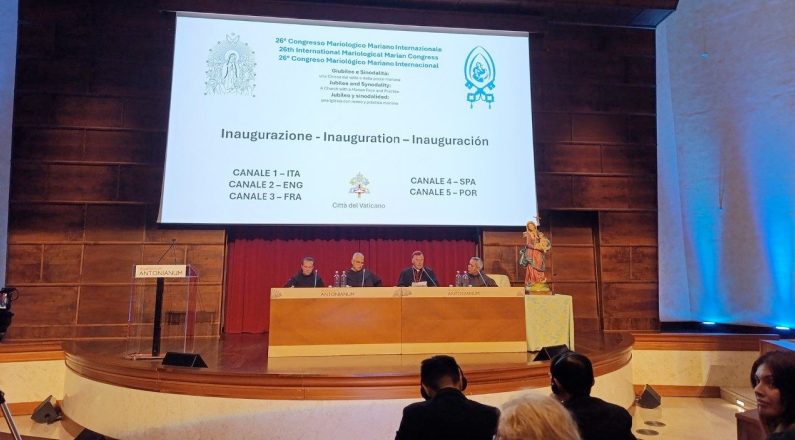
(ZENIT News / Rome, 10.02.2025).- Rome has just witnessed an uncommon convergence of scholarship, faith, and culture. From September 3 to 6, more than 600 theologians, researchers, and cultural figures gathered at the Auditorium Antonianum for the 26th International Mariological Congress organized by the Pontifical International Marian Academy (PAMI). The theme—“Jubilee and Synodality: A Church with a Marian Face and Practice”—set the tone for a gathering that was both theological in depth and pastoral in outlook.
What emerged from the four days of debate, prayer, and testimony was not simply an academic exercise, but a renewed attempt to situate the figure of Mary at the center of contemporary Catholic life. Rather than treating Marian studies as a devotional niche or a field for specialists, participants insisted on its role as an integrative lens, capable of holding together theology, culture, and the lived reality of the Church.
The closing address by Pope Leo XIV -read by a representative- underscored this point. He challenged the assembly with a striking question: is a Church with a Marian face a relic of the past, or a prophecy for the future? His response was clear. To him, Marian theology offers not nostalgia for a bygone Christendom, but a dynamic vision that shakes complacency and fosters new creativity.
This approach is deeply rooted in the Second Vatican Council, which framed the mystery of Mary within the wider mystery of Christ and the Church. That perspective, reiterated repeatedly at the congress, allows Mariology to function as what some scholars called a “discipline of synthesis.” It holds together reason and affection, doctrine and pastoral practice, universality and local realities.
The Pentecost icon, chosen as the emblem of this congress, illustrated the point vividly: Mary at the heart of the nascent Church, praying in the Upper Room, embodying the listening and openness that define synodality. Several speakers highlighted how her “fiat” was not a private gesture, but a communal one, offered on behalf of God’s people.
Cardinal Mario Grech, Father Stefano Cecchin, Sister Valerija Nedjeljka Kovač, and others explored how a Marian perspective could enrich both the Jubilee Year of 2025 and the synodal journey now underway. Their interventions suggested that Marian theology is not only about doctrine, but also about forming ecclesial attitudes: listening, dialogue, and service to those on the margins.
The congress also innovated by looking beyond the academy. For the first time, PAMI introduced the “International Marian Award: Mary, Way of Peace Among Cultures.” Artists, musicians, and visual creators were honored for works that express Marian inspiration in contemporary idioms. This opening to culture underscored Pope Leo XIV’s own call for Marian thought to be present not only in seminaries and sanctuaries, but also in literature, art, and music—the places where societies forge meaning today.
A recurring theme was the need to rediscover Mary’s humanity. Father Cecchin, PAMI’s president, reminded participants that the Mother of God is not only Queen of Heaven but also a woman who fully lived the struggles and joys of human life. This, he argued, makes her not a distant icon but a companion on the journey, “a friend who walks with us,” as he put it, echoing the story of Cana where she seeks fullness of life for others.
By the congress’s conclusion, it was evident that the Academy’s task in the coming years is not limited to systematic research. Rather, it must promote a Mariology that is intellectual and practical, contemplative and cultural, able to speak to questions of human identity, relationships, and dignity in an age marked by fragmentation.
In this light, a “Church with a Marian face” is not about multiplying devotions, but about rediscovering how the figure of Mary—woman, mother, disciple—illuminates the Church’s path toward communion, mission, and hope.
Thank you for reading our content. If you would like to receive ZENIT’s daily e-mail news, you can subscribe for free through this link.

Publicaciones relacionadas:
 Photo Gallery: These Are the First Digital Collection Boxes (or Baskets) for Alms at One of the Pope’s Basilicas in Rome
 Where do the Trevi Fountain coins go and what does the Pope have to do with that destination?
 Pope Francis meets his own clergy four years later: this is what they talked about
 Venezuela: Virgin Mary moves 2.7 million Catholics
