

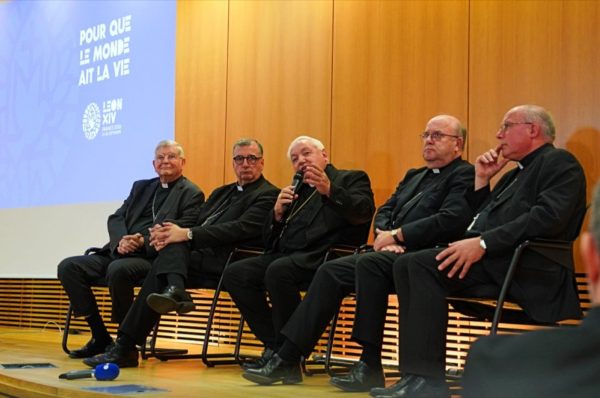
(ZENIT News / Paris, 09.12.2026).- Pope Leo XIV will arrive in France on September 25 to a country that, at least for the moment, appears far more eager to see him than many might have expected. More than a million people are expected to encounter the Pope during his four-day apostolic journey, with registrations continuing to rise for the major events in Paris, Lourdes and Metz. But behind the impressive numbers, the French bishops see something more significant: an opportunity to rediscover the country’s Christian vocation and to ask what the Church can offer a society searching for hope.
The scale of the response has already transformed the visit into a national event. About 450,000 people have registered for the September 26 Mass around the Place de la Concorde and the Champs-Élysées, while some 8,000 new registrations have been arriving each day. The 80,000 places for the youth vigil at the Stade de France have been filled, with a waiting list still open. Lourdes reached its authorized capacity of 150,000 registrations for the Sunday Mass, while Metz has recorded around 40,000 expressions of interest and has seen its hotels fully booked.
For Cardinal Jean-Marc Aveline, president of the French Bishops’ Conference, the enthusiasm should not be reduced to the attraction of a major public figure. The Pope, he argues, comes to encourage and strengthen the French Church, but also to offer words whose significance can extend beyond France. The cardinal has urged Catholics to resist the temptation to predict what Leo XIV will say and instead prepare themselves to listen. The real challenge, in his view, is to discern the spiritual hunger revealed by the extraordinary response to the visit.
That perspective helps explain the choice of the journey’s motto: “That the world may have life.” Initially, the organizers considered a theme centered on peace, but eventually turned to the question of life. The phrase, inspired by Christ, was immediately accepted by Leo XIV and also reflects a central concern of his first encyclical, Magnifica Humanitas: the defense of human dignity wherever it is threatened. Aveline suggested that the Pope’s message in France will therefore concern life not merely as an ethical question, but in its broader human dimensions.
The bishops are also presenting the journey as an opportunity to look again at France itself. Aveline believes Leo XIV is particularly interested in a country whose history is inseparable from Christianity, even though its contemporary culture is deeply secularized. Rather than simply lamenting secularization, the cardinal sees another question emerging: how did France preserve such a remarkable Christian inheritance, and what might that history say to the country today?
That is why the visit is being framed less as an exercise in nostalgia than as an invitation to recover a vocation. France’s Christian past is visible in the saints and other figures who shaped its history, Aveline said, but the task now is to identify what that vocation might mean in the contemporary world and develop it creatively. Bishop Benoît Bertrand similarly described the expectations surrounding the journey in terms of joy, diversity and anticipation, including hopes that the Pope will strengthen Catholics in faith and mission and encourage a Church particularly close to the poor and humble.
The itinerary itself reflects that ambition. In Paris, Leo XIV will encounter both enormous crowds and much smaller groups, moving between the public square and more intimate encounters. He will visit the Carmelite church of Saint Joseph on September 26 and pause at the Carmelite Martyrs’ Staircase in memory of religious men killed during the French Revolution. The visit will also recall figures such as Blessed Frédéric Ozanam and Brother Christian de Chergé of Tibhirine, as well as the Carmelite Brother Lawrence of the Resurrection, whose spirituality is particularly close to Leo XIV.
The Pope will also meet catechumens and newly baptized Catholics at the Catholic Institute of Paris. Their presence is especially revealing in a country often described primarily through its secularization: the meeting will give a public place to people who are moving in the opposite direction, discovering Christianity and entering the life of the Church. Leo XIV will hear testimonies from a catechumen, a newly baptized Catholic and a spiritual director.
Lourdes will provide a very different setting. More than 200,000 people are expected over the Pope’s brief stay, including about 150,000 during Sunday and almost 25,000 for the evening Marian procession. But the most delicate moment will be a private meeting with seven survivors of sexual abuse.
French bishops have explained that the format reflects Leo XIV’s own desire for a genuinely personal conversation rather than a large meeting dominated by speeches. The seven participants were selected to include both men and women, people abused as minors and adults, and survivors from different ecclesial environments, including religious life, diocesan settings, schools and parishes. Others who wished to participate will be able to send written testimonies to the Pope, with a broader follow-up meeting planned for December.
That encounter gives the journey another dimension. The motto speaks of life, but the Church’s credibility in defending human dignity also depends upon confronting the ways in which dignity has been violated within its own institutions. The French bishops have stressed their continuing responsibility for prevention and for making the Church a safe place. In Lourdes, the language of life and dignity will therefore meet the painful testimony of people whose lives were profoundly wounded by abuse.
The journey will end in Metz, where its European dimension will become particularly visible. Bishop Philippe Ballot has recalled a city marked by three wars and two annexations but also by the reconciliation between France and Germany. With some 40,000 people already expressing an intention to attend, the Pope’s presence is being understood not simply as a French ecclesial event but as an occasion with wider European significance. The final Mass will accommodate 12,000 people, while a two-kilometer route outside the cathedral will allow Leo XIV to encounter families and people approaching the end of life.
All this comes with a formidable logistical and financial burden. The French bishops estimate the total cost of the journey at €27 million, while only €5.5 million had been collected by September 8. Yet the organizers insist that the financial challenge has not eclipsed the sense of anticipation. General Hervé Wattecamps, responsible for the Paris organization, has described the scale of the preparations as almost dizzying, particularly as thousands of new people continue to register every day.
Even the question of religion in public space has acquired symbolic importance. The Mass at the Place de la Concorde and the Champs-Élysées has prompted debate in a country strongly committed to secularism. Archbishop Laurent Ulrich of Paris has responded that the French Republic neither recognizes nor privileges a religion, but does guarantee the public expression of religious convictions. The Church obtained the required authorization for the celebration, following the same procedure applicable to other public events.
The contradiction is only apparent. A Pope visiting one of Europe’s most secular societies will be entering a public space precisely because religious freedom permits believers to express their faith there. And the response so far suggests that the question facing France may be less whether religion has disappeared than whether it still has something meaningful to say.
Leo XIV’s first major encounter with France will offer an unusually visible test of that question. The crowds, the catechumens, the survivors of abuse, the families, the young people and the pilgrims converging on Lourdes and Metz represent very different experiences of contemporary France. What connects them is not necessarily agreement about the Church, but a willingness to encounter the Pope.
For the French bishops, that is the opportunity. They are not preparing merely to receive Leo XIV; they are preparing themselves to hear him. And the most revealing measure of the journey may ultimately be what happens after the crowds disperse: whether “That the world may have life” becomes more than a papal travel motto, and whether it helps a secularized France reconsider the sources of its hope, its Christian inheritance and its understanding of human dignity.
Thank you for reading our content. If you would like to receive ZENIT’s daily e-mail news, you can subscribe for free through this link.

Publicaciones relacionadas:
 For the first time, a Pope will address the Spanish Parliament: it will be Leo XIV during his visit to Madrid in June 2026
 The Middle East, the spread of war, and the position of the Pope and the Catholic Church
 Venues of Pope Leo XIV‘s Apostolic Visit to Spain Will Include the Real Madrid Stadium, the Sanctuary of Montserrat, Parliament and Time with The Spanish Sovereigns
 Under the agreement with China, Leo XIV appoints a new bishop
