

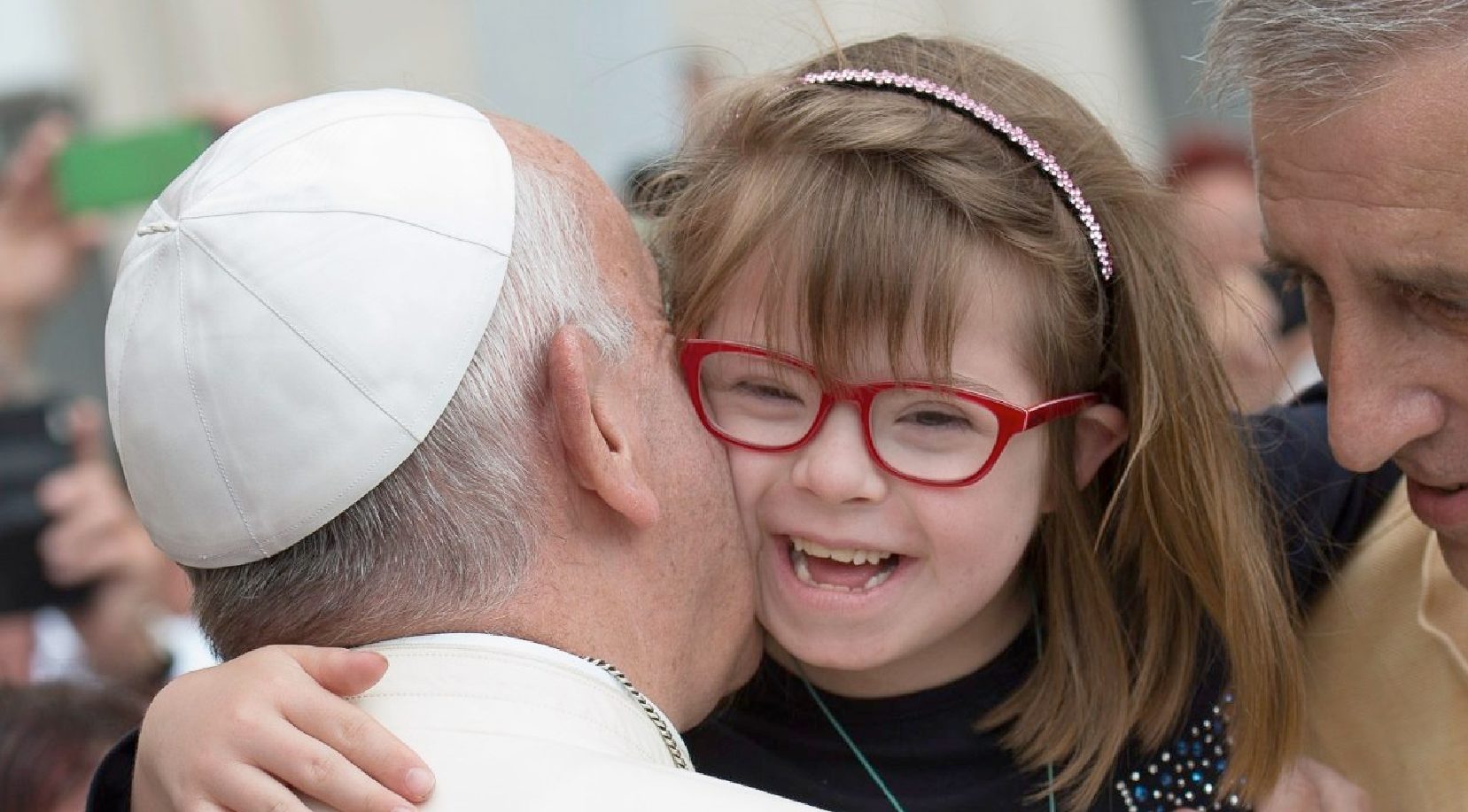
(ZENIT News / Geneve, 03.25.2026).- The Holy See has issued a pointed warning: modern prenatal medicine, for all its sophistication, risks becoming an instrument of exclusion. Speaking in Geneva, Archbishop Ettore Balestrero, the Vatican’s permanent observer to the United Nations, called for an end to what he described as discriminatory practices targeting unborn children diagnosed with Down syndrome.
His remarks, delivered at an event hosted by the Jérôme Lejeune Foundation, come at a moment when technological progress in prenatal screening has fundamentally altered the landscape of pregnancy and decision-making. Since the introduction of non-invasive prenatal testing in 2011—procedures that eliminate the miscarriage risks associated with earlier diagnostic methods—screening has become routine across much of the developed world. The consequence, however, has been a dramatic increase in the termination of pregnancies following a diagnosis of Down syndrome.
Balestrero framed the issue in technical anthropological and moral ones. Individuals with Down syndrome, he insisted, cannot be reduced to a clinical category or a perceived limitation. Their dignity, he argued, is not contingent on health, productivity, or social expectations, but is intrinsic—rooted in their very existence from the moment of conception.
This position places the Vatican in direct tension with prevailing practices in several countries. In Iceland, where prenatal screening is widely offered and accepted, births of children with Down syndrome have become exceedingly rare. The phenomenon prompted Icelandic geneticist Kári Stefánsson to remark that the condition has been “virtually eradicated” from the country—a statement that has drawn international scrutiny. The United Nations has since urged Iceland to strengthen protections against discrimination toward people with disabilities, including those with Down syndrome.
Elsewhere, the data reveal similar patterns. In the United Kingdom, the number of children born with Down syndrome fell by 54 percent between 2011 and 2015, following the expansion of prenatal testing. Current legislation allows abortion in such cases up to the moment of birth, a legal framework that disability advocates increasingly challenge. In England and Wales, approximately 90 percent of pregnancies involving a Down syndrome diagnosis end in abortion.
For critics, these figures point to a troubling paradox: societies that formally reject discrimination against persons with disabilities appear to tolerate—if not implicitly encourage—its most radical form before birth. This is precisely the contradiction Balestrero sought to highlight, condemning what he termed “eugenic practices” linked to prenatal screening and selective abortion.
Advocacy groups, particularly in the United Kingdom, have long argued that current laws send a discriminatory message about the value of lives affected by disability. Lynn Murray, a representative of the campaign group Don’t Screen Us Out, welcomed the archbishop’s remarks, emphasizing that legal frameworks permitting late-term abortion on grounds of disability undermine principles of equality and inclusion.
Her testimony reflects a recurring theme among families: that after a prenatal diagnosis, abortion is frequently presented as the default or even preferred option. This, advocates argue, reveals not only a medical bias but a broader cultural narrative—one that subtly defines certain lives as less worthy of protection.
The Vatican’s position does not reject medical progress; rather, it challenges the ethical horizon within which that progress operates. The expansion of screening technologies, while offering valuable information, also introduces new forms of pressure—social, economic, and psychological—on expectant parents. In this sense, the debate is not merely about individual choices, but about the frameworks that shape those choices.
At its core, Balestrero’s appeal is an attempt to reframe the conversation. Against a backdrop of statistical decline and technological efficiency, he insists on a principle that resists quantification: that the worth of a human life cannot be calibrated by diagnosis, prognosis, or societal convenience.
Whether that argument can meaningfully influence policy in increasingly secular and biomedical contexts remains uncertain. But the data themselves—sharp declines in births, near-elimination in some countries—ensure that the question will not easily fade. The challenge now, as the Vatican sees it, is whether modern societies are prepared to confront the ethical implications of their own success in detecting—and preventing—the lives of the most vulnerable.
With information from The Catholic Herald
Thank you for reading our content. If you would like to receive ZENIT’s daily e-mail news, you can subscribe for free through this link.

Publicaciones relacionadas:
 Study of Euthanasia and Assisted Suicide in the USA Shows Influence of Faith in the Acceptance of Both Practices
 USA: Abortion Is The Most Important Electoral Topic for Women
 The grandmother who went to jail for praying silently outside an abortion clinic
 Woman Accused of Harassment Simply for Praying Outside An Abortion Clinic
