

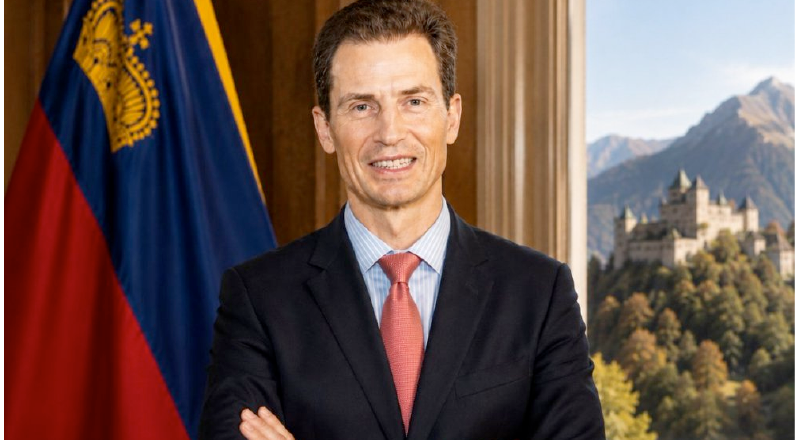
(ZENIT News / Guadalajara, Mexico, 07.09.2026).- In a Europe where monarchies generally retain a strictly ceremonial role, the small Principality of Liechtenstein serves as an exception. Its Prince Regent and heir, Alois of Liechtenstein, recently announced that he will veto the proposed abortion law reform if it successfully clears the parliamentary process. This move reignites a debate the country experienced fifteen years ago.
The proposed initiative seeks to introduce a law allowing abortion within a specific timeframe, specifically, during the first twelve weeks of pregnancy. Currently, Liechtenstein’s legislation permits exceptions only when there is a serious threat to the pregnant woman’s life or health, or when the pregnancy is the result of a sexual crime.
In an interview with the newspaper Liechtensteiner Vaterland, Prince Alois, a practicing Catholic, recently announced that he would not sanction the proposed reform. «The protection of unborn life represents a fundamental social and ethical value,» he stated, adding that the proposal did not sufficiently guarantee «the fundamental legal interest of protecting life.»
This is not the first time the heir to the throne has intervened so directly in this debate. In 2011, a similar initiative proposed legalizing abortion during the first twelve weeks of pregnancy and included provisions for cases involving severe fetal disabilities. Even before the public vote took place, Prince Alois announced that he would exercise his right of veto if the reform were to pass.
Ultimately, this proved unnecessary. In the referendum held in September of that year, 52.3% of voters rejected the proposal; consequently, the Prince did not have to resort to one of the prerogatives that distinguish the Liechtenstein monarchy from other European Royal Houses.Liechtenstein’s Constitution grants significant powers to the country’s Monarch, following a 2003 referendum initiated by Prince Alois’s father, Prince Hans-Adam II. These powers include the authority to veto laws passed by Parliament, dismiss the elected government, and appoint judges; consequently, although it is a constitutional monarchy in practice, it is often described as a unique absolute monarchy within Europe. This power is held by Prince Alois, who has served as Regent since 2004.
In 2012, following the controversy sparked by Prince Alois’s announcement that he would veto a measure regarding abortion, citizens were once again called to the polls to decide whether to limit this power. The response was decisive: more than three-quarters of the electorate supported the Princely House retaining its prerogative intact.
Fifteen years after the first major political push regarding this issue, Liechtenstein once again faces the same dilemma: a society debating abortion regulation and one of the few European monarchies where the Head of State retains the actual power to prevent a law from coming into force.
Belgium: The Unique Case of King Baudouin
The case of King Baudouin of Belgium occurred in 1990 and stands as one of Europe’s most unique constitutional episodes.
When Parliament passed the law decriminalizing abortion, Baudouin informed the government that his Christian conscience would not allow him to sign it. Rather than definitively blocking the law or abdicating, he asked for a solution that respected both the Constitution and his conscience.
The government, led by Wilfried Martens, invoked a constitutional provision declaring the King «unable to reign» for approximately 36 hours. During that brief period, the Council of Ministers exercised the functions of the Head of State and promulgated the law; the following day, Parliament declared that the King could resume his duties.
Contrasts in Europe
In Europe, abortion is legal in the vast majority of countries, albeit with varying time limits and conditions. However, there are some States where it is heavily restricted or virtually prohibited.
Malta presents a key example, as it is the European country with the most restrictive legislation. For decades, it banned abortion under all circumstances. In 2023, it introduced a very limited exception for cases where the mother’s life is in danger and the fetus is not viable.
Initiatives by groups seeking to expand access to abortion continue to emerge, while pro-life organizations and authorities uphold the existing restrictive laws. The debate remains highly intense.
Poland has one of the most restrictive laws in Europe. Since a 2020 Constitutional Court ruling, abortion is permitted only when the pregnancy endangers the woman’s life or health, or results from rape or incest.
In Andorra, abortion is prohibited under all circumstances. Many women travel to Spain or France to access the procedure. However, a reform is currently underway in this small, staunchly Catholic principality to liberalize the law.
Furthermore, some countries do not ban abortion but impose significant restrictions, such as Hungary, where the procedure is legal under specific conditions, though since 2022, women have been required to listen to the fetal heartbeat before the procedure.
In Slovakia, abortion is legal during the early weeks of pregnancy, but there are administrative requirements and waiting periods.
Monaco permits abortion only under limited circumstances, such as certain health risks or pregnancies resulting from sexual assault.
In 2025, the Monegasque Parliament passed a bill by a wide margin to expand the decriminalization of abortion. However, Prince Albert II of Monaco refused to sign the law, preventing it from entering into force.
The Prince justified his decision by noting that the Principality’s historical and constitutional identity is linked to Catholicism, and that existing legislation already provided for exceptions in very limited cases, such as danger to the mother’s life, rape, or certain fetal malformations.
The debate will continue
In the United Kingdom (England and Wales), parliamentary debate continues regarding the decriminalization of abortion for women who terminate pregnancies outside the legal framework. While some lawmakers seek to cement this reform, others have tabled amendments to repeal it or toughen the legislation.
A particularly significant development occurred in February 2026, when the European Commission clarified that Member States could use existing European social funds to help women access legal abortions, particularly those traveling from countries with highly restrictive laws, such as Malta and Poland. This measure does not mandate changes to national laws but facilitates financial support should a country choose to implement it.
Regarding initiatives to ban or further restrict abortion, there have been no major national laws enacted recently in Europe that establish new, sweeping prohibitions. Countries with the most restrictive regulations, such as Malta, Poland, Liechtenstein, and Andorra, have essentially maintained their legal frameworks, even as political and social debate continues.
Pope Leo’s prayer intention for this month
«For respect for human life» — his is precisely the prayer intention that Pope Leo XIV entrusts to the entire Church for the month of July. Through the «Pray with the Pope» initiative, promoted by the Pope’s Worldwide Prayer Network, the Pontiff invites the faithful and people of good will to join their prayers so that every human being may be welcomed, protected, and respected at every stage of existence, «from the first moment to the last breath of their journey on earth.»
The prayer also includes a plea for forgiveness for times when “indifference or the ‘throwaway culture’ prevails, when we fail to recognize the other as a person worthy of love.” Finally, the Pope asks that the Church be «an open home where every life is celebrated, and where no one feels unwanted.»

Publicaciones relacionadas:
 How Many Exorcists Are There in the Catholic Church and in Which Countries Do They Work?
 The “grandmother” who has spent a total of 11 years in jail for opposing abortion
 British justice fines Catholic woman for… praying outside clinic where babies are killed!
 Sister Paulina Melite: The «David vs. Goliath» of the Pro-Life Movement in India and Her Impressive Work
