

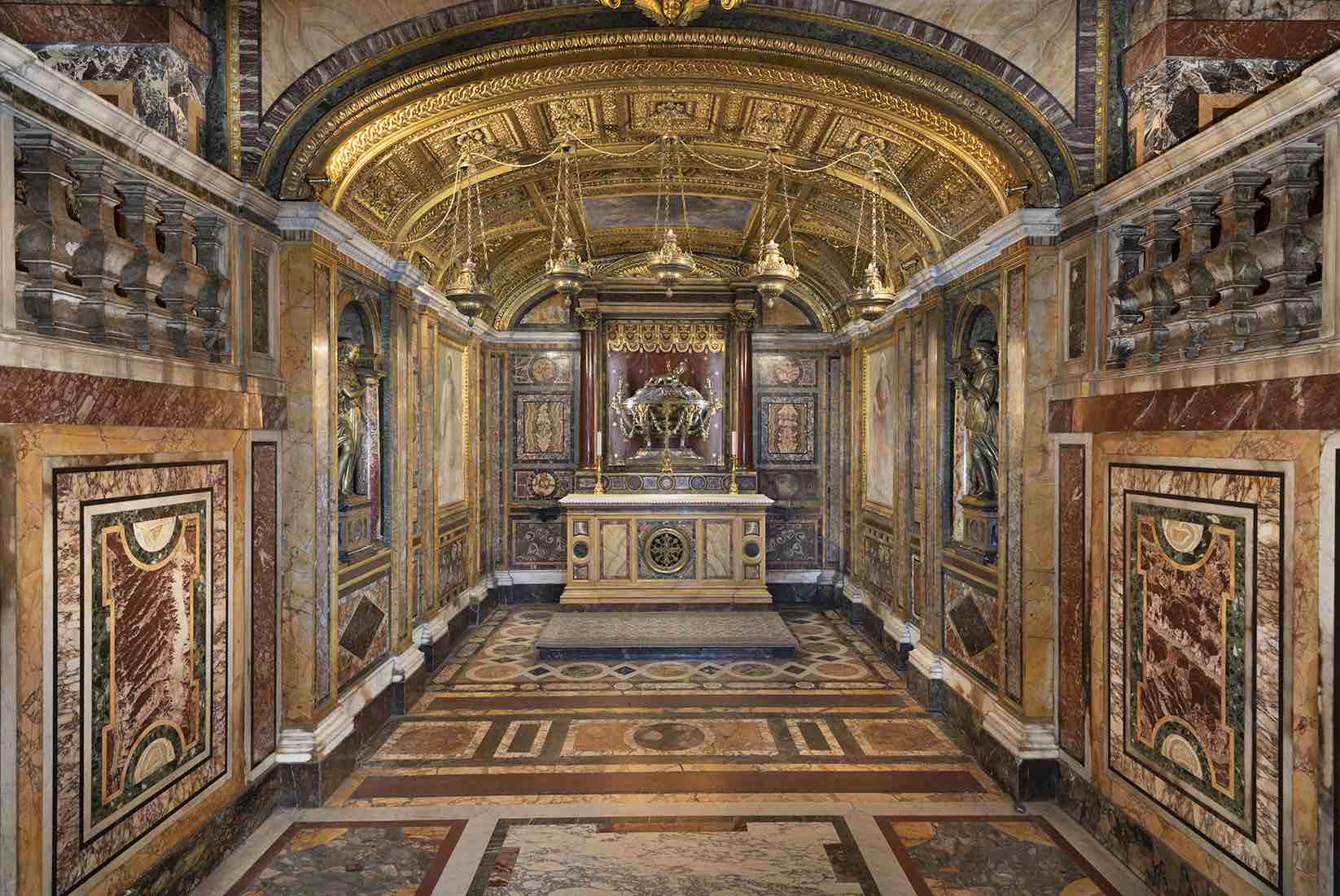
(ZENIT News / Vatican City, 10.02.2026).- For a few weeks, one of the oldest and most venerated symbols of the Christian Christmas will be exceptionally visible up close in the heart of the Papal Basilica of Saint Mary Major. Starting October 1, the relics of the Holy Crib, for centuries the center of Christmas devotion at the Liberian Basilica of Saint Mary Major, will temporarily leave their usual location in the monumental Confessio facing the Papal Altar to be displayed in a spot much closer for the faithful and pilgrims.
This is not merely a conservation project, but an event that intertwines faith, history, art, and memory, offering the public a unique opportunity to contemplate up close a relic intimately linked to the very identity of Saint Mary Major, the Roman Basilica that, more than any other, has preserved the memory of the Nativity of Christ throughout the centuries.
The Basilica of the Nativity and the Memory of the Bethlehem Manger
The history of the Holy Manger has its roots in the early centuries of Christianity and is intertwined with that of the Liberian Basilica itself. The relics preserved in Santa Maria Maggiore consist of five fine pieces of sycamore wood, traditionally identified as fragments of the manger where, according to the Gospel, Mary laid Jesus after His birth.
An ancient tradition links their presence in Rome to the devotion that arose around the sites of the Nativity and the figure of Saint Jerome, who lived in Bethlehem for many years between the 4th and 5th centuries. Veneration of the Manger contributed profoundly to defining the liturgical and devotional identity of the Roman Basilica, to such an extent that, in ancient times, Santa Maria Maggiore was also known as Santa Maria ad Praesepe («Saint Mary at the Manger»).
It is precisely this memory linked to Bethlehem that has made the Liberian Basilica, over the centuries, the quintessential Christmas Basilica: a connection that concerns not only the relics but also permeates its history, its liturgy, and even its extraordinary artistic heritage.
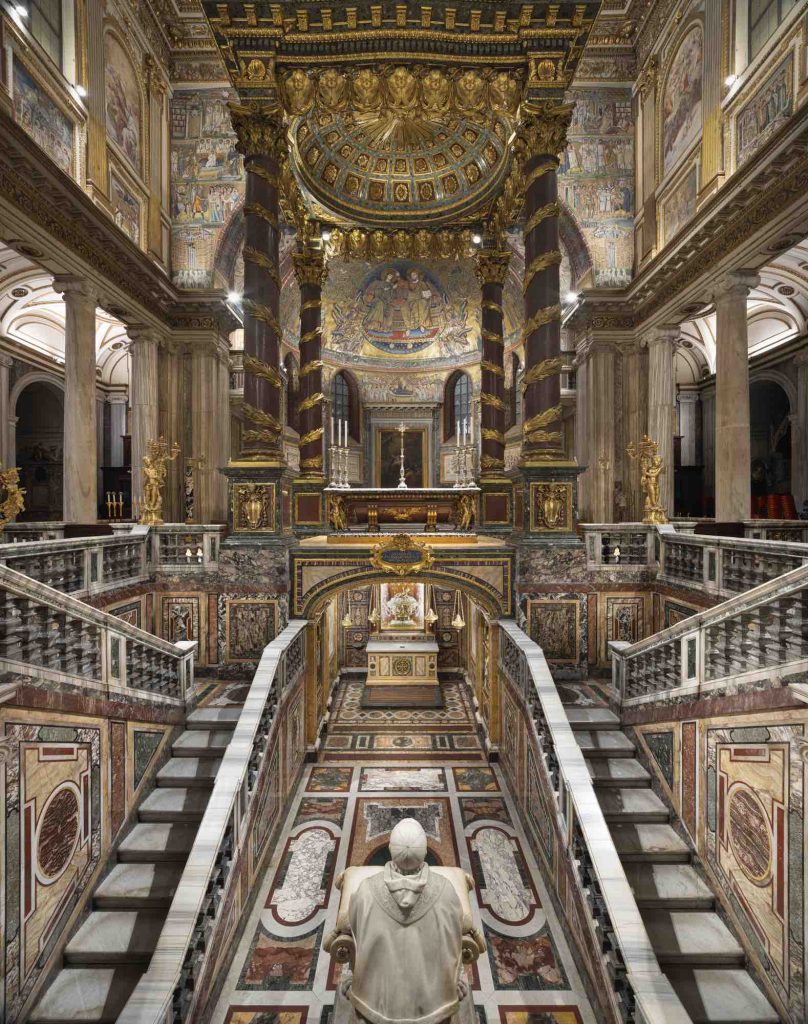
Roma Sanata Maria Maggiore Cripta della Confessione
From Valadier to Vespignani: Two Centuries of Art Surrounding the Holy Cradle
The monumental arrangement of the relics tells a significant story of Roman art.
In 1802, Giuseppe Valadier, one of the leading figures of Neoclassicism in Rome, designed the extraordinary reliquary intended to house the sacred relics. Conceived in the shape of a cradle, the work utilized precious materials and Neoclassical elegance to transform the vessel itself into a visual evocation of the mystery of the Nativity.
Decades later, Pius IX provided the Holy Cradle with a new, solemn, and monumental setting. Between 1861 and 1864, the Roman architect Virginio Vespignani created the grand Confessio in front of the Papal Altar, a dramatic, semi-underground space where the reliquary found its privileged place.
Vespignani showcased an extraordinary array of polychrome marbles — approximately sixty varieties, mostly sourced from excavations then underway in Rome and Ostia –, creating one of the 19th century’s most significant interventions within the Basilica.
This ensemble, now an inseparable part of the identity of Santa Maria Maggiore, is the subject of a new project aiming to combine the protection of these relics with state-of-the-art conservation standards.
A New Display Case to Preserve Two Thousand Years of History
The project arose from the need to replace the existing internal structure, made of wooden panels, which no longer guarantees optimal, consistent conservation conditions. The new display case is being designed according to modern criteria for stability, security, and microclimate control, while simultaneously integrating with the historic setting and the complex architectural structure of the Confessio.
However, the intervention will not be merely technical. Behind the Holy Manger, a new blue mosaic, composed of glass enamel and gold tesserae, will be created to symbolically evoke the sky of the Nativity. The arrangement of the stars will reproduce the celestial configuration reconstructed for that night in Bethlehem, transforming the background of the niche into a starry sky and creating an ideal link between Rome and Bethlehem, between the relic and the site of Christ’s birth.
An Exceptionally Close Encounter with the Holy Cradle
These works will make possible an event that is difficult to replicate.
During the restoration, the reliquary will be moved to one of the side altars in the right nave, near the Sistine Chapel, allowing the faithful to approach the Holy Cradle in a unique state of contemplation and closeness.
The choice of location also takes on a compelling iconographic significance: the relic will engage in a dialogue with Pompeo Batoni’s Annunciation, a splendid work of 18th-century Roman painting. Thus, within the space of the Basilica, the Angel’s announcement to Mary will be ideally followed by the tangible memory of the Nativity, from the Ecce Ancilla Domini to the manger in Bethlehem, from the Annunciation to the Incarnation.
This juxtaposition will transform the temporary exhibition into a true journey of faith and art.
During the exhibition, the Confessio will remain closed to the public. On December 24, in keeping with the Basilica’s custom, the Holy Cradle will be solemnly moved to the Papal Altar, where it will remain throughout the Christmas season. On Epiphany, the reliquary will finally return to its historic niche, where its new display case and the restored mosaic ceiling await it.
Protection, Art, and Devotion for a Symbol of Christian Christmas
The restoration will be carried out under the supervision of the Directorate of Museums and Cultural Heritage of the Vatican City State Governorate and entrusted to Progetto Arte Poli of Verona, a studio specializing in the creation of sacred art and restoration projects for major ecclesiastical complexes.
This temporary exhibition thus becomes far more than the outcome of a construction project: it represents an exceptional opportunity to rediscover one of Christianity’s great treasures, viewing it from a proximity that is normally impossible and, through it, traversing nearly two thousand years of devotion, history, and art. For at Santa Maria Maggiore, Christmas is not merely celebrated; it is preserved within the very memory of the Basilica.

Publicaciones relacionadas:
 Father Marko Rupnik Corrects the Society of Jesus: He Asked to Leave First and with Him All the Jesuits of the Aletti Center
 “I’ll Do Things My Way”: The New Prefect for the Doctrine of the Faith Talks About the German Synod and Blessings to Gay Couples
 The Pope’s Global Prayer Network has a new director: this is what the network looks like and does
 The only cardinal in Iran was evacuated from the country and transferred to Rome: here is what is known
