

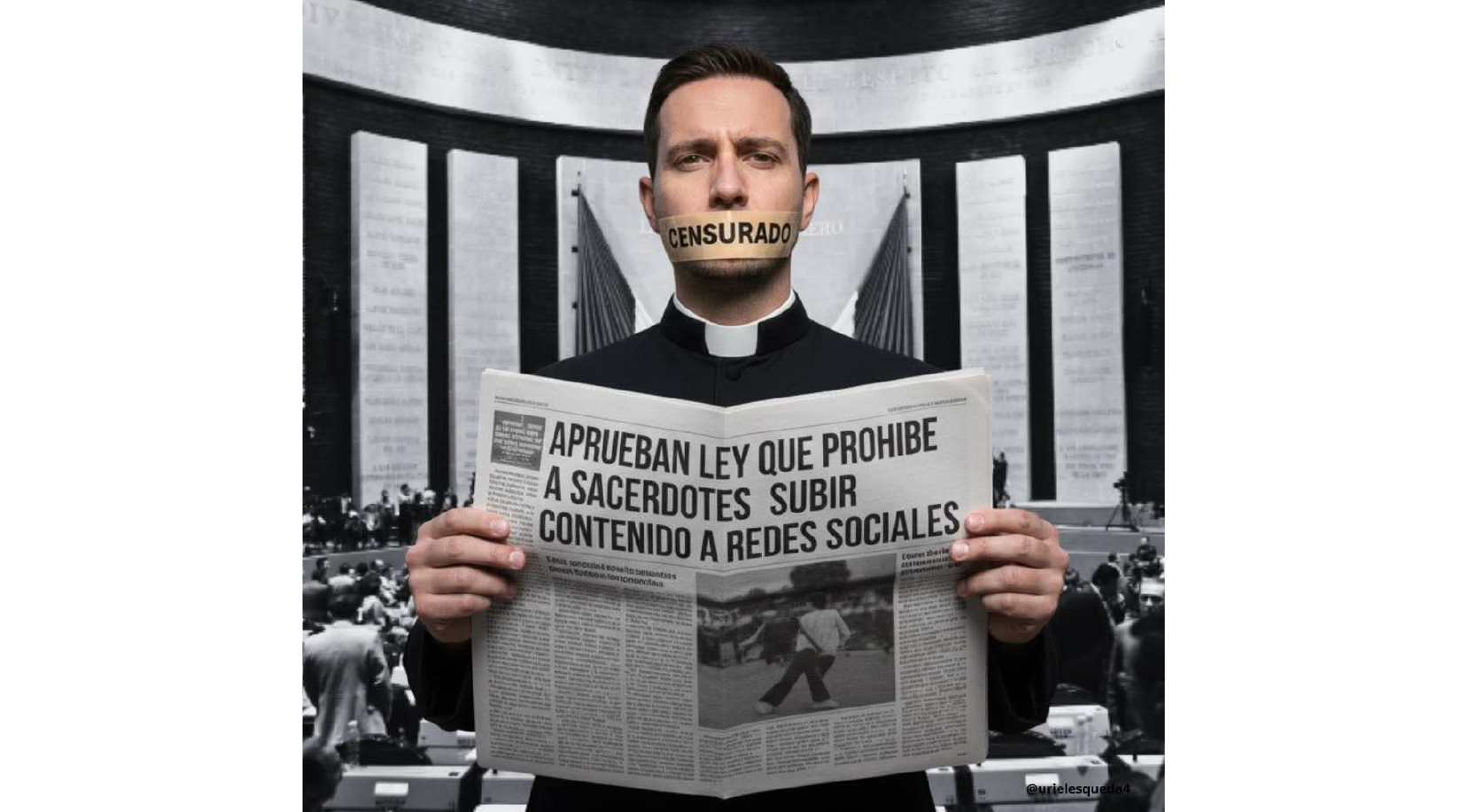
(ZENIT News / Mexico City, 11.09.2025).- When the Mexican Congress opened debate in early November 2025 on a proposal to regulate what priests, pastors, and nuns may post online, few expected the issue to ignite such a storm. Yet the initiative, introduced by Morena lawmaker Arturo Ávila Anaya, has rapidly evolved into a heated national argument over faith, freedom, and the limits of the secular state in the digital era.
At the heart of the dispute lies a proposed amendment to Article 16 of the Law on Religious Associations and Public Worship. For decades, that article has prohibited religious institutions from owning or operating broadcast media. Ávila’s proposal extends that prohibition into the virtual world, seeking to bring religious voices on social media under the same kind of scrutiny once reserved for radio and television.
The new paragraph would require all ministers or religious organizations operating digital platforms — from TikTok accounts to livestreamed homilies — to follow rules set by the government’s new Agency for Digital Transformation and Telecommunications, in coordination with the Ministry of the Interior. The goal, according to its author, is to ensure respect for “digital rights,” “net neutrality,” and the “prevention of hate speech.”
To supporters inside Morena, this is a necessary modernization. The law, they argue, was written in an analog age, when the state’s neutrality was threatened by broadcasting licenses, not by viral videos. Today, when religious figures command millions of followers online, the government must, in their view, establish boundaries that protect pluralism and prevent the misuse of faith as a political weapon.
But critics — and they are many — see something darker. The Mexican Bishops’ Conference (CEM) denounced the proposal as a veiled attack on freedom of expression, warning that it would place priests and believers under state supervision. “It is censorship disguised as law,” said Uriel Esqueda, an attorney for the civic group Actívate.org.mx. “For the first time in decades, religious leaders would become the only citizens whose speech on digital platforms is subject to federal regulation.”
CEM president Archbishop Ramón Castro amplified those concerns by sharing an online statement from «Catholic influencers» calling the initiative “a grave violation of international law.” The post accused the government of weaponizing the language of tolerance to silence religious viewpoints. “They say it’s about preventing hate,” the message read, “but in truth it’s about preventing faith from being heard.”
Defenders of the proposal reject such accusations, insisting that its intent is not to silence but to standardize. They point to its inclusion of progressive digital principles — accessibility for people with disabilities, promotion of cultural heritage, and oversight of algorithms to avoid discrimination — as evidence of a balanced approach. They also note that the bill explicitly bans political proselytism and discrimination by religious figures, which they say strengthens the secular fabric of the state.
Still, the specter of government control over sermons, prayers, or religious commentary has stirred deep unease. Civil society groups have launched petition drives to block the initiative, gathering tens of thousands of signatures and warning that Mexico risks sliding back to an era when priests could be punished for speaking publicly about moral or social issues.
The controversy touches a raw nerve in Mexico’s national psyche. The country’s commitment to *laicidad*, the strict separation of church and state, remains one of its foundational principles — but so too does freedom of conscience. The internet, a space where both collide, is now the newest frontier of that struggle.
Whether the bill is ultimately approved or not, it has already achieved one thing: it has forced Mexico to confront an uncomfortable question. In a digital world where every priest is a potential broadcaster and every believer a publisher, can the state still draw a clear line between faith and public life without crossing into censorship?
The coming months will determine not only the fate of the initiative but also how Mexico defines freedom itself in an age when belief is streamed, tweeted, and shared in real time.
Thank you for reading our content. If you would like to receive ZENIT’s daily e-mail news, you can subscribe for free through this link.

Publicaciones relacionadas:
 Pope creates new diocese in China and appoints bishop, in agreement with country’s communist government
 Attack in Catholic Church in Istanbul: More Details Come to Light
 Washington bill aims to violate confidentiality of confessions
 Chinese Bishop Is Arrested for Celebrating Mass, Marking the Beginning of the Jubilee Year, Without the Permission of the Communist Government
