

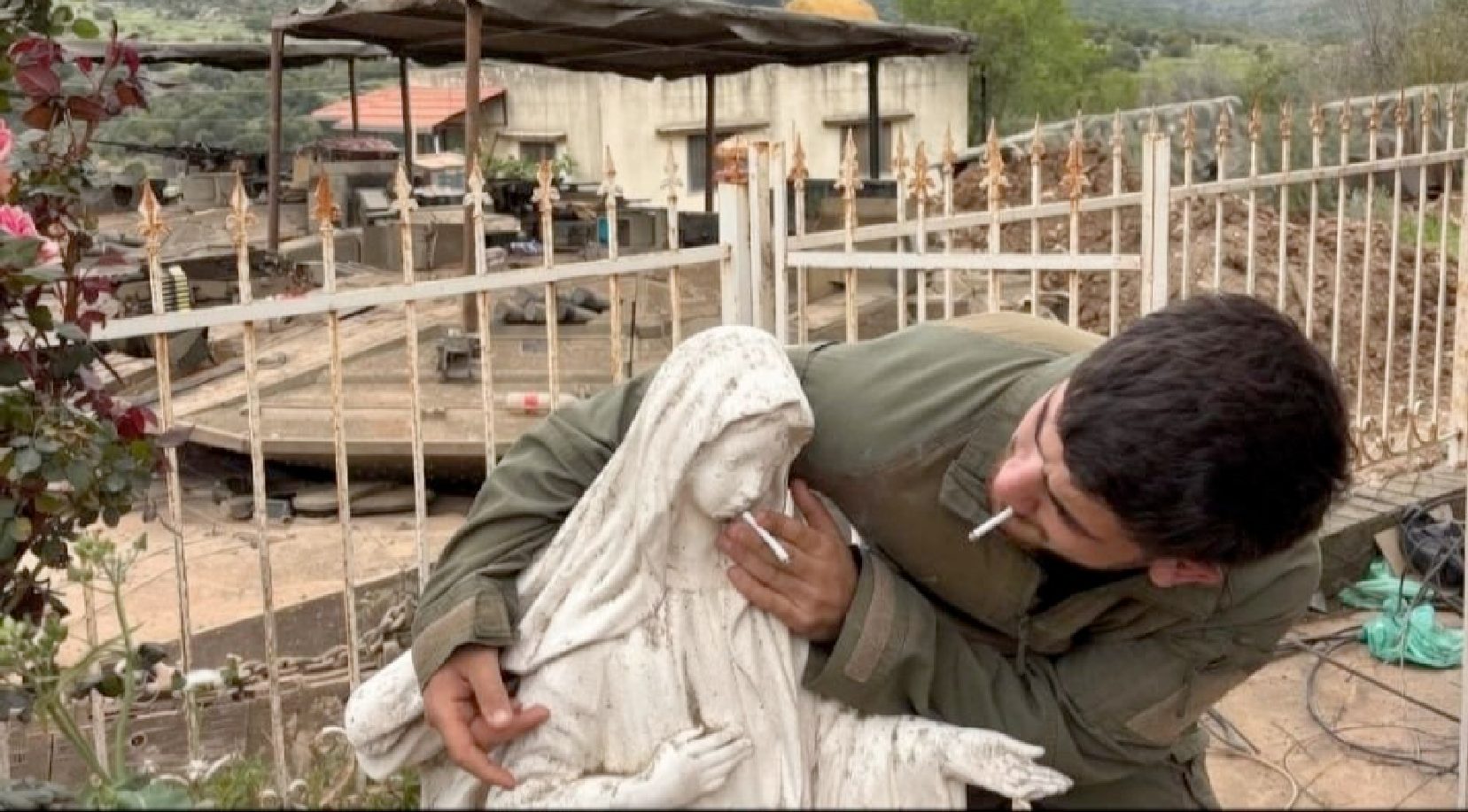
(ZENIT News / Jerusalem, 05.13.2026).- The Israeli military has sentenced several soldiers to prison terms following two separate incidents involving the desecration of Christian statues in southern Lebanon, episodes that have intensified concern among local Christians already caught in the turbulence of the widening Middle Eastern conflict.
The latest controversy erupted after a photograph circulated widely on social media during the first week of May 2026. The image showed an Israeli soldier standing beside a statue of the Virgin Mary, wrapping one arm around it while placing a cigarette at the lips of the Marian figure. The scene, reportedly photographed in southern Lebanon several weeks earlier, provoked outrage among Christians across the region and beyond.
On Monday, May 11, the Israeli army announced disciplinary measures against the soldiers involved. According to military authorities, the soldier who staged the act received a sentence of 21 days in military prison, while the soldier who photographed the incident was sentenced to 14 days.
Lieutenant Colonel Ariella Mazor, speaking on behalf of the army, stressed that the Israeli armed forces “consider the incident with utmost severity” and insisted that the soldiers’ behavior “completely diverges from the values expected” of military personnel.
The military also reiterated that Israel “respects freedom of religion and worship, as well as the holy sites and religious symbols of all religions and communities.”
Yet the incident did not occur in isolation. It followed another controversy only days earlier involving the destruction of a Christian statue in the Lebanese village of Debel, a predominantly Christian locality near the Israeli border.
In that earlier case, images spread online showing an Israeli soldier using a hammer or axe against a damaged crucifix statue depicting Christ. The footage triggered condemnation from Christian leaders, foreign officials, and even Israeli political figures concerned about the reputational and moral consequences of such actions.
The Israeli military subsequently announced that two soldiers connected to that incident would also serve 30-day prison sentences and be removed from combat duties.
For many Christians in Lebanon, however, the issue goes beyond individual misconduct. The incidents have revived longstanding fears among Middle Eastern Christian communities that, during periods of war and geopolitical confrontation, their sacred symbols and fragile presence are often treated as secondary concerns by larger regional powers.
Southern Lebanon contains numerous ancient Christian villages and shrines that reflect the country’s historically diverse religious landscape. Although Lebanon is widely associated internationally with sectarian tensions and the powerful influence of Islamist movements such as Hezbollah, it also remains home to one of the largest Christian populations in the Middle East.
Many Lebanese Christians, especially in the south, now find themselves trapped between multiple fronts: the military confrontation between Israel and Hezbollah, Iran’s growing regional influence, and the continuing instability that has devastated Lebanon’s economy and social fabric.
The recent war dramatically intensified after Hezbollah, backed by Iran, launched missiles across the border shortly after the broader confrontation involving Israel and Iran escalated earlier this year. Israel responded with a ground offensive in southern Lebanon aimed at dismantling Hezbollah infrastructure and military positions.
Israeli forces currently maintain control over a strip of territory extending roughly ten kilometers into Lebanese territory despite an ongoing fragile ceasefire.
The Israeli army insists its operations target only facilities used by Hezbollah militants. Nevertheless, the scale of destruction in southern Lebanon has alarmed local authorities and residents alike. Entire communities have been displaced, and many fear that homes, churches, and villages damaged during the fighting may never be fully restored.
The army announced the same day as the sentencing that another Israeli soldier, serving as a driver near the Lebanese border, had been killed in combat operations. According to Israeli figures, 18 soldiers have died in the area since the conflict linked to the confrontation with Iran intensified.
Thank you for reading our content. If you would like to receive ZENIT’s daily e-mail news, you can subscribe for free through this link.

Publicaciones relacionadas:
 Churches welcomes UN resolution calling for end to Israel’s occupation of Palestine
 Christian Brothers Schools in Jerusalem Protest Israeli Restrictions on Palestinian Teachers
 Vatican questions “preventive” war in Iran as Leo XIV intensifies diplomatic calls for peace
 Ceasefire brings no peace to Lebanon as Israel continues its attacks
