

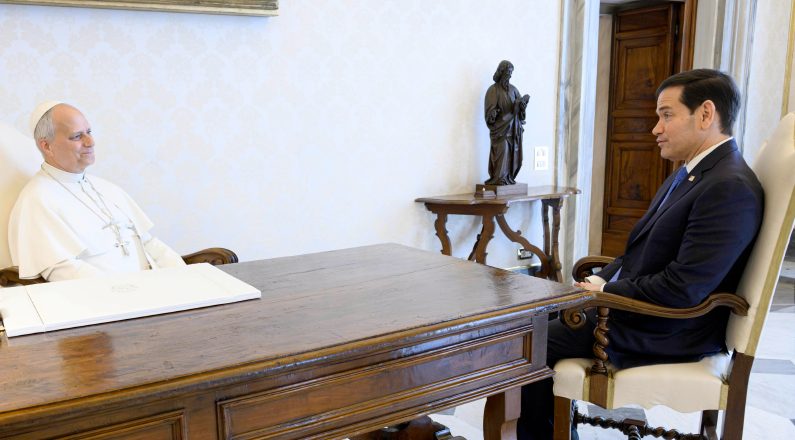
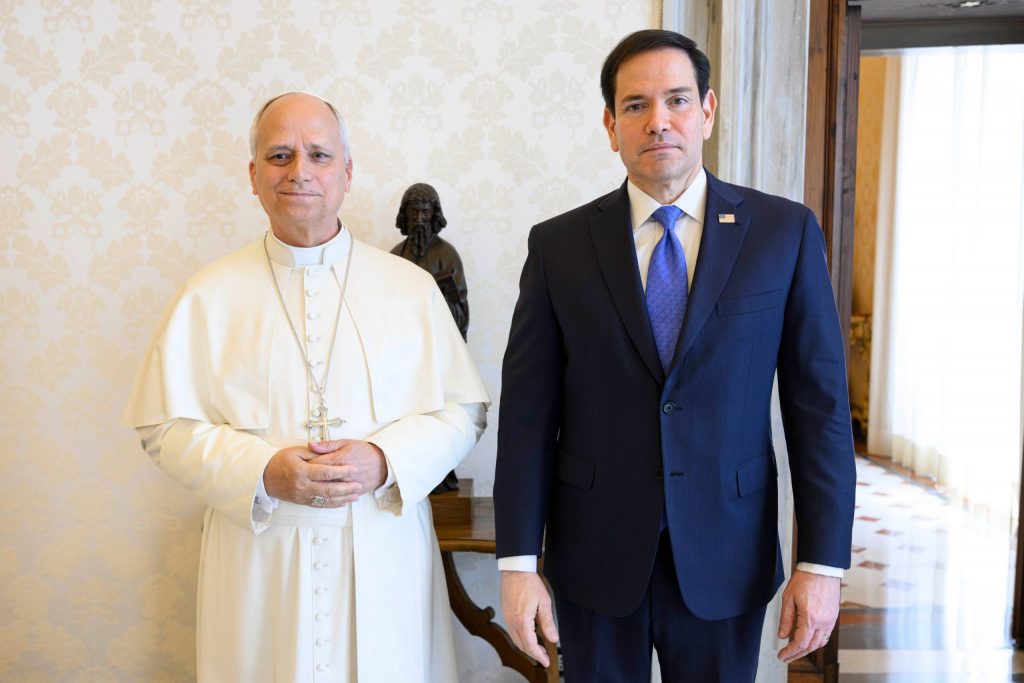
(ZENIT News / Vatican City, 05.07.2026).- After weeks marked by unusually sharp public friction between the White House and the Vatican, Pope Leo XIV received United States Secretary of State Marco Rubio in a private audience on Thursday, May 7, in what appears to be the clearest attempt yet to stabilize relations between the Holy See and the administration of President Donald Trump.
According to the Holy See Press Office, the conversations were described as cordial and focused on reaffirming the shared commitment of the Holy See and the United States to maintaining constructive bilateral relations. Rubio also met with Cardinal Pietro Parolin and Archbishop Paul Richard Gallagher, the Vatican’s equivalent of a foreign minister.
The meeting took place against the backdrop of an escalating verbal dispute triggered by Trump’s repeated accusations that Leo XIV had shown sympathy toward Iran and had failed to oppose Tehran’s nuclear ambitions strongly enough — claims the Vatican has categorically rejected.
Ver esta publicación en Instagram
In remarks made only one day before Rubio’s arrival, Cardinal Parolin openly challenged the accuracy of Trump’s statements while carefully avoiding direct personal confrontation. Speaking to journalists outside Rome’s Augustinianum Institute, the Vatican Secretary of State insisted that the Holy See’s position on nuclear weapons has remained consistent for decades.
“We must tell the truth,” Parolin said, explaining that the Vatican has always worked for nuclear disarmament and has repeatedly supported international agreements limiting or prohibiting atomic arsenals. The cardinal added that the Holy See’s position on the matter is “very clear.”
The exchange underscored a broader tension that has steadily intensified since Leo XIV’s election and especially after his criticism of war rhetoric, migration policies, and military escalation in several regions of the world. The disagreement deepened further after Trump publicly accused the Pope of undermining American interests and endangering Catholics through his comments on international conflicts.
Yet Thursday’s audience suggested that both sides may now be seeking a less confrontational path.
On social media following the meeting, Rubio stated that he and the Pope had discussed “our shared commitment to promoting peace and human dignity,” language notably softer and more diplomatic than the rhetoric dominating recent headlines.
Inside the Vatican, officials appeared equally determined to prevent the dispute from deteriorating into a deeper rupture between Washington and the Holy See. Parolin emphasized that the Vatican remains open to dialogue with all political leaders, including Trump himself.
Ver esta publicación en Instagram
“The Holy Father has never closed the door to anyone,” the cardinal said when asked whether a direct phone conversation between the Pope and the American president could eventually take place. “If there were a request for direct dialogue, I imagine he would have no problem accepting it.”
That remark may prove significant. Historically, the Holy See has often attempted to preserve channels of communication even during periods of severe geopolitical disagreement. Vatican diplomacy traditionally operates through long-term engagement rather than ideological alignment with specific governments. The Church’s diplomatic corps — one of the oldest in the world — frequently positions itself as a mediator capable of speaking simultaneously with opposing sides in global conflicts.
This explains why Vatican officials continue insisting on negotiation regarding Iran and other international crises, even while facing criticism from political leaders who favor more confrontational approaches.
Parolin reiterated that armed conflicts cannot ultimately be solved by force alone. Lasting solutions, he argued, require sincere negotiations in which all parties are allowed to express their concerns and search for common ground.
The Vatican delegation and Rubio reportedly discussed a wide range of global flashpoints beyond the immediate controversy involving Iran. According to Parolin, conversations included wars, humanitarian crises, political instability, Latin America, and likely Cuba as well — all longstanding concerns in Vatican diplomacy.
The inclusion of Latin America is particularly relevant because tensions between the Trump administration and Pope Leo XIV have not been limited to Middle Eastern issues. Since the beginning of his pontificate, Leo XIV has repeatedly emphasized the moral responsibilities of nations toward migrants, the dangers of ideological polarization, and the need to avoid reducing religion to political nationalism or civilizational conflict.
Some Vatican observers believe this broader moral framework helps explain why relations between the first American pope and Trump have become unusually delicate. While both figures speak frequently about Christianity and Western civilization, they often appear to envision very different roles for religion in public life and international affairs.
Even so, the Vatican seems unwilling to allow the disagreement to become permanent hostility. Parolin stressed that the United States remains an indispensable international interlocutor because of its influence across nearly every major geopolitical crisis currently unfolding.
“How can one ignore the United States?” the cardinal asked rhetorically. “It is impossible.”
That pragmatic realism has long characterized Holy See diplomacy. The Vatican frequently maintains dialogue even with governments whose policies it criticizes sharply, believing that communication remains preferable to isolation.
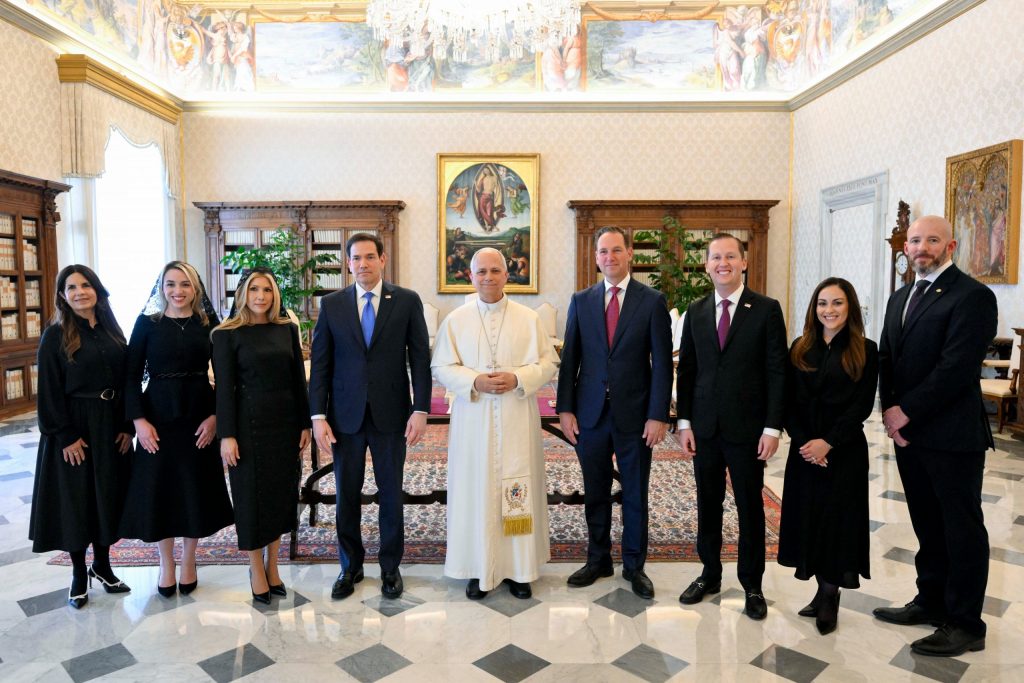
Thursday’s meeting therefore carried significance beyond protocol. It represented a test of whether two influential global actors — one political, one spiritual — can continue speaking constructively despite profound differences over war, diplomacy, and the moral language surrounding international power.
For now, both sides appear interested in lowering the temperature.
Whether this audience marks the beginning of a genuine thaw or merely a temporary pause in tensions remains uncertain. But the images emerging from the Vatican — cordial meetings, diplomatic exchanges, and cautious openness to future dialogue — contrasted sharply with the hostile rhetoric that had dominated only days earlier.
Thank you for reading our content. If you would like to receive ZENIT’s daily e-mail news, you can subscribe for free through this link.

Publicaciones relacionadas:
 What Does Pope Leo XIV’s Letter to the President of Ukraine Say? Full Text
 Trump invited the Vatican to the new “Peace Board.” The Holy See confirms that Leo XIV is considering accepting
 Pope Leo XIV “responds” to Trump’s threat regarding Iran’s extinction: here is what he said
 Trump and Vance prolong the conflict with Leon XIV as Russia and Brazil join the controversy
