

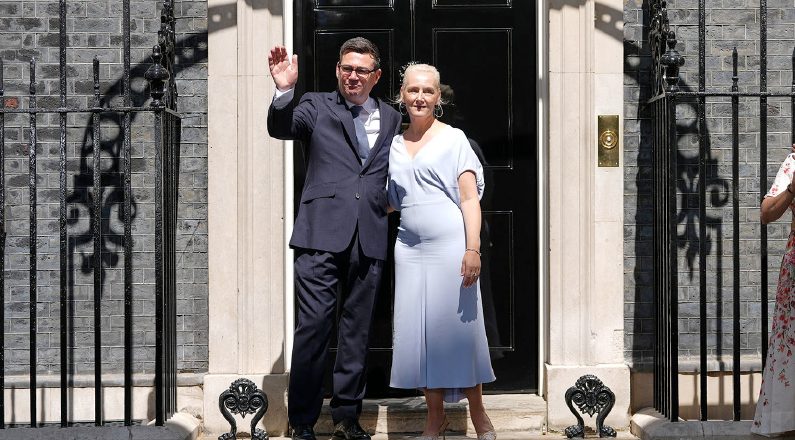
(ZENIT News / London, 07.21.2026).- For centuries, the idea would have seemed almost impossible: a practicing Catholic leading the government of a country whose constitutional identity has been intertwined with the Church of England since the English Reformation.
Yet that is the historic threshold the United Kingdom has now crossed with the appointment of Andy Burnham as Prime Minister following the resignation of Sir Keir Starmer. At 56, the former Mayor of Greater Manchester becomes the first British Prime Minister to enter Downing Street openly identifying as a lifelong Catholic—a milestone that carries constitutional, cultural and religious significance far beyond party politics.
Burnham assumes office under unusual circumstances, becoming the seventh British Prime Minister in just a decade without first leading his party through a general election. But while the political transition has attracted immediate attention, it is his religious identity that has sparked one of the most intriguing public conversations in modern British politics.
Unlike Tony Blair, who entered the Catholic Church only after leaving office, or Boris Johnson, who was baptized Catholic but later embraced Anglicanism, Burnham has consistently acknowledged that Catholicism shaped his upbringing and continues to influence his political outlook, even while admitting that he no longer considers himself particularly religious in terms of personal practice.
His roots help explain that identity.
Born near Liverpool in 1970 to a Catholic family with Irish heritage, Burnham attended Catholic schools, served as an altar boy and grew up in a region where Catholicism, Labour politics and working-class solidarity were deeply interconnected. During his childhood he was influenced by Archbishop Derek Worlock of Liverpool, whose outspoken defense of miners, struggling families and disadvantaged communities left a lasting impression on many young Catholics in northwest England. According to social scientist Francis Davis, Burnham himself helped play recordings of Worlock’s messages in his parish as a young altar server.
That experience appears to have shaped the political philosophy Burnham still articulates today.
Rather than emphasizing doctrinal debates, he frequently points to Catholic social teaching as the foundation of his public life. He has repeatedly spoken about the common good, decentralizing political power, combating homelessness and strengthening local communities. During his nine years as Mayor of Manchester, these themes became defining features of his administration, leading him to work closely with leaders from various religious traditions.
His admiration for Pope Francis also became evident during a 2023 visit to the Vatican, where he presented the Pope with a signed football jersey and later described the meeting as one of the most moving experiences of his life. In subsequent speeches, he embraced Francis’ call for a «culture of encounter,» arguing that Britain must rebuild trust through dialogue and solidarity rather than polarization.
Yet Burnham’s Catholic identity has also become the source of significant criticism from many Christians.
Although he credits Catholic social teaching with shaping his politics, he has openly disagreed with the Church on several major moral issues. He supports legal abortion, same-sex marriage and assisted suicide for terminally ill patients, positions that directly contradict Catholic teaching. Years ago, he also criticized what he described as the Church’s excessive focus on sexual ethics and urged Pope Francis to modernize Catholic teaching on same-sex unions.
For that reason, some commentators describe Burnham as representing a form of cultural Catholicism: deeply attached to the Church’s social vision while rejecting significant elements of its moral doctrine.
Andrea Williams, chief executive of Christian Concern, has argued that such a distinction is ultimately inconsistent. She contends that a Christian leader should defend both the Church’s social concern for the poor and its understanding of marriage and the sanctity of human life.
The constitutional implications are equally noteworthy.
Although the Catholic Emancipation Act of 1829 removed most legal restrictions on Catholics holding public office, remnants of Britain’s post-Reformation constitutional settlement remain. The monarch continues to serve as Supreme Governor of the Church of England and promises at the coronation to uphold the Protestant faith.
Consequently, constitutional scholars have noted that certain responsibilities involving appointments within the established Church could require delegation if the Prime Minister is Catholic. Rather than creating a constitutional crisis, the situation illustrates how centuries-old legislation continues to shape the modern British constitution in subtle but meaningful ways.
The symbolism extends beyond Westminster.
Burnham assumes office at a time when Britain’s religious landscape is undergoing profound change. While participation in the Church of England (anglican) has declined significantly over recent decades, Catholicism has gained renewed public visibility through immigration, conversions from Anglicanism and an increasingly confident public presence. His appointment therefore reflects not only a political transition but also the evolution of British society itself.
The new Prime Minister has already identified one immediate domestic priority: ending rough sleeping. Standing outside Number 10 Downing Street after taking office, he declared that tackling homelessness would be among his government’s first objectives—a commitment many observers see as consistent with the emphasis on human dignity found in Catholic social teaching.
At the same time, international challenges are already arriving at his doorstep. Humanitarian organizations have urged his government to adopt a different approach toward the Israeli-Palestinian conflict, including stronger measures regarding settlements, trade and arms exports. The requests underline the complex moral and geopolitical decisions that await the new administration from its first days in office.
Catholic leaders have responded to Burnham’s appointment with both encouragement and realism.
Archbishop Richard Moth, president of the Catholic Bishops’ Conference of England and Wales, congratulated the new Prime Minister while emphasizing that political leadership should be guided by respect for human dignity, concern for families, solidarity with the marginalized and the pursuit of the common good. He also assured Burnham and his family of the Church’s prayers and expressed hope for continued constructive cooperation between the government and the Catholic community.
Whether that relationship proves harmonious will depend largely on the policies Burnham ultimately pursues. Questions surrounding assisted suicide, the protection of religious schools and freedom of conscience are likely to test the relationship between his government and Britain’s Catholic hierarchy.
Another significant encounter may also lie ahead.
The Apostolic Nuncio has suggested that a visit by Pope Leo XIV to the United Kingdom is increasingly likely. Such a journey would acquire added historical resonance now that Britain has its first lifelong Catholic Prime Minister and approaches the bicentenary of Catholic Emancipation in 2029. It would also provide an opportunity for two leaders who both draw inspiration from Catholic social teaching—though they may arrive at different political conclusions—to engage directly.
Burnham’s rise therefore represents more than a change of government.
It signals the remarkable transformation of a nation where Catholics were once excluded from the highest offices of state and where religious identity was a source of legal discrimination. Today, a man formed by Catholic schools, influenced by Catholic social teaching and proud of his Catholic heritage occupies the country’s highest political office.
Thank you for reading our content. If you would like to receive ZENIT’s daily e-mail news, you can subscribe for free through this link.

Publicaciones relacionadas:
 United Kingdom: Prime Minister supports initiative to help persecuted Christians
 Reconstruction of the face of St. Teresa of Jesus: this is what her face looked like according to science
 Archdiocese of Chicago brings alleged fraudsters who allegedly posed as abuse victims to trial
 The Pope’s powerful homily on the Feast of Corpus Christi: may religiosity not be a museum of the past, but a school of faith from which we can draw inspiration even today
