

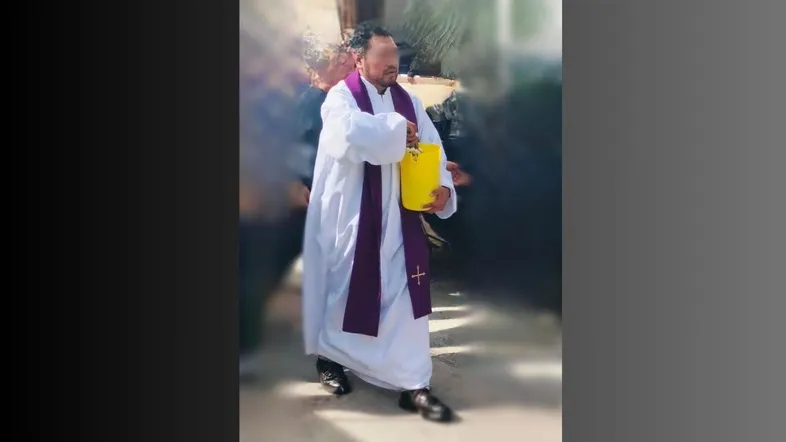
(ZENIT News / Mexico City, 10.05.2026).- For Catholics, the word “priest” carries a very specific meaning. It implies not only a person who performs religious functions, but someone who belongs to the Church, has received the required formation and ordination, and acts with the authorization of the ecclesial community to which he claims to minister. In Mexico, two recent warnings from Catholic archbishops have highlighted what can happen when that identity is blurred.
In the Archdiocese of Tuxtla Gutiérrez, Archbishop José Francisco González González has warned Catholics about people presenting themselves as priests or Church representatives in order to collect money supposedly destined for parishes. In one recent case in Villaflores, a man claimed to be a priest, requested financial assistance and even used a bank terminal to receive what he presented as donations. The archdiocese subsequently established that he had no authorization from the Church to conduct the collection.
The problem has not been confined to a single parish. Similar requests have reportedly been made at private homes in Tuxtla Gutiérrez, with individuals seeking money in the name of particular parishes. In response, Catholic communities have used their social-media accounts to warn parishioners that the appeals were unauthorized.
González therefore urged Catholics not to respond to religious fundraising requests automatically, however convincing the person making the appeal might appear. When someone claims to be a priest or a member of a religious community, the archbishop said, the request should be checked directly with the parish concerned. Legitimate collections, he stressed, should be identifiable and known to the appropriate Church authorities.
The warning from Acapulco concerns a different kind of confusion, but one that can be even more difficult for ordinary Catholics to recognize.
Archbishop Leopoldo González González issued a public notice on September 25 concerning an announced ordination of one «priest» and two «deacons» in Acapulco. The ceremony was scheduled to take place at Papagayo Park and involved Eleuterio Nava Galicia, who was announced for priestly ordination, and Hloguer Morales Miranda and Jesús de Jesús Ortiz, who were announced for diaconal ordination.
The invitation described them as belonging to a “Catholic rite.” But the archbishop explained that the organization behind the ceremony is the Apostolic Ecumenical Church Servants of the Holy Spirit of Veracruz, a religious association registered with Mexico’s Interior Ministry only in 2025.
The crucial point, according to the archdiocese, is that this organization does not belong to the Catholic Church under Pope Leo XIV. Its own description identifies it as being of “non-Roman Catholic rite.” Consequently, Archbishop González stressed that it is separate from the Archdiocese of Acapulco.
That clarification was issued not to settle a dispute with another Christian body, but to prevent Catholics from assuming that the use of the word “Catholic” automatically means that a minister or community belongs to the Catholic Church in communion with the Pope.
The distinction has practical consequences. The archbishop specifically warned that if these individuals were to administer sacraments, those sacraments would not be recognized by the Catholic Church. He instructed that the notice be read at Sunday celebrations throughout the archdiocese on September 27 and, where appropriate, repeated in parishes where the individuals might have contact with Catholics.
Taken together, the two cases reveal two different vulnerabilities.
The first is straightforward deception: someone assumes the identity of a priest or Church representative to obtain money. The second involves an organization that uses Catholic terminology while remaining outside the Catholic Church governed by the Pope.
Thank you for reading our content. If you would like to receive ZENIT’s daily e-mail news, you can subscribe for free through this link.

Publicaciones relacionadas:
 Belgium: draft with progressive demands circulated in the Belgian Catholic Church
 The Congregation of the Mission of St. Vincent de Paul marks 400th Anniversary with major renovation of its Motherhouse in Paris
 Canadian bishops issue brief note on Christian prayer
 Can Europe Force the Church to Erase a Baptism? A Belgian Case Puts Religious Freedom Before the EU Court
