

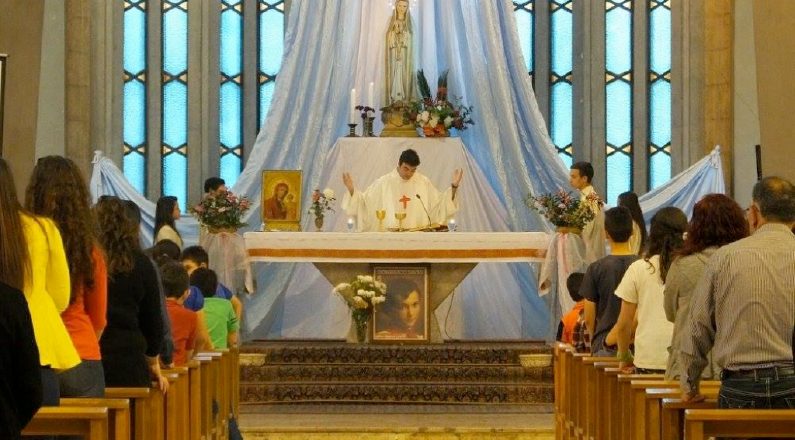
Edward McNamara, LC
(ZENIT News / Rome, 01.25.2026).- Answered by Legionary of Christ Father Edward McNamara, professor of liturgy and sacramental theology at the Pontifical Regina Apostolorum university.
Q: My question is not exactly about the liturgy rubrics, but rather about the text of the opening prayer (collect) at Mass on Tuesday after the solemnity of the Epiphany. The text of the collect as I have in our Missal says: «O God, whose Only Begotten Son has appeared in our very flesh, grant, we pray, that we may be inwardly transformed through him whom we recognize as outwardly like ourselves. who lives and reigns with you ….» It dawned on me that there is something not right in the wording, which seemed to suggest that Christ was not truly and fully human but only «outwardly like ourselves.”
Is it a lack of attention to proper translation wording, or are we sidelining the whole struggle of the first three centuries over the nature of Christ, definitively concluding with the definition at [the Council of] Nicaea, if I am not mistaken, that Christ was both truly, really and fully divine and truly, really and fully human? Although the opening line of the prayer does affirm the teaching and faith that the «Only Begotten Son has appeared in our very flesh,» the conclusion «whom we recognize as outwardly like ourselves» seems to suggest it is only an outward appearance and not a reality of being fully human as ourselves! Am I misreading the text? — J.S., Johannesburg, South Africa
A: The original Latin text says: «Deus, cuius Unigenitus in substantia nostrae carnis apparuit, praesta, quaesumus, ut per eum, quel similem nobis foris agnovimus, intus reformari mereamur. Qui tecum ….»
Historically, this prayer is found in several places and is also present in the 1962 missal for the Octave of the Epiphany. It is found in several ancient liturgical manuscripts from the seventh and eight centuries, sometimes in the context of the Baptism of the Lord.
It would seem to be inspired by a text taken from a Christmas sermon of Pope St. Leo the Great (Sermo 26, 1, PL 54, 213 A): «Hodie enim auctor mundi editus est utero virginali, et qui omnes naturas condidit, eius est factus Filius quam creavit. Hodie Verbum Dei carne apparuit vestitum, et quod numquam fuit humanis oculis visibile, coepit etiam manibus esse tractabile. Hodie genitum ir nostrae carnis animaeque substantia Salvatorem angelicis vocibus didicere pastores.»
«For today the Maker of the world was born of a Virgin’s womb, and He, who made all natures, became Son of her, whom He created. Today the Word of God appeared clothed in flesh, and That which had never been visible to human eyes began to be tangible to our hands as well. Today the shepherds learned from angel’s voices that the Savior was born in the substance of our flesh and soul; and today the form of the Gospel message was pre-arranged by the leaders of the Lord’s flocks, so that we too may say with the army of the heavenly host: ‘Glory in the highest to God, and on earth peace to men of good will.’»
Biblically, both St. Leo and the collect would seem to be rooted in three passages:
— Ephesians 3:16-17: «I pray that, according to the riches of his glory, he may grant that you may be strengthened in your inner being with power through his Spirit and that Christ may dwell in your hearts through faith, as you are being rooted and grounded in love.»
— Philippians 2:5-7: «Let the same mind be in you that was in Christ Jesus, who, though he existed in the form of God, did not regard equality with God as something to be grasped, but emptied himself, taking the form of a slave, assuming human likeness. And being found in appearance as a human …»
— And 1 John 3:2: «Beloved, we are God’s children now; what we will be has not yet been revealed. What we do know is this: when he is revealed, we will be like him, for we will see him as he is.»
Given the venerable history of this text, and its approval by the Holy See over several centuries, there is no question as to its orthodoxy in its original text.
While translations do not have the same level of doctrinal certainty as the original Latin texts, and occasionally even approved translations have had to be amended due to doctrinal imprecisions, in general the fact that they have been approved by the Holy See would give them at least the benefit of the doubt with respect to orthodoxy.
A different translation was proposed by scholars in 1975: «God the Father, your only Son revealed himself to us by becoming man. May we who share his humanity come to share his divinity, for he lives and reigns with you Holy Spirit, one God, for ever and ever.»
The translation of this prayer found in the previous English version of the Roman Missal, published in the 1970s, rendered this prayer: «Father, your son became like us when he revealed himself in our nature: help us to become more like him, who lives and reigns ….»
The current translation is much closer to the Latin original although the order of the contrast between the inner transformation and the outer appearance is inverted, probably as it would seem to flow better in English.
It would seem that the effort to preserve this contrast between inward transformation and outward recognition of Jesus humanity provoked our reader’s doubt and confusion.
That said, I think that if we take the prayer as a whole, and do not isolate the word «outwardly» from its context as a contrast to the inward transformation brought about by Christ become man, and appearing as such to other men in the liturgical celebration of Christmas, Epiphany and the Lord’s Baptism, any danger of an erroneous interpretation as a negation of Nicaea can be excluded.
The prayer, therefore, implores the Father for spiritual renewal through Christ’s humanity. It’s a prayer for internal transformation by acknowledging Jesus’ human nature to facilitate our own spiritual change. In this way, it links his visible presence to the granting of interior grace.
* * *
Readers may send questions to zenit.liturgy@gmail.com. Please put the word «Liturgy» in the subject field. The text should include your initials, your city and your state, province or country. Father McNamara can only answer a small selection of the great number of questions that arrive.
Thank you for reading our content. If you would like to receive ZENIT’s daily e-mail news, you can subscribe for free through this link.

Publicaciones relacionadas:
 40 British celebrities, nobles, politicians and artists ask the Pope, in The Times, not to limit traditional Mass any more
 Last Minute Liturgical Agreement Avoids Catholic Schism in India
 10 short questions and answers on the Instrumentum Laboris for the Synod on Synodality 2024
 Questions about liturgy: ¿Bows Toward Priests?
