

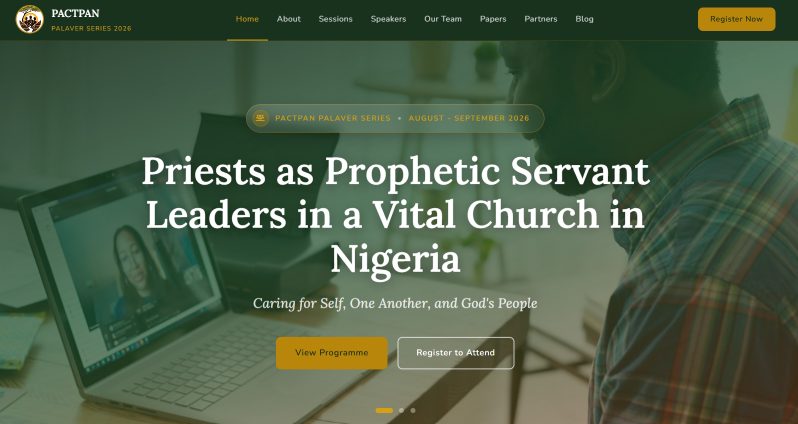
(ZENIT News / Rome, 08.31.2026).- For priests accustomed to measuring their lives by the needs of others, stopping can feel almost like a failure of duty. But Archbishop Fortunatus Nwachukwu is making the opposite case: rest is not a concession to weakness. It is part of the discipline required to remain capable of serving.
Speaking virtually on August 26 at the launch of a six-week formation program examining priestly life in Nigeria, the Vatican official argued that the Church must take the physical and psychological well-being of its clergy seriously. Priests and bishops, he noted, are not protected from exhaustion, depression or chronic stress simply because they have received a sacred vocation.
“Rest is not a luxury in priestly life,” Nwachukwu said. “It is necessary for physical and mental health.”
His warning carries particular weight in Nigeria, where he recalled repeatedly seeing the graves of priests in the Diocese of Aba. Many, he said, died before reaching 50, while comparatively few lived beyond 60 or 70. He also pointed to the growing number of younger priests experiencing mental-health difficulties, asking what the Church can do before exhaustion becomes a crisis.
The question, he stressed, is not whether God calls priests to sacrifice. It is whether the Church fully appreciates the human limits of those who answer that call.
That distinction is important. Christian ministry has never meant treating the body as an inconvenient obstacle to spiritual life. In the Gospels, Jesus does not present ceaseless activity as the measure of fidelity. After the apostles return from an intense period of missionary work, he tells them to withdraw to a quiet place and rest. The Gospel account emphasizes just how demanding their work had become: people were coming and going in such numbers that the disciples scarcely had time to eat.
Nwachukwu sees in that episode a principle particularly relevant to contemporary priesthood. Energy is a gift, but it needs direction. Passion without limits can eventually become exhaustion; dedication without renewal can undermine the very mission it was intended to serve.
The same logic appears in Christ’s invitation to those who are weary and burdened. For Nwachukwu, Christian rest is not simply recreational withdrawal from responsibilities. It is a form of renewal that restores the person physically, mentally and spiritually.
That means very practical things: sufficient food and sleep, periods away from routine demands, healthy boundaries, supportive relationships and professional assistance when necessary. It also means giving priests space to renew their relationship with God, with brother priests, with family members and with the faithful they serve.
The issue has become particularly visible following the resignation of German Bishop Karl-Heinz Wiesemann after a period of severe psychological strain. Nwachukwu cited the episode as a reminder that bishops, too, can reach their limits. Ecclesiastical authority does not eliminate human vulnerability.
The Nigerian initiative, titled “Fully Alive in Christ: Self-Care — The Priest as a Living Gift,” seeks to address precisely this often-neglected dimension of priestly formation. Participants will examine quality of life, service, joy, aspirations, fears, anxiety, emotional well-being, burnout, healthy relationships and spiritual renewal. They will receive training materials and a certificate of participation.
The initiative also raises a question extending beyond Nigeria. Catholic priests in many parts of the world are expected to respond to increasingly complex pastoral demands while often carrying responsibilities that leave little room for genuine recovery. A priest may be pastor, preacher, administrator, counselor, community leader and first responder to families in crisis, sometimes within the same day.
Yet a priest who is permanently exhausted cannot indefinitely give from an inexhaustible reserve.
For Nwachukwu, the answer is not to dilute the demands of priesthood but to understand them more realistically. Caring for oneself, he said, does not mean abandoning ministry. Properly understood, it enables a priest to remain healthy enough to continue it.
That is why the biblical understanding of rest matters. It is not simply the absence of work. It is a return to the source from which work receives its meaning.
Nwachukwu even connected this idea with a reflection by Pope Benedict XVI on the spiritual restlessness of the Magi: their inner searching became fruitful because it ultimately led them toward Christ. Human energy, similarly, needs a destination. Without one, even noble enthusiasm can scatter.
The lesson is strikingly simple. The priest does not become more faithful by pretending he has no limits. Nor does asking for help represent a retreat from his vocation. In some circumstances, recognizing exhaustion, accepting assistance and stepping away temporarily from routine demands may be precisely what responsible stewardship of a vocation requires.
For a Church that asks its priests to accompany people through suffering, grief, illness and uncertainty, there is a compelling consistency in ensuring that priests themselves are not left alone when they become weary.
The priest is called to be a gift. But a gift, Nwachukwu’s argument suggests, must first be cared for if it is to remain capable of being given.
Thank you for reading our content. If you would like to receive ZENIT’s daily e-mail news, you can subscribe for free through this link.

Publicaciones relacionadas:
 Success Story: This Is the Residence Where 8 Out of 10 Priests with Psychological Issues Find Success
 U.S.: Sexual abuse of individuals under the pastoral care of a clergy member is classified as a specific crime in the Civil Penal Code
 The Vatican Rejects German Bishops’ Request to Allow Laypeople to Deliver Homilies: Here’s Why
 Are There False Accusations of Abuse Against Priests? An Italian Case Ends with the Accuser’s Conviction
