

(ZENIT News / Rome, 10.19.2026).- The Society of Saint Pius X (SSPX) says its appeal against the Vatican’s excommunication decree remains under consideration in Rome. In its latest statement, issued on October 13, the Society said it had continued to pursue the remedies provided by canon law, but offered no details about which authority is currently handling the case or whether Rome has formally replied.
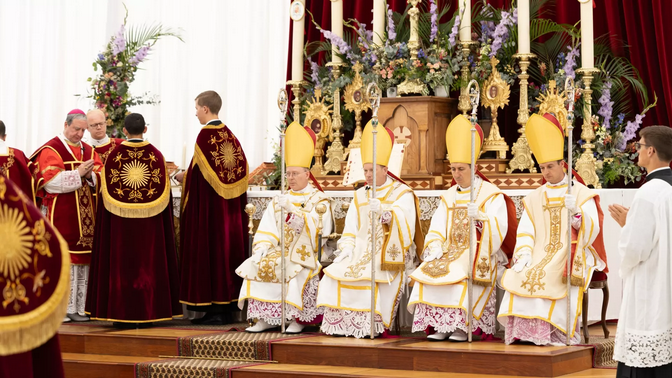
The conflict erupted in July 2026, after the SSPX consecrated four bishops without papal approval. The Vatican’s Dicastery for the Doctrine of the Faith, led by Cardinal Víctor Manuel Fernández, declared that six bishops had incurred automatic excommunication. The Society subsequently challenged the decree, arguing that its objections should be examined through the Church’s own legal procedures.
The case now raises a difficult question for both sides: whether a dispute that touches the limits of ecclesiastical authority can be resolved through canonical review before the estrangement between Rome and the traditionalist fraternity deepens further.
A legal challenge, with important procedural consequences
The SSPX announced on July 13 that it had lodged a preliminary appeal with the doctrinal dicastery on July 11, invoking canons 1734 and following of the Code of Canon Law. This initial step seeks the revocation or correction of an administrative decree and normally precedes an appeal to a higher authority.
The Society maintains that the appeal suspends the execution of the penalties under canon 1353 while the proceedings are pending. Under the canonical framework cited by the SSPX, the authority that issued the decree has 30 days to respond to a request for revocation. If no response is given, a further period of 15 useful days applies for pursuing an appeal to the superior authority.
Should the preliminary request be rejected, or remain unanswered within the applicable procedure, the Society could seek review through the Supreme Tribunal of the Apostolic Signatura, the Vatican’s highest judicial body for certain administrative disputes. However, the SSPX’s October statement does not confirm that it has reached this stage. It refers only to the competent authorities and says the Society intends to maintain discretion while the process continues.
That silence leaves the precise procedural status unclear. The SSPX’s communications indicate that it considers its challenge ongoing, but do not establish whether the dicastery has issued a definitive response or whether a subsequent appeal has been filed.
Six bishops named in the Vatican decree
The decree dated July 2, signed by Cardinal Fernández and the dicastery’s secretaries, Archbishop John J. Kennedy and Monsignor Armando Matteo, concerns the consecrations carried out without papal authorization.
It declares that Bishop Alfonso de Galarreta, identified as the principal consecrator, and the four newly consecrated bishops—Pascal Schreiber, Michael Goldade, Michel Poinsinet de Sivry and Marc Hanappier—incurred excommunication latae sententiae, a penalty incurred automatically under the conditions specified by canon law. The same penalty was extended to Bishop Bernard Fellay because of his direct participation in the rite.
An accompanying explanatory note went further, describing the Society’s ministers as schismatic in their exercise of ministry and warning that Catholics who formally adhere to a schism could also incur excommunication. It also questioned the validity of confessions and marriages celebrated by SSPX priests. Those assertions have prompted public discussion, including debate over confession by Cardinal Gerhard Müller and canon lawyer Juan Ignacio Arrieta.
These issues should not be collapsed into a single question. The status of the bishops, the canonical consequences of their consecrations, the circumstances in which Catholics may receive sacraments from SSPX priests, and the validity of particular sacramental acts are related but distinct matters. The accompanying note sets out the Vatican dicastery’s position; the legal and theological questions surrounding its implications have also been publicly debated.
The stakes extend beyond the penalties
The SSPX presents its appeal as an exercise of a right available to anyone who believes an administrative act has caused them injury. Its July statement described the initiative as an effort to seek correction while remaining committed to justice, truth and the good of the Church. In its latest message, the Society also invited priests and faithful to remain united in prayer for the Pope and the whole Church, whose supreme law, it noted, is the salvation of souls.
The Vatican’s position, meanwhile, reflects the importance Catholic Church assigns to communion with the Pope and the requirement of papal authorization for episcopal consecrations. The appointment and consecration of bishops are not merely internal administrative questions: they concern the visible structure of the Church and the authority through which its sacramental and pastoral life is governed.
The canonical appeal offers a means to examine the contested decree through established procedures. But the existence of an appeal should not be mistaken for a final judgment on the merits of the Society’s objections, just as the gravity of an excommunication does not by itself settle every disputed legal or theological question.
The timing has added to the uncertainty. The SSPX’s October 13 statement appeared on the same day Pope Leo XIV underwent surgery at Rome’s Gemelli Hospital. The Society’s communications director, James Vogel, had previously told a conservative American media outlet that no definitive response had yet been received, while emphasizing that excommunications, however serious, are not infallible.
For now, the public record provides no final resolution. The SSPX says its challenge remains active, while the details of the proceedings in Rome remain undisclosed. Whether the dispute advances to the Apostolic Signatura or is resolved at an earlier stage, its outcome will matter not only for the six bishops but also for Catholics seeking clarity about the boundaries of ecclesial communion, the authority of the Holy See and the canonical status of the Society’s ministry.
Thank you for reading our content. If you would like to receive ZENIT’s daily e-mail news, you can subscribe for free through this link.

Publicaciones relacionadas:
 USA: Bishops publish national synthesis for the interim stage of the 2021-2024 Synod
 Catholic Church in USA presents annual report against sexual abuse: these are the advances and pitfalls
 Real Madrid Goes to the Cathedral to Offer the Champions League Cup to the Virgin of Almudena
 U.S. Bishops’ Administrative Committee Approves Transition of Ad Hoc Committee Against Racism to a Permanent Subcommittee
