

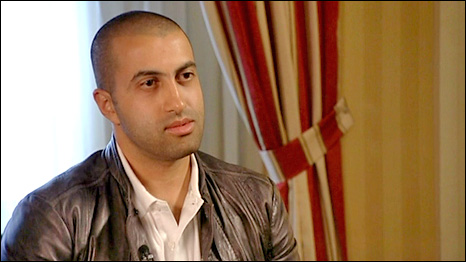
(ZENIT News / Rome, 11.27.2026).- The son of one of the seven founders of the terrorist group Hamas, defected from the organization and converted to Christianity. Having witnessed the ideology and objectives of Hamas firsthand, he fled and warns that the goal of extremist Islamic groups is not merely the liberation of Palestine — «from the river to the sea» — but the destruction of Israel, with the ultimate aim of the conquest of . . . Rome.
Mosab Hassan Yousef has lived three lives: leader of a terrorist group, Israeli spy, and exile after converting to Christianity. He was a young leader in Hamas, as the heir to Sheikh Hassan Yousef, a co-founder of the organization, who spent many years in Israeli prisons. Born in Ramallah, in the West Bank, Mosab joined the political wing of Hamas. He was arrested in Israel in 1996 and subsequently released by the Shin Bet, Israel’s internal security service. He changed sides following a crisis of conscience regarding suicide terrorism.
After being arrested again — while secretly acting as a spy for Israel — he was trained by the Shin Bet to infiltrate Hamas once more. He proved highly effective as an Israeli spy under the codename «The Green Prince.» «I provided information about suicide bombers who intended to kill civilians indiscriminately,» Mosab explained in an interview on the Italian television program Nicola Porro (on the network Rete 4). The «Green Prine explained that his information frustrated dozens of attacks — an enormous moral responsibility.»
In 1999, he converted to Christianity. He describes it as «the consciousness of Christ, which is the path of love.» He emphasizes the value of the evangelical principle: «Do not judge.» Judgment belongs to the Lord alone. «Love your enemy» — he took that principle and put it into practice. «I loved my enemy unconditionally, following Christ.»
His disillusioned view of Hamas, which he calls a «terrorist group», stemmed from witnessing an uncompromising, intolerant, and totalitarian form of Islamism. He points to the movement’s ambition to transform the entire world, not just the Middle East: «During Friday prayers, Rome is often mentioned. We grew up with the ambition of conquering Rome. This is not just a Hamas agenda; it is a prophecy attributed to the Prophet Muhammad: Rome must fall into the hands of Muslims before the Day of Judgment arrives. The goal of Hamas, and of all jihadist groups, is an Islamic Caliphate.»
He confirms the existence of numerous jihadist documents, particularly those from ISIS, which outline a strategy for military conquest and the infiltration of society. He reiterates: «The situation is far more serious than people realize. Once you unleash violence, there is no telling how it will end. It evolves from protesting for a cause to feeling oppressed, eventually fostering a culture of resentment and victimhood. When enough people succumb to this resentment, affecting the economy, education, and political life, everything begins to collapse, like a domino effect.»
Mosab points to the political Left as the gateway into Western society and its institutions: «The alliance between the Left (anarchists, Communists, progressives, liberals) and Islam is a phenomenon seen everywhere. In the United States, they have caused a great deal of harm. By their very nature, Islamists would be willing to enslave leftist activists; however, for the time being, they have found a common enemy and have formed an alliance out of opportunism. In the eyes of the Islamists, the Left consists merely of ‘useful idiots’ — democrats who wish to open the door to all sorts of minorities.»
The recent news regarding the new National Center for Combating Islamophobia — an organization tasked with monitoring the media and collecting reports on acts of aggression, judicial rulings, articles, commentary, and social media posts directed against Muslims — saw the Center present its first report in Milan on November 14th and 15th. Notably, this new initiative carried out its presentation without allowing access to the press.
On October 21, the President of the Italian Episcopal Conference, Cardinal Matteo Zuppi, presented a document intended for students and teachers of Catholic religious education. The document offers a highly sanitized portrayal of Islam, remaining silent on the persecution, repression, and lack of religious freedom prevalent in most Islamic countries. This guide, designed for educators and imams, aims to «support work with the new generations.»
It’s difficult to see how the concept of «Islamophobia» can be considered valid when Muslims themselves suppress freedom of expression. It would be more appropriate to speak of the need for vigilance against excessive aggression, both against Muslims and by Muslims against Christians. If the term is accepted without any sense of balance, then Mosab Hassan Yousef, despite being a direct witness to Islamic extremism, would have to be accused of «Islamophobia» simply for giving an interview.
While it is right to curb hatred directed by a Christian toward Islam, it’s equally necessary to put an end to the hatred directed by Islamic groups or individuals toward Christians.

Publicaciones relacionadas:
 INTERVIEW: Cardinal Guixot Discusses Fruits of Pope & Grand Imam’s Abu Dhabi Document on Human Fraternity
 FEATURE : ‘An Economy Which Excludes No One’ — Cardinal Turkson Explains to ZENIT Importance of Pope’s Assisi Encounter
 Pope Francis Will Be 85 on Saturday and This Is the Person with Whom He Will Celebrate His Birthday
 Priest Attacked with Acid in 2018 Dies in Nicaragua
