

(ZENIT News / Paris, 09.25.2026).- Nearly 2,000 people have turned to France’s independent body for the recognition and repair of sexual abuse within the Catholic Church. As the five-year initiative prepares to close to new cases, its final report sets out both the value of its work and the unresolved challenge facing the Church: turning acknowledgment into lasting institutional change.
Created on November 8, 2021, in the wake of a landmark investigation into abuse, the National Independent Authority for Recognition and Reparation (INIRR) was designed to offer survivors a route to recognition and reparation beyond the criminal justice system. The inquiry that preceded it estimated that about 330,000 children had suffered sexual abuse over seven decades by clergy or others connected with the Church in France, and described institutional failings as systemic. This figure has been disputed by various organizations because it is considered a generalization, but it is the official figure.
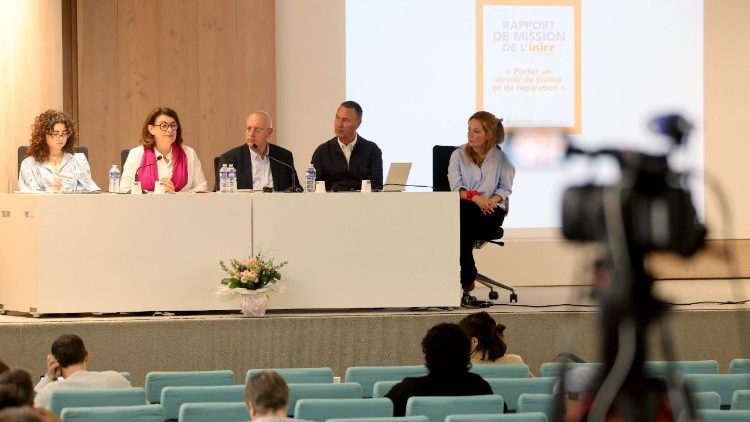
At a Paris briefing on September 22, INIRR president Marie Derain de Vaucresson said the authority’s experience had yielded lessons not only for the Church but also for civil society. Its multidisciplinary approach drew on victimology, and its work sought to address the harm through careful listening, formal acknowledgment, financial compensation and psychological support.
The authority has issued more than 1,184 decisions granting financial or other forms of reparation. Hundreds of cases remain unresolved. Survivors who completed the process received an average financial award of €36,892, paid through a special fund financed by the Church. The amount is intended to support recovery, rather than assign a monetary value to the abuse itself.
For many survivors, the formal recognition has carried a significance that money alone cannot provide. Cécile Reneaume, who was abused as a child by a now-deceased leader of a Catholic community, said the letter she received from the INIRR affirmed that the Church recognized specific failings and gave credibility to the child who had been unable to speak. In cases where the alleged abuser has died, such acknowledgment can be especially consequential: Cécile’s case, for example, could no longer proceed through the courts.
Another survivor, identified only as Eric, described the shock and anger he initially felt when he learned the amount of his compensation. He had been raped by a priest between the ages of eight and 14. Over time, he said, he came to understand that the award was not a judgment on his worth or a price placed on his childhood. The authority’s recognition, he explained, helped him feel that someone beyond himself believed what had happened.
The INIRR’s work has also included forms of reparation not reducible to a payment: helping survivors write their stories, arranging meetings with local Church representatives, or installing memorial plaques. Its case managers’ attentive listening and the body’s independence were identified in the report as key factors in survivors’ sense that they had been treated justly.
The need for such support continues. Among people who contacted the authority last year, the average age was 56; roughly two-thirds were men and one-third women. Some survivors have only recalled abuse decades later. Philippe Gomes said therapeutic hypnosis helped him remember abuse by two priests when he was between seven and 12. His experience, like others’, illustrates how the effects of trauma can surface long after childhood.
Yet the authority’s impending closure has exposed a second, institutional question. The French bishops’ conference decided that the INIRR would stop accepting new requests on August 31, 2026, after fulfilling its five-year mandate. The announcement prompted a fresh rise in contacts: 45 people approached the body in August alone, while 183 had contacted it during the year. Staff will continue supporting those who came forward before the deadline until the end of 2027. A successor system, INIAVE, is then expected to take over, with a permanent remit focused on restorative justice and long-term support.
The timing gives the report added significance: it was released ahead of Pope Leo XIV’s four-day visit to France, during which he is expected to meet privately with seven survivors of clerical and Church personnel abuse. The report was due to be presented to Cardinal Jean-Marc Aveline, president of the French bishops’ conference.
For survivors who testified at the report’s presentation, the independent process offered a measure of relief, but not a restoration of trust in the Church as a whole. One said that although the INIRR had helped, much remained to be done by Church institutions. Derain de Vaucresson put the next responsibility plainly: the task is no longer simply to encourage victims to come forward, but to ensure that institutions learn to listen.
Thank you for reading our content. If you would like to receive ZENIT’s daily e-mail news, you can subscribe for free through this link.

Publicaciones relacionadas:
 The Pope is met with an attack in Algeria; in Cameroon, he is greeted by an announcement of a ceasefire amid the civil war
 Dates and Locations Announced for Mass Events with Pope Leo XIV in Spain
 French bishops announce the Pope’s visit for September 2026: here’s what we know
 Spanish prisoners will receive Bibles as gifts on the occasion of the Pope’s visit to Spain
