

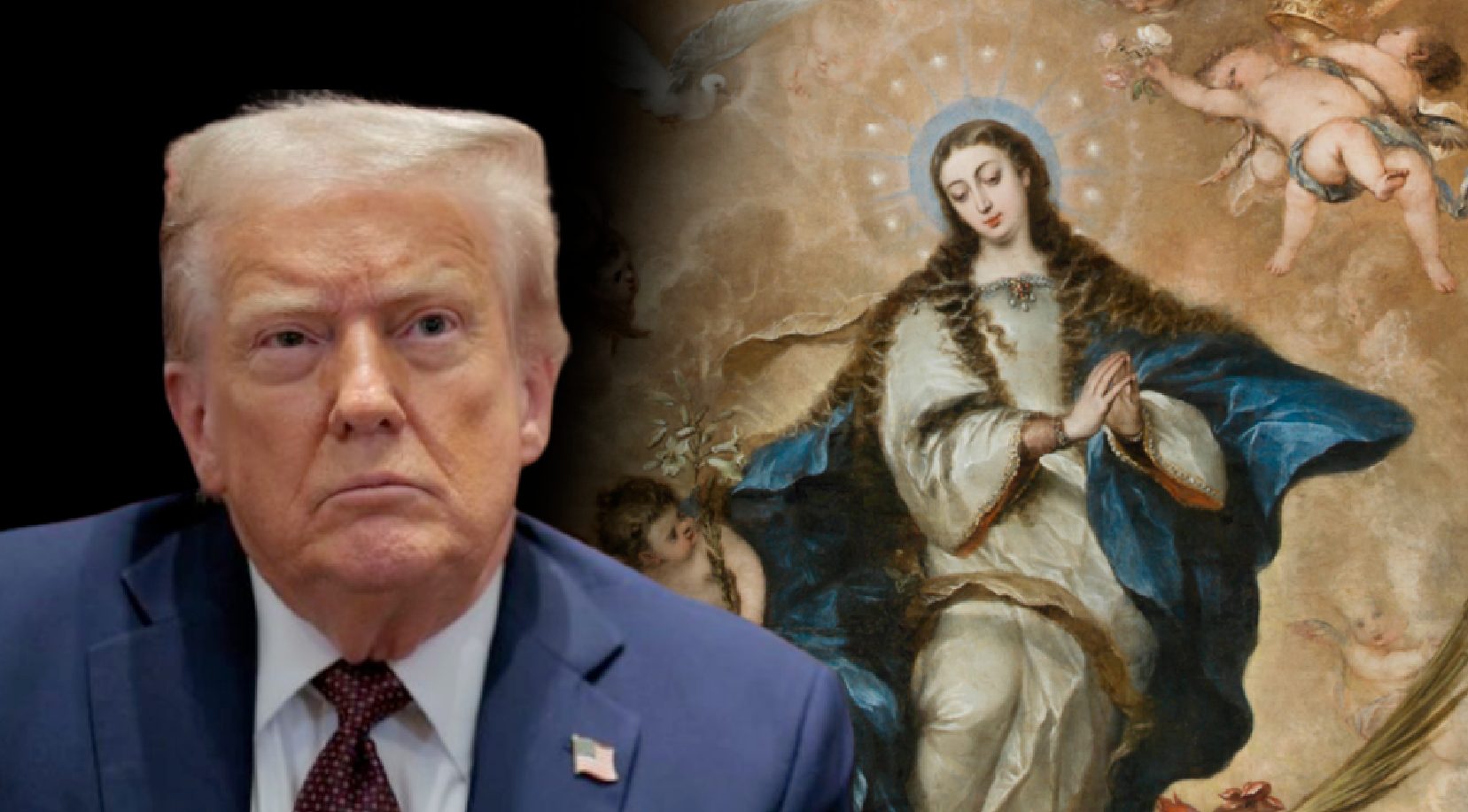
(ZENIT News / Washington, 12.08.2025).- President Donald Trump marked the feast of the Immaculate Conception with a formal presidential message, giving national prominence to a Catholic solemnity rarely acknowledged from the White House. Although presidents have invoked Mary in various cultural or seasonal contexts, no documented predecessor—Catholic or otherwise—had explicitly recognized the December 8 feast in an official statement.
The message unfolded as both a meditation on Mary’s role in salvation history and an appeal to the religious memory of the United States. It also contained a theological misstep on the timing of the Incarnation. Yet the symbolism of a sitting president elevating a distinctly Catholic mystery of faith proved more striking than the doctrinal imprecision itself.
Trump described Mary as a figure whose fidelity shaped “the course of humanity,” recalling her consent at the Annunciation as an act of profound consequence. By invoking her humility, courage, and willingness to receive God’s will, he cast the biblical scene not merely as a religious event but as a narrative with continuing relevance for the American conscience. The statement quoted the Gospel of Luke and included the text of the Hail Mary.
The message then traced the presence of Marian piety in the nation’s development, citing Bishop John Carroll’s 18th-century consecration of the fledgling republic to the Virgin, the thanksgiving Mass in New Orleans commemorating the Battle of New Orleans, and the Marian devotion embraced by saints and national figures across three centuries. Trump situated Mary within a broader American story, presenting her as an emblem of hope, perseverance, and peace as the country approaches the 250th anniversary of its independence.
For some Catholic, the gesture signaled a remarkable shift in the public language of American political leaders. Susan Hanssen, a historian at the University of Dallas, called the proclamation “a dazzling historical moment,” noting that no previous president had spoken so forthrightly about Mary’s role in the mystery of the Incarnation. She viewed the message as a cultural milestone, especially in a society where explicit Christian references in political speech often draw scrutiny.
Others framed the statement within Trump’s ongoing effort to strengthen his connection with religious voters. Caleb Henry, a political scientist at Franciscan University, interpreted the message as an extension of the America Prays initiative, which encourages citizens to petition for national renewal ahead of the country’s semiquincentennial. For Henry, the proclamation signaled Trump’s desire to speak directly to Catholic constituencies, bypassing civil and ecclesial intermediaries to present his narrative of the nation’s spiritual roots.
Not all commentary focused on politics. The statement’s portrayal of the Incarnation—suggesting that God took on human flesh at Christ’s birth rather than at His conception—prompted clarification. Dominican theologian Aquinas Guilbeau observed that the misunderstanding persists widely, even among devout Christians, despite early doctrinal definitions and centuries of catechetical teaching. He noted that familiar hymns and poems often repeat this error, underscoring the need for clearer formation.
The White House message also touched on global concerns. Reflecting on Pope Benedict XV’s dedication of a statue of Mary, Queen of Peace, during the First World War, Trump invoked the image of the Virgin as a guide for those longing for an end to present-day conflicts. The statement linked Marian devotion to universal aspirations for harmony, justice, and reconciliation.
Reactions among Catholic leaders in the United States were measured. Some bishops have praised Trump’s alignment with Church teaching on gender ideology while voicing reservations on immigration enforcement and reproductive technologies. Against this background, the president’s Marian proclamation emerged as an unconventional gesture—unexpected, yet resonant with segments of the Catholic population.
Trump’s message concluded with an appeal for peace and a renewed desire for unity, presenting Mary not only as a figure of Catholic devotion but as a symbol capable of inspiring a wider civic imagination.
Below is the full text of the Declaration:
***
Presidential Message on the Feast of the Immaculate Conception
Today, I recognize every American celebrating December 8 as a Holy Day honoring the faith, humility, and love of Mary, mother of Jesus and one of the greatest figures in the Bible.
On the Feast of the Immaculate Conception, Catholics celebrate what they believe to be Mary’s freedom from original sin as the mother of God. She first entered recorded history as a young woman when, according to Holy Scripture, the Angel Gabriel greeted her in the village of Nazareth with news of a miracle: “Hail, favored one! The Lord is with you,” announcing that “you will conceive in your womb and bear a son, and you shall name him Jesus.”
In one of the most profound and consequential acts of history, Mary heroically accepted God’s will with trust and humility: “Behold, I am the handmaid of the Lord. May it be done to me according to your word.” Mary’s decision forever altered the course of humanity. Nine months later, God became man when Mary gave birth to a son, Jesus, who would go on to offer his life on the Cross for the redemption of sins and the salvation of the world.
For nearly 250 years, Mary has played a distinct role in our great American story. In 1792, less than a decade after the end of the Revolutionary War, Bishop John Carroll—the first Catholic bishop in the United States and cousin of signer of the Declaration of Independence Charles Carroll—consecrated our young Nation to the mother of Christ. Less than a quarter-century later, Catholics attributed General Andrew Jackson’s stunning victory over the British in the climactic Battle of New Orleans to Mary. Every year, Catholics celebrate a Mass of Thanksgiving in New Orleans on January 8 in memory of Mary’s assistance in saving the city.
Over the ages, American legends like Elizabeth Ann Seton, Frances Xavier Cabrini, and Fulton Sheen, who spent their lives glorifying God in service to others, have held a deep devotion to Mary. The Basilica of the National Shrine of the Immaculate Conception, located in the heart of our Nation’s Capital, honors Mary as the largest church in North America. The timeless hymn “Ave Maria” remains beloved by countless citizens. She has inspired the establishment of countless churches, hospitals, and schools. Nearly 50 American colleges and universities bear Mary’s name. And, just days from now, on December 12, Catholics in the United States and Mexico will celebrate the steadfast devotion to Mary that originated in the heart of Mexico—a place now home to the beautiful Basilica of Our Lady of Guadalupe—in 1531. As we approach 250 years of glorious American Independence, we acknowledge and give thanks, with total gratitude, for Mary’s role in advancing peace, hope, and love in America and beyond our shores.
More than a century ago, in the midst of World War I, Pope Benedict XV, the leader of the Roman Catholic Church, commissioned and dedicated a majestic statue of Mary, Queen of Peace, bearing the infant Christ with an olive branch so that the Christian faithful would be encouraged to look to her example of peace by praying for a stop to the horrific slaughter. Just a few months later, World War I ended. Today, we look to Mary once again for inspiration and encouragement as we pray for an end to war and for a new and lasting era of peace, prosperity, and harmony in Europe and throughout the world.
In her honor, and on a day so special to our Catholic citizens, we remember the sacred words that have brought aid, comfort, and support to generations of American believers in times of need:
Hail, Mary, full of grace, the Lord is with thee. Blessed art thou among women and blessed is the fruit of thy womb, Jesus. Holy Mary, Mother of God, pray for us sinners, now and at the hour of our death. Amen.
Thank you for reading our content. If you would like to receive ZENIT’s daily e-mail news, you can subscribe for free through this link.

