

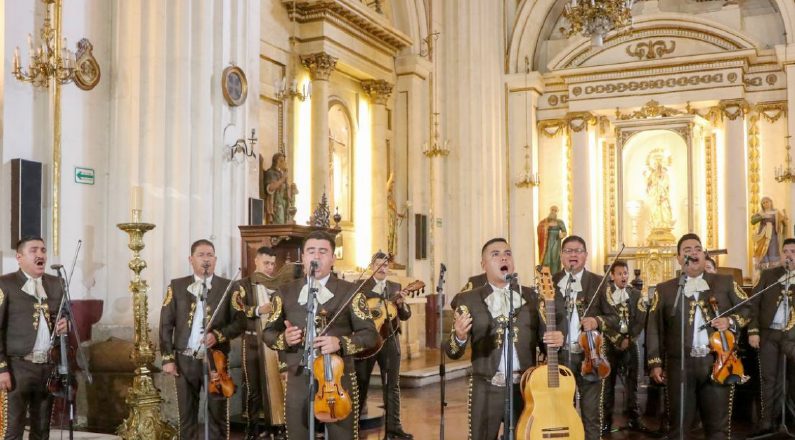
(ZENIT News / Mexico City, 01.04.2026).- In a country where church weddings are often as much cultural events as sacramental celebrations, a Mexican diocese has moved to redraw the boundaries between personal taste and liturgical meaning. Just days before Christmas, the Diocese of Cuernavaca released a detailed set of norms clarifying what kind of music belongs— and does not belong— at Catholic wedding Masses.
The document, titled Music for the Celebration of Marriage: Practical Guidelines, was issued on 22 December by the diocesan Office for Sacred Music. Its publication is no coincidence. Located in the state of Morelos, south of Mexico City, Cuernavaca has become one of the country’s most sought-after wedding destinations, prized for its historic churches, manicured gardens and mild climate. The popularity of destination weddings, however, has also intensified tensions between liturgical discipline and the expectations of couples accustomed to cinematic soundtracks and customized ceremonies.
At the heart of the guidelines is a reminder rather than a list of prohibitions. Bishop Ramón Castro Castro of Cuernavaca, who also serves as president of the Mexican bishops’ conference, frames the document as an effort to safeguard the unity, beauty and spiritual depth of the marriage liturgy. A wedding, he insists, is not a private performance staged inside a church, but an act of prayer by the Church itself, drawing the couple into the mystery of Christ’s love for his people.
From that premise flow a number of concrete clarifications. The diocese emphasizes that there is only one entrance procession for the couple, accompanied by a single chant, rather than separate musical moments for bride and groom. Citing the General Instruction of the Roman Missal, the text recalls that the ritual envisions either welcoming the couple at the church door or receiving them at their place near the altar— not a sequence of individualized entrances designed to showcase personal musical preferences.
This is where the document addresses one of the most sensitive issues in contemporary Catholic weddings: the use of popular music. The guidelines explicitly discourage the inclusion of film soundtracks, sports anthems or other pieces composed for non-liturgical contexts, even if they are emotionally meaningful to the couple. The problem, the diocese argues, is not aesthetic quality but symbolic coherence. Music at Mass is meant to serve the rite, not overshadow or reinterpret it.
In that light, even some of the most familiar wedding staples come under scrutiny. The diocese notes that the famous wedding marches by Richard Wagner and Felix Mendelssohn fail to meet liturgical criteria and are therefore inappropriate at any point in the sacramental celebration. Their original contexts, the document explains with unusual frankness, are theatrical rather than sacred: Wagner’s Lohengrin accompanies a couple to the bridal chamber, not to an altar, while Mendelssohn’s music comes from a Shakespearean comedy featuring a deliberately absurd marriage.
Rather than leaving musicians and couples empty-handed, the guidelines propose a repertoire of approved liturgical compositions suited to the different moments of the rite. The aim is not austerity but musical integrity— pieces that arise from and reinforce the prayer of the Church.
One particularly delicate topic receives a nuanced treatment: the use of mariachi music. In many parts of Mexico, including Cuernavaca, the so-called “Misa con Mariachi” has become a familiar expression of popular religiosity. Acknowledging this tradition, the diocese does not ban mariachi outright, but insists that its use must be decided in close dialogue with the priest who presides. Mariachi musicians, the text stresses, must understand the structure of the liturgy, respect its moments of silence, and be prepared with appropriate sacred repertoire rather than adapting secular songs.
Silence itself emerges as a key theme. The document underscores that certain moments— the exchange of consent, the blessing and exchange of rings and arras, and the nuptial blessing— should take place without any music, even instrumental. These are not gaps to be filled, the diocese suggests, but moments where the sacramental action speaks most clearly on its own.
The guidelines also reaffirm that the fixed prayers of the Mass, such as the Gloria, the Sanctus, the Lord’s Prayer and the Agnus Dei, may not be altered. If they cannot be sung according to the liturgical texts, they must be recited, not replaced or paraphrased.
Underlying these practical norms is a distinctly sacramental vision of marriage. Drawing on the Catechism of the Catholic Church, the document recalls that the spouses seal their consent by offering their lives to one another in union with Christ’s self-offering made present in the Eucharist. Music, in this context, is not decoration but ministry— a service to grace rather than a backdrop for emotion.
That point is emphasized by Father Cristian Alejandro Hernández Orduña, director of the diocesan Office for Sacred Music, who describes the guidelines as an effort to preserve both the beauty and the internal logic of the liturgical sign. Wedding music, he argues, should help the faithful recognize what is truly taking place: not simply a celebration of romantic love, but a sacrament through which God’s own love is made audible and visible.
In a setting where weddings often blend religious ritual with cultural spectacle, the Diocese of Cuernavaca’s document reads as a call to recalibrate priorities. It does not deny the importance of joy or local tradition, but it asks couples, musicians and clergy alike to allow the liturgy to shape the celebration— even, and perhaps especially, in the music that accompanies the walk toward the altar.
Thank you for reading our content. If you would like to receive ZENIT’s daily e-mail news, you can subscribe for free through this link.

Publicaciones relacionadas:
 St. Basil Institute for the Theology of Creation to Host Online Conference on Ecology and the Theology of Creation
 New Bishop of Shanghai: Sticking Point Between China and Vatican
 U.S. Bishops to Meet Nov. 11-14 in Baltimore; Assembly to Be Live Streamed
 Outlining a moral vision for US foreign policy: full text of the statement by three US cardinals
