

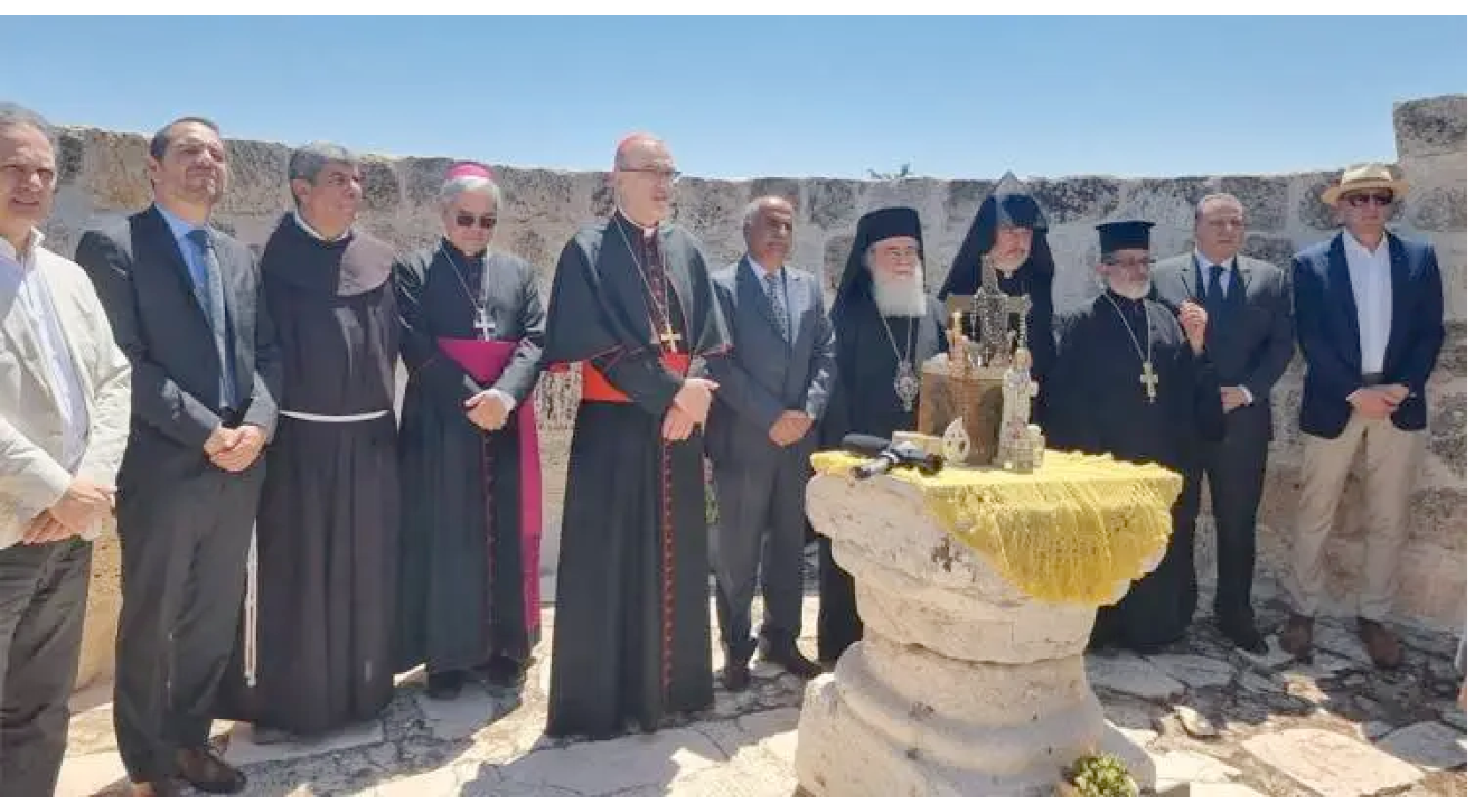
(ZENIT News / Jerusalem, 01.20.2026).- In a rare and carefully worded intervention, the Patriarchs and Heads of Churches in Jerusalem have publicly reasserted who speaks for Christianity in the Holy Land—and who does not. In a joint declaration released on Saturday, 17 January, the leaders of the city’s historic Christian communities warned that the growing visibility of Christian Zionism represents a direct threat to ecclesial unity and to the fragile Christian presence in the region.
Speaking collectively on behalf of Catholic, Orthodox and Protestant churches, the signatories reminded both believers and political authorities that “the flock of Christ in this land is entrusted to the apostolic Churches,” which have exercised pastoral responsibility in Jerusalem for centuries. The statement leaves little ambiguity: spiritual authority in the Holy Land does not belong to foreign movements or self-appointed intermediaries, but to the churches that have lived, served and suffered there continuously since the earliest days of Christianity.
The immediate concern raised by the Patriarchs is what they describe as the misleading activity of local individuals promoting “harmful ideologies,” explicitly naming Christian Zionism. According to the statement, such initiatives distort public perception, sow confusion among the faithful and weaken the unity of Christian communities. Even more troubling, the church leaders note, is that these actors have found political backing in Israel and abroad, allowing a theological current with clear political implications to present itself as a legitimate voice of local Christianity.
For the churches of Jerusalem, the issue is not abstract theology but lived reality. Invoking the Apostle Paul’s image of the Church as one body with many members (Romans 12:5), the Patriarchs warn that claiming authority outside ecclesial communion wounds that body and places an additional burden on the historic churches precisely in the land where Jesus lived, taught, suffered and rose from the dead. They also express alarm that representatives of Christian Zionist circles have been received at official levels, both locally and internationally, calling such gestures an intrusion into the internal life of the churches and a dismissal of the pastoral mandate entrusted to Jerusalem’s Christian leaders.
The declaration culminates in an unequivocal assertion: only the Patriarchs and Heads of Churches represent the Christian communities of the Holy Land in matters of religious, communal and pastoral life. The closing prayer asks God, “the Shepherd and Guardian of souls,” to grant wisdom to protect his people and preserve their witness in the land made sacred by the Gospel.
To understand the weight of this statement, it is necessary to grasp what Christian Zionism is—and why it has long troubled Middle Eastern Christians. As a movement, Christian Zionism interprets the return of Jews to the Holy Land and the creation of the State of Israel in 1948 as the fulfillment of biblical prophecy. While often presented as pro-Jewish, the theology typically holds that, in the final unfolding of history, many Jews will ultimately accept Jesus as Messiah, leading to a form of “Jewish Christianity” at the end times. Critics, including Jewish scholars such as Rabbi Dan Cohn-Sherbok, have pointed out the paradox of an alliance that ultimately foresees the disappearance of Judaism as a living faith.
Historically, Christian Zionism is not new. Its roots can be traced back to strands of Protestant thought four centuries ago and later to 19th-century dispensationalism. In the modern era, however, it has become particularly influential within sectors of American evangelical Protestantism. The movement is well funded, highly organized and increasingly visible. Since 1980, it has operated through the International Christian Embassy Jerusalem, and each year thousands of adherents travel to the city during the Jewish festival of Sukkot. The political corollary of this theology is unqualified support for the Israeli state, viewed as a necessary step toward the fulfillment of Old Testament prophecy and the eventual coming of the Kingdom of God.
Jerusalem’s church leaders have confronted this ideology before. In August 2006, a group of Christian heads of churches—including the then Latin Patriarch Michel Sabbah—issued the Jerusalem Declaration on Christian Zionism, rejecting what they described as a theological and political movement that aligns the Gospel with empire, colonialism and militarism. That document argued that apocalyptic speculation cannot override the Christian demand for justice, reconciliation and peace in the present.
The renewed warning in January 2026 comes amid heightened international attention to Christian Zionist activism. Although not named explicitly, church officials appear to be alluding to a high-profile event organized by Israel’s Ministry of Foreign Affairs in December, when a delegation of around 1,000 U.S. Protestant pastors gathered in Jerusalem to reinforce the Judeo-Christian alliance and U.S.–Israel relations. For local Christians, such spectacles risk creating the impression that foreign movements speak on their behalf—an impression the Patriarchs are determined to correct.
The message from Jerusalem is therefore both theological and pastoral, but also deeply political in its implications. In a region where Christians constitute a small and vulnerable minority, the Patriarchs fear that imported ideologies, however influential abroad, may further marginalize local believers and entangle them in agendas not of their choosing. By drawing this clear boundary, the churches of Jerusalem are not entering a culture war; they are defending continuity, presence and responsibility in a land where Christianity was born—and where its future remains precarious.
Thank you for reading our content. If you would like to receive ZENIT’s daily e-mail news, you can subscribe for free through this link.

Publicaciones relacionadas:
 Statement by the bishops of the Holy Land on “Christian Zionism”
 Jerusalem: Holy Week Behind Closed Doors. A Statement from the Catholic Patriarch
 Four German Bishops Formally Disassociate Themselves from the German Synodal Path to Remain in the Catholic Church
 Pope Francis’ confessor dies in Argentina at age 98
