

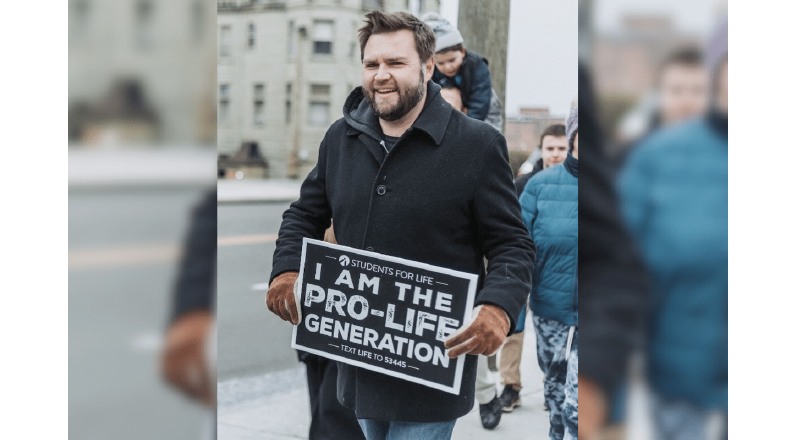
(ZENIT News / Washington, 01.21.2026).- When tens of thousands of demonstrators gather on the National Mall on January 23, 2026, for the 53rd annual March for Life, the spotlight will once again fall on Vice President JD Vance. Scheduled to address the pre-march rally at 11:00 a.m., Vance will become one of the most prominent voices at this year’s event, underscoring both the enduring political relevance of the pro-life movement and the tensions currently running through it.
Vance occupies a singular place in contemporary American politics. He is only the second Catholic to serve as vice president of the United States, a fact not lost on organizers or participants of an event that has long drawn heavily from Catholic and evangelical constituencies. His presence at the 2026 march will mark his second appearance as vice president, following his address at the 2025 March for Life, which also stood as his first major public speech after assuming national office.
In that earlier appearance, Vance framed his opposition to abortion in personal terms, pointing to fatherhood as a decisive factor in shaping his convictions. “Becoming a father helped cement my belief that an unborn life deserves protection,” he told the crowd, linking private experience with public policy. He also stressed that the march itself is not merely symbolic. Rather, he argued, it represents a daily, sustained effort by the pro-life movement beyond a single winter gathering in Washington. His closing promise that day, “We’ll be back next year,” now takes concrete form.
This year’s roster of speakers reflects the march’s continued alignment with Republican leadership on Capitol Hill. Alongside Vance, House Speaker Mike Johnson and Representative Chris Smith of New Jersey, one of Congress’s longest-serving and most outspoken pro-life advocates, are expected to address the rally. Organizers say the event will once again draw participants from across the country, many of whom travel long distances annually to make the march a fixture of their civic and religious calendars.
President Donald Trump will not attend the 2026 march in person, but the White House has confirmed that he will deliver a pre-recorded message to the crowd. Speaking to EWTN News on January 16, Trump described the message as “beautiful” and offered warm words for the demonstrators themselves, calling them “great people.” His virtual participation continues a pattern established during his presidency, in which symbolic gestures toward the pro-life base have often accompanied more complex policy signals.
Those policy signals have recently provoked unease among pro-life activists. The Trump administration has faced criticism following remarks suggesting that Republicans should be “flexible” on the Hyde Amendment, the decades-old provision that restricts the use of federal funds for abortion, as well as decisions restoring funding streams to Planned Parenthood. When asked directly about Hyde, Trump indicated that the issue would be addressed in his recorded remarks to marchers. A White House official later told EWTN News that the administration intends to work with Congress to secure “the strongest possible pro-life protections,” though without specifying legislative details.
For many observers, these tensions highlight a broader reality facing the pro-life movement in a post–Roe v. Wade landscape. Since the Supreme Court’s 2022 decision overturned the constitutional right to abortion, the focus has shifted from federal courts to Congress, state legislatures, and executive policy. The March for Life, founded in 1974 in response to Roe, now operates in a fundamentally altered legal environment, where internal disagreements over strategy and compromise have become more visible.
Vance’s role at the 2026 march thus carries significance beyond a single speech. As a Catholic vice president addressing a movement that has long drawn moral language from Christian anthropology, he embodies the intersection of personal belief, religious identity, and political power. Whether his message will help reassure activists unsettled by recent policy debates remains to be seen. What is certain is that, once again, the March for Life will serve as a barometer of the pro-life movement’s priorities, anxieties, and expectations as it navigates a new and more contested phase of American public life.
Thank you for reading our content. If you would like to receive ZENIT’s daily e-mail news, you can subscribe for free through this link.

