

(ZENIT News / Asís, 03.15.2026).- The Franciscan Order in Italy has issued a public warning to Catholics around the world after reports that alleged relics of St. Francis of Assisi are being offered for sale on internet marketplaces at high prices. According to the friars responsible for the saint’s shrine in Assisi, the items circulating online are almost certainly fraudulent and represent a disturbing attempt to commercialize objects that the Church considers sacred.
The alarm was raised after listings appeared on popular e-commerce platforms such as eBay and Etsy claiming to offer relics connected to the medieval saint—among them supposed fragments of bone, traces of blood and pieces of clothing attributed to the founder of the Franciscan movement. Some of the offers were accompanied by prices that reached several hundred pounds.
One listing advertised a medallion containing what was described as a “rare and interesting relic of St. Francis of Assisi” for 707 pounds or “best offer.” Another item, presented as a rare antique reliquary, was listed for nearly 967.47 pounds. For the Franciscan community that safeguards the saint’s memory in Assisi, such sales are not only misleading but incompatible with Catholic teaching.
Brother Giulio Cesareo, head of communications for the Franciscan friars in Assisi, told the news agency Kathpress that relics are never legitimate commercial objects. He described the online offerings simply as a fraud. For the Church, he said, relics are spiritual treasures belonging to the community of believers and therefore cannot be treated as consumer goods.
Cesareo expressed particular concern that buyers might be deceived into believing they were acquiring authentic devotional objects. The phenomenon, he observed, risks reducing sacred items to the level of everyday merchandise, “as if they were dish soap, T-shirts or hand cream,” when in reality they hold a completely different meaning within the Catholic tradition.
Why relics matter in Catholic tradition
In Catholic spirituality, relics are physical remains of saints—or objects associated with them—that believers venerate as tangible links with the lives of holy men and women. Their use dates back to the earliest centuries of Christianity, when the faithful gathered to pray near the tombs of martyrs.
Over time the Church developed strict rules to prevent abuses. Authentic relics are normally preserved inside sealed reliquaries and accompanied by official documentation certifying their origin. They are placed in churches or sanctuaries where they can be venerated, not traded.
Church law explicitly forbids their sale. In a 2017 instruction, Cardinal Marcello Semeraro, prefect of the Dicastery for the Causes of Saints, reiterated that relics must remain sealed and safeguarded in conditions that respect their sacred character. They must also be accompanied by ecclesiastical certificates confirming authenticity.
For this reason, Franciscan authorities say that claims of relics appearing on commercial websites should immediately raise suspicion.
A reaction from Assisi
The concern is particularly acute in Assisi, the Umbrian city where Francis died in 1226 at the age of 44 and where his remains are preserved in the Basilica of St. Francis. The shrine attracts millions of pilgrims and remains one of the most significant spiritual destinations in the Catholic world.
Brother Marco Moroni, the Franciscan custodian of the Sacred Convent attached to the basilica, addressed the issue in a video message. He described the online trade in supposed relics as both “repugnant and absurd,” warning that the emergence of a digital marketplace assigning high prices to such items contradicts the Church’s understanding of relics.
For the friars who guard the saint’s tomb, the problem is not only legal but spiritual: the commercialization of relics distorts the purpose for which they exist—namely, to inspire faith and devotion rather than profit.
The paradox of devotion and commerce
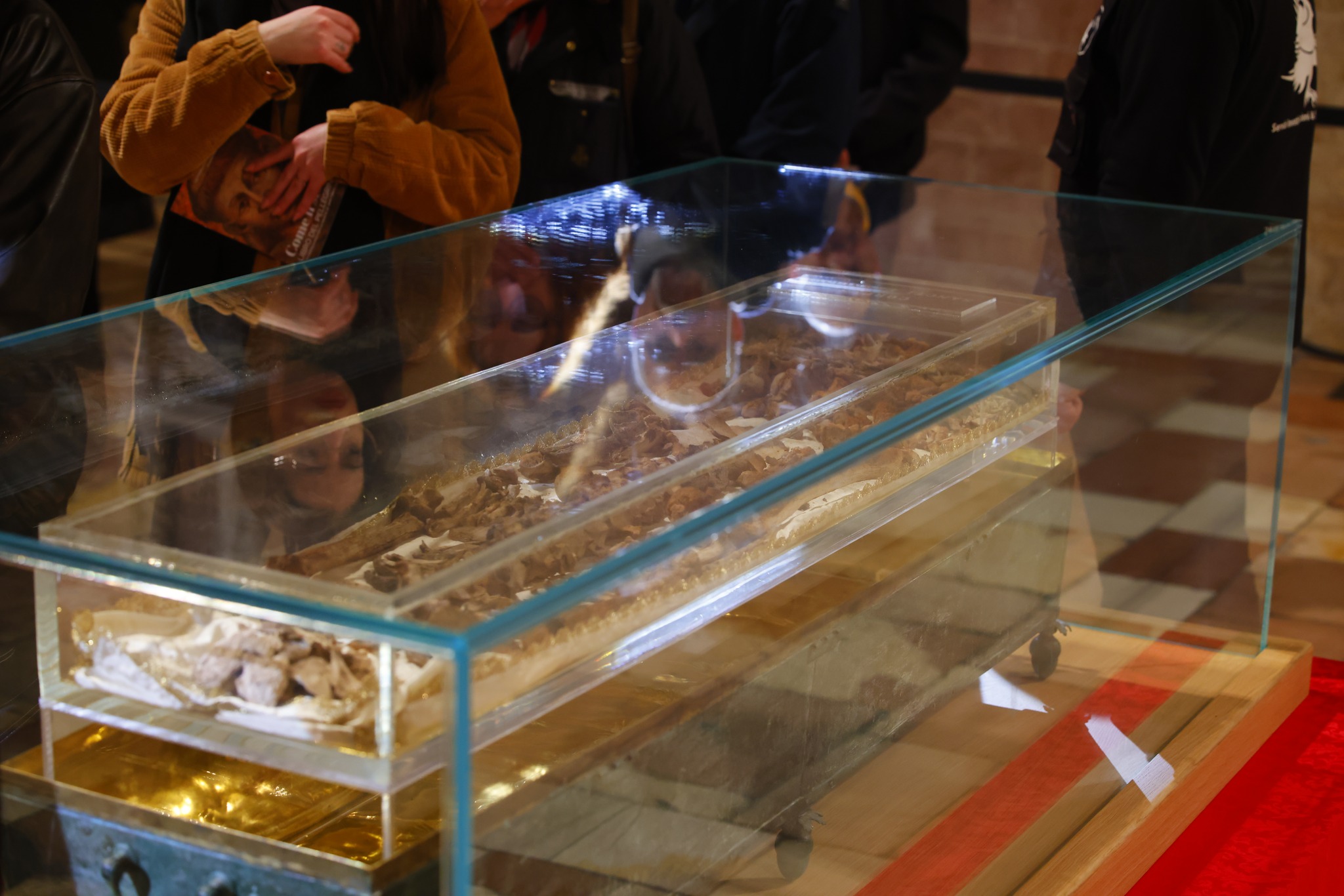
The controversy arises at a moment when interest in St. Francis remains particularly strong. The saint’s relics have recently been displayed for public veneration in the Lower Basilica of Assisi as part of commemorations marking the eighth centenary of his death.
The remains, placed in a bullet-resistant plexiglass reliquary, have already been viewed by more than half a million pilgrims. The exposition is scheduled to continue until the end of March 2025.
The enormous devotion surrounding the figure of Francis partly explains why his name attracts attention even in online marketplaces. Yet that same devotion also makes the faithful vulnerable to deception when alleged relics appear for sale without reliable documentation.
For this reason, Franciscan officials are urging believers to approach such offers with skepticism and to report suspicious listings to the relevant platforms.
Their message is straightforward: relics associated with the “Poverello of Assisi,” one of the most beloved saints in Christian history, are not commodities to be bought and sold. In the eyes of the Church, they belong to the spiritual heritage of all believers—and therefore cannot carry a price tag.
Thank you for reading our content. If you would like to receive ZENIT’s daily e-mail news, you can subscribe for free through this link.

Publicaciones relacionadas:
 United States: this is the numerical status of permanent deacons in the country
 172 Children of Iraq Make Their First Communion in the Land that the Islamic State Had Destroyed
 Bomb Threat at Córdoba’s Cathedral Sparks Debate Over Sacred Heritage and Security
 USA: The National Catholic and Muslim Dialogue: “Journeying Together”
