

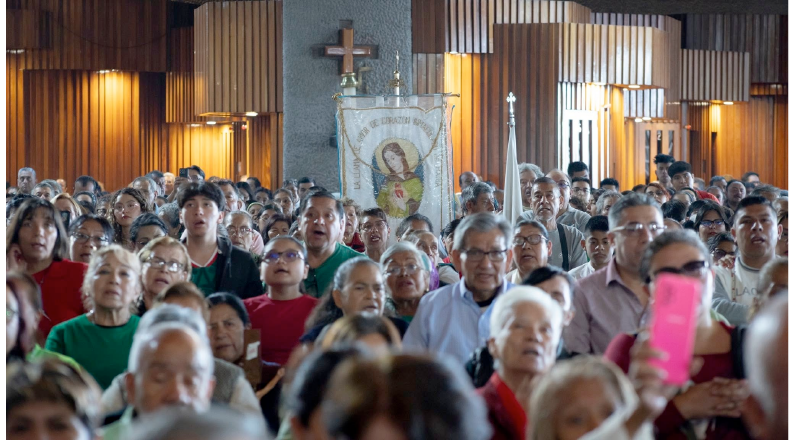
(ZENIT News / Mexico City, 07.12.2026).- Mexico remains one of the great strongholds of global Catholicism, yet new demographic data reveal a nation undergoing a profound transformation in religious identity. While the Catholic Church continues to be the faith of the overwhelming majority of Mexicans, the country is becoming increasingly diverse, presenting fresh pastoral and cultural challenges for a Church that has long shaped the nation’s history.
According to Mexico’s 2020 Population and Housing Census conducted by the National Institute of Statistics and Geography (INEGI), 77.7% of the population—approximately 97.9 million people—identified as Catholic. Although that still represents an overwhelming majority, it marks a notable decline from the 82.7% recorded a decade earlier.
The figures also show significant growth among Protestant and Evangelical Christians, who now account for 11.2% of the population, while nearly one in ten Mexicans declares having no religion. In addition, more than three million people describe themselves as believers without formal religious affiliation, illustrating how personal spirituality is increasingly replacing inherited religious identity for many citizens.
Published in 2023, INEGI’s study “Panorama of Religions in Mexico 2020” highlights how dramatically the country’s religious composition has evolved. At the end of the nineteenth century, fewer than 1% of Mexicans belonged to religions other than Catholicism. Today, more than 14.3 million people profess other faiths, while 13.3 million identify either as having no religion or no formal religious affiliation. Together, these groups represent almost 22% of Mexico’s population.
The census also reveals striking regional contrasts. Catholicism remains particularly strong across central and western Mexico. States such as Guanajuato, Jalisco, Michoacán and Zacatecas report some of the country’s highest percentages of Catholic residents, often exceeding 90%.
In absolute numbers, the State of Mexico leads with more than 13.3 million Catholics, followed by Jalisco (7.45 million), Mexico City (6.99 million), Veracruz (6.05 million), Guanajuato (5.6 million), and Puebla (5.55 million).
The picture changes considerably in the southeast. Chiapas records the country’s lowest proportion of Catholics, with only about 54% of residents identifying with the Church. Quintana Roo follows with approximately 55%, while Campeche and Tabasco stand at roughly 60% and 62%, respectively. These regions have experienced substantial growth among Evangelical communities and other Christian denominations.
Evangelical Protestantism has established particularly strong roots in eight states, where at least 15% of residents belong to those churches. Chiapas leads with 32.5%, followed by Tabasco at 27.1%, Campeche at 24.3%, and Quintana Roo at 20.9%.
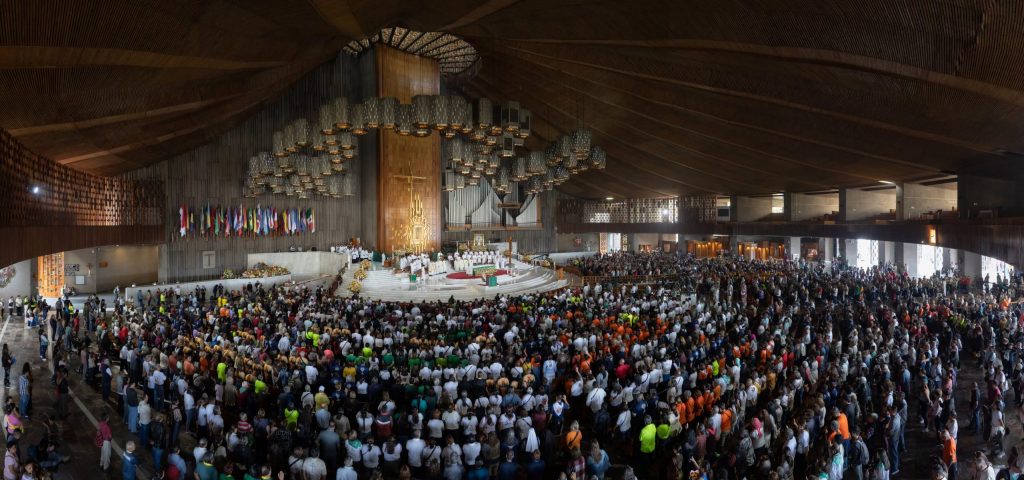
Meanwhile, secularization is advancing most rapidly in urban and border regions. Baja California, Quintana Roo and Mexico City report some of the country’s highest percentages of residents without religious affiliation, ranging between 11% and 22%. Sociologists frequently associate this trend with urbanization, migration, higher educational attainment, and greater exposure to diverse cultural influences.
For Mexico’s bishops, these changes require more than statistical analysis—they demand a renewed missionary vision. The Mexican Bishops’ Conference has repeatedly acknowledged that while Catholicism remains the nation’s principal religion, Mexico can no longer be described as religiously homogeneous.
Bishops argue that the appropriate response is not simply preserving existing structures but strengthening evangelization in a society where faith is no longer transmitted automatically from one generation to the next. Their priorities include deeper catechetical formation, greater pastoral outreach to young people, and a missionary Church capable of engaging an increasingly pluralistic culture. This approach reflects the pastoral emphasis encouraged first by Pope Francis and now continued under Pope Leo XIV, calling Catholics to become a Church that actively reaches people rather than waiting for them to return.
Despite the gradual decline in its percentage of adherents, Mexico continues to occupy a pivotal place within world Catholicism. Vatican statistical publications, including the 2026 Pontifical Yearbook and the 2024 Annuarium Statisticum Ecclesiae, project that the country now has approximately 101.3 million baptized Catholics, making it the second-largest Catholic nation in the world after Brazil, ahead of countries such as the Philippines, the United States, and Italy.
That apparent paradox reflects Mexico’s demographic reality. While Catholic affiliation has declined proportionally, population growth has allowed the total number of Catholics to remain extraordinarily high.
The emerging picture is therefore one of continuity and change. Catholicism remains deeply woven into Mexico’s cultural identity and continues to represent one of the largest concentrations of faithful anywhere in the world. Yet the steady expansion of other Christian communities, the growing number of people without religious affiliation, and the increasing diversity of beliefs suggest that the Church’s future will depend less on inherited tradition than on its ability to present the Gospel convincingly to a generation for whom religious commitment has become an increasingly personal choice.
Thank you for reading our content. If you would like to receive ZENIT’s daily e-mail news, you can subscribe for free through this link.

Publicaciones relacionadas:
 Durham University issues report on impact of abuse crisis on Catholic communities
 Pew Research Center Report Highlights Concerns Over Declining Religious Influence in America
 According to The New York Times, Progressive Priests Have No Generational Replacement in the American Clergy
 American Catholics are in favor of the death penalty. This is according to a recently published survey
