

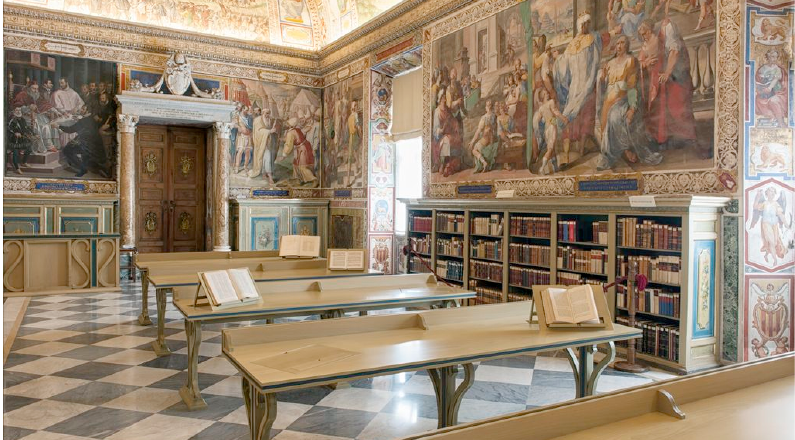
(ZENIT News / Vatican City, 07.12.2026).- On September 14 at 11:00 a.m., Pope Leo XIV will visit the Vatican Apostolic Library and inaugurate the exhibition “AQVA. Catastrophe and Wonder.”
The exhibition cycle “Catastrophe and Wonder,” has been made possible with the support of Fondazione Roma – with which a three-year institutional partnership will commence – and Intesa Sanpaolo. It represents a new chapter in the Vatican Library’s centuries-old mission of conservation and dissemination. The cycle reflects on natural elements as mirrors of humanity’s hopes and fears. These elements, which pose some of the greatest threats to the preservation of historical heritage – and thus to collective memory – become a universal allegory of humanity’s deepest anxieties about what lies beyond its control. This first installment focuses on water: starting from the perception of it as a threatening force, the narrative evolves into a path of reconciliation, ultimately restoring its significance as a vital resource.
“The Apostolic Library, together with the Apostolic Archive, is pleased to welcome the Holy Father, Pope Leo XIV, to inaugurate the exhibition cycle ‘Catastrophe and Wonder.’ These exhibitions are intended to foster dialogue between contemporary art and the Library’s centuries-old heritage. On several occasions, the Pope has emphasized fidelity to the past and fidelity to the future. The present – including the present of this exhibition – can become a home where past and future meet as friends. Through its own distinctive gestures, the Apostolic Library – the Library of the Apostle, the Library of the Pope – wishes to contribute to the building of this home,” explains the Librarian and Archivist of the Holy Roman Church, Monsignor Giovanni Cesare Pagazzi.
“After the tremendous critical and public success of the 2025 exhibition ‘En route,’ we are even more bold and curious to experiment in new ways of engaging with the contemporary world. We are convinced of the enduring relevance of what we preserve and of the importance of promoting it today. In Fondazione Roma and Intesa Sanpaolo, we found the same depth of vision, and it was easy to align our efforts. Collaboration with the Governorate and other offices of the Holy See has been equally fruitful,” adds the Prefect of the Vatican Library, Rev. Mauro Mantovani.
Created in collaboration with the French artist JR, the American typographer Bill Moran, and the Italian chef Fulvio Pierangelini – each of whom reinterprets the Library’s historical collections through their own artistic
practices – the exhibition is curated by Rev. Giacomo Cardinali, Simona De Crescenzo, Francesca Giannetto, and Delio Proverbio.
“The starting point of the entire exhibition cycle was Gaetano Volpi’s bibliophilic treatise ‘Del furore d’aver libri’ (1756), which lists the dangers that threaten the preservation of books: from water to fire, from light to animals, and even the damage inflicted by human beings themselves on their cultural heritage.
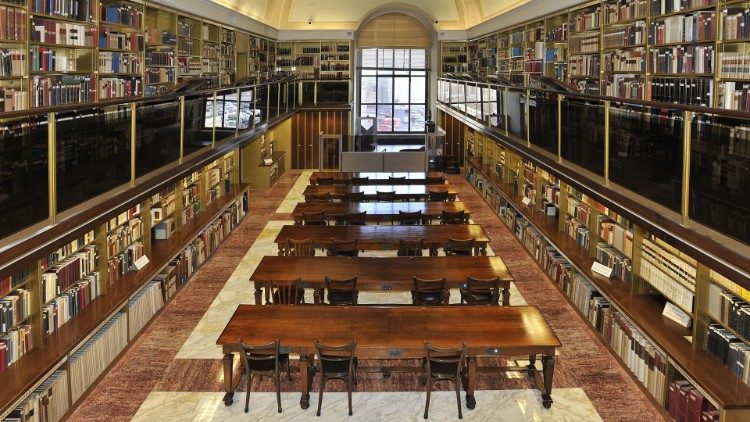
In the belief that, in the face of fear, it is wiser to pause and move through it, we enlisted three extraordinarily creative minds – an artist, a typographer, and a chef – and discovered unexpected horizons precisely within what usually frightens us.
The exhibition ‘AQVA’ also provides an opportunity to celebrate the 470th anniversary of the publication, financed and promoted by the Vatican Library, of the remarkable treatise on fish by the physician Ippolito Salviani, completed in Rome in 1557,” notes Rev. Giacomo Cardinali, Library Vice Prefect and Commissioner for Exhibitions.
About the Vatican Apostolic Library
The Vatican Apostolic Library is an ancient institution dedicated to preservation and research, belonging to the Pope and closely connected to the governance and ministry of the Holy See.
With historic ties to the papal Scrinium, the existence of which is documented as early as the 4th century, the Library began its modern history with Pope Nicholas V, who in the mid-15th century decided to open the papal book collections to scholars (“pro communi doctorum virorum commodo,” Letter of April 30, 1451), and with Pope Sixtus IV, who provided a more stable organizational structure with the Bull Ad decorem militantis Ecclesiae of June 15, 1475.
Its vast collections – comprising manuscripts, archival materials, printed volumes both ancient and modern, coins and medals, prints and drawings, as well as cartographic and photographic materials – have always been accessible to qualified scholars from around the world, regardless of race, religion, origin, or culture. The Library specializes primarily in philological and historical disciplines, and, retrospectively, also in theology, law, and the sciences.
Thank you for reading our content. If you would like to receive ZENIT’s daily e-mail news, you can subscribe for free through this link.

Publicaciones relacionadas:
 Charism, governance, and communion: Three reflections from the Pope to the consecrated lay members of Regnum Christi
 Leo XIV’s view of sport in a letter about the Winter Olympics
 Pope Leo XIV Speaks Again About Trump and the War (and It Is Announced That the Pope Will Carry the Cross Throughout the Stations of the Cross on Good Friday)
 Believing isn’t always easy; Pope Leo XIV knows this and offers a concrete “solution”
