

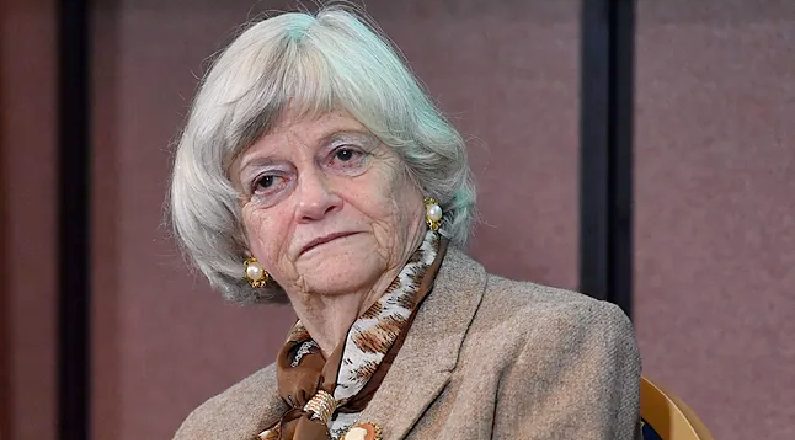
(ZENIT News / London, 07.13.2026).- The sudden death of Ann Widdecombe, one of Britain’s most recognizable Catholic public figures and an unwavering defender of the sanctity of life, has led to a murder investigation. The investigation has prompted tributes across the political spectrum while raising new questions about the circumstances surrounding the final hours of the former parliamentarian, whose outspoken Christian convictions shaped much of her public life.
Widdecombe, 78, was found dead at her home in Haytor, on the edge of Dartmoor in southwest England, after emergency services responded on July 9. Initial reports suggested she may have suffered a fatal fall, but forensic examinations led detectives from Devon and Cornwall Police to launch a homicide investigation instead.
Authorities believe the attack occurred approximately a day before her body was discovered. Investigators quickly secured the property for extensive forensic work and appealed to the public for information. Police have emphasized that there is currently no evidence pointing to terrorism or a politically motivated crime, although all investigative avenues remain under review.
The inquiry has already seen significant developments. An initial suspect was detained but later released, while investigators subsequently arrested another British man, aged 28, in Rotherham, South Yorkshire, more than 200 miles from the crime scene. He remains in police custody as detectives continue to piece together the events leading to Widdecombe’s death. Police have also indicated that they are not currently seeking any additional suspects.
For more than two decades, Widdecombe was a familiar presence in British politics. Representing the Conservative Party in Parliament from 1987 until 2010, she later returned to public life as a Member of the European Parliament with the Brexit Party, where she focused particularly on immigration and justice issues. Beyond politics, she became known to millions through television appearances, bestselling novels, and newspaper columns.
Yet for many Catholics, her public legacy extended well beyond Westminster.
Born into an evangelical family in 1947, Widdecombe entered the Catholic Church in 1993 after the Church of England voted to ordain women to the priesthood. She later explained that her decision reflected a search for doctrinal certainty after years of disappointment with what she perceived as growing theological compromise within Anglicanism.
In one of her final televised interviews, given to EWTN News in September 2025, she described what she considered the distinctive strength of Catholicism: its willingness to uphold objective truth even when doing so is unpopular. She also expressed optimism about the future of the Church, pointing to renewed interest among young people, increasing Bible sales, and the vitality of Catholic communities across Africa and other parts of the Global South.
Throughout her years as a Catholic laywoman, Widdecombe consistently defended Church teaching on the dignity of human life, marriage, and moral responsibility. She never married and often spoke about the gradual, lifelong nature of Christian conversion rather than viewing faith as a single defining moment.
The news of her death prompted expressions of sorrow from political leaders across ideological divides. Prime Minister Keir Starmer described the news as deeply shocking while urging restraint until investigators establish the facts. Conservative leader Kemi Badenoch condemned what she called a horrific attack and extended condolences to Widdecombe’s family and friends. Health Secretary James Murray, despite acknowledging political disagreements, praised her lasting contribution to British public life.
As detectives continue their investigation, many questions remain unanswered, including whether the suspect had any prior relationship with Widdecombe and what motive may have led to the killing.
For Britain’s Catholic community, however, the immediate focus has shifted from political debate to remembrance. Widdecombe leaves behind the memory of a public servant who never concealed the convictions that shaped her decisions. Whether speaking in Parliament, defending unpopular moral positions, or explaining why she embraced the Catholic faith, she consistently argued that authentic public service required fidelity to principles rather than changing cultural fashions.
Thank you for reading our content. If you would like to receive ZENIT’s daily e-mail news, you can subscribe for free through this link.

Publicaciones relacionadas:
 Cardinal Joseph Zen, Archbishop Emeritus of Hong Kong, Is Nominated for the Nobel Peace Prize
 USA: Five-Year Prison Term for Protesting Against Abortion
 Mexico: “The hardest is telling a child their father was killed,” says Michoacán religious sister
 The situation in Gaza as told by the parish priest of the only Catholic community in that martyrized land
