

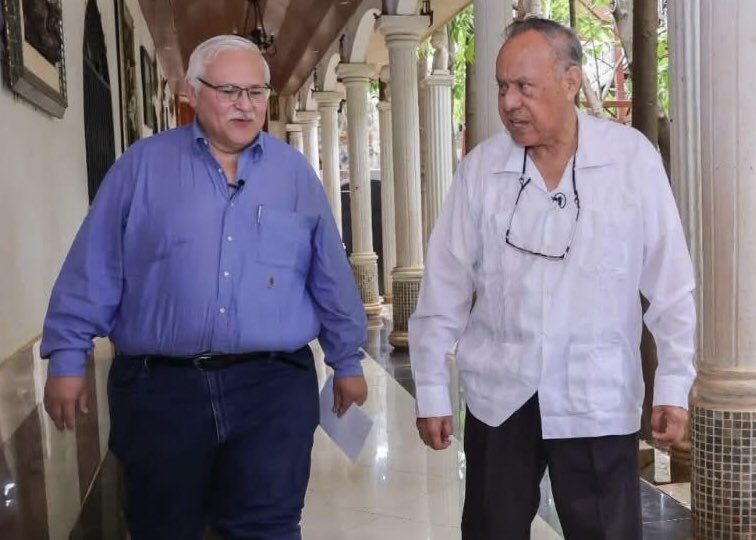
(ZENIT News / Manguam 08.14.2026).- More than 40 days after his detention and disappearance, Bishop Juan Abelardo Mata has appeared alive in a nine-minute video released by media close to Nicaragua’s government. The images show the 80-year-old retired Bishop of Estelí walking through a rural property, discussing plants, crops, reading and prayer. Yet the carefully presented appearance has answered only one of the questions surrounding his case — that he is alive — while leaving unresolved the more fundamental question of whether he is actually free.
The video surfaced shortly after the Inter-American Commission on Human Rights asked the Inter-American Court of Human Rights to expand protective measures for Mata and four people associated with him, describing the situation as one of extreme gravity and a potential risk of irreparable harm. Against that backdrop, the timing of the recording has inevitably attracted attention.
In the footage, Mata appears relaxed and in reasonable physical condition. A government-aligned journalist and ruling-party legislator Adolfo Pastrán accompany him as he speaks about his daily routine. Asked about his vitality, the bishop briefly replies that prayer helps greatly. He says that a brother and a niece have visited him and describes his existence at the property in Tisma, in the Masaya district, as a kind of monastic life centered on silence, study and prayer.
The presentation is striking precisely because of what it does not show.
There is no explanation of the circumstances surrounding Mata’s detention. Nothing is said about the days during which his whereabouts were unknown, about the interrogations reported after his arrest, or about whether police officers continue to restrict his movements. The video does not establish whether he is under house arrest or is genuinely free to leave the property.
That distinction is crucial.
Mata disappeared from public view after events at the end of June. On June 28, during Mass, he had asked for prayers for the persecuted Church in Nicaragua, as well as for Bishop Rolando Álvarez, who is now living in exile in Rome, and for priest Frutos Valle. He was detained the following day and again on June 30. For several days, there was no clear public account of his whereabouts. On July 4, the government said that he had undergone an investigation and was in “perfect condition” at his home.
The government said the investigation concerned the origin of properties and family relationships that it considered incompatible with his priestly status. Supporters of Mata, however, have described the episode as part of a much broader pattern of pressure against one of Nicaragua’s most outspoken Catholic critics.
#Nicaragua Regimen da prueba de vida de Monseñor Mata, diputado sandinista lo visita pic.twitter.com/bybiz7TEyn
— 100% NOTICIAS (@100noticiastv) August 12, 2026
The bishop’s age and health made the uncertainty particularly worrying. Mata uses a pacemaker, although in the newly released footage he briefly indicates that there is no problem with his medical checkups. The recording does not provide independent medical information, nor does it establish when it was filmed.
That absence of basic context has fueled skepticism among those who have followed the persecution of the Catholic Church in Nicaragua. Father Edwing Román, a Nicaraguan priest living in Miami, accused the government of using the video to present a carefully controlled version of events while omitting the circumstances of Mata’s detention and the reported police presence around the property.
Former Nicaraguan ambassador to the Organization of American States Arturo McFields Yescas likewise compared the episode with the regime’s previous treatment of Bishop Rolando Álvarez. In 2023, after international pressure for proof that Álvarez was alive, the government released photographs and video of the imprisoned bishop. Álvarez was eventually expelled from Nicaragua in January 2024 and now lives in Rome.
The parallel is significant because the issue is not simply whether a detained religious leader can be shown smiling before a camera. A genuine proof of life normally carries greater meaning when accompanied by verifiable information about a person’s legal status, physical freedom and ability to communicate without coercion.
For that reason, the new images should not be confused with a resolution of Mata’s case.
Mata, who led the Diocese of Estelí for more than three decades, from 1990 until 2021, has long been a critical voice in Nicaragua. His history makes the current episode part of a larger confrontation between the government and the Catholic Church, rather than an isolated dispute over property or personal circumstances.
The timing also gives the episode a deeply personal dimension. Mata was ordained a priest on August 15, 1976, meaning that the day the video emerged coincided with his 50th anniversary of priestly ordination. Nicaraguans living in exile marked the occasion with calls for Masses, rosaries and prayers for his life, health and freedom, including the traditional offering of “one thousand Hail Marys.”
The anniversary therefore became something more than a celebration of half a century of priesthood. For many Nicaraguan Catholics, it became an occasion to pray for a pastor whose own freedom remains uncertain.
There is an important distinction here that can easily disappear amid the propaganda battle: showing that a person is alive is not the same as demonstrating that the person is free. Nor does an apparently cordial conversation establish the circumstances in which it was recorded.
The government has provided images. What it has not provided is a transparent account of Mata’s detention, his current legal status, the conditions governing his movements and the date on which the video was filmed.
Until those questions are answered, the nine-minute appearance will remain less a conclusion than another chapter in the long confrontation between Nicaragua’s government and a Catholic Church that has repeatedly found itself under pressure.
Thank you for reading our content. If you would like to receive ZENIT’s daily e-mail news, you can subscribe for free through this link.

Publicaciones relacionadas:
 After one month of Nicolás Maduro’s imprisonment, the Venezuelan government restores Cardinal Porras’ passport
 Traditional Congregation Accused of “Brain Washing”: Superior Faces Prison
 Archbishop of Homs, Syria, after last weekend massacre: “We do not want more bloodshed”
 Chinese Communist government takes advantage of Pope’s death to unilaterally impose new bishops
