

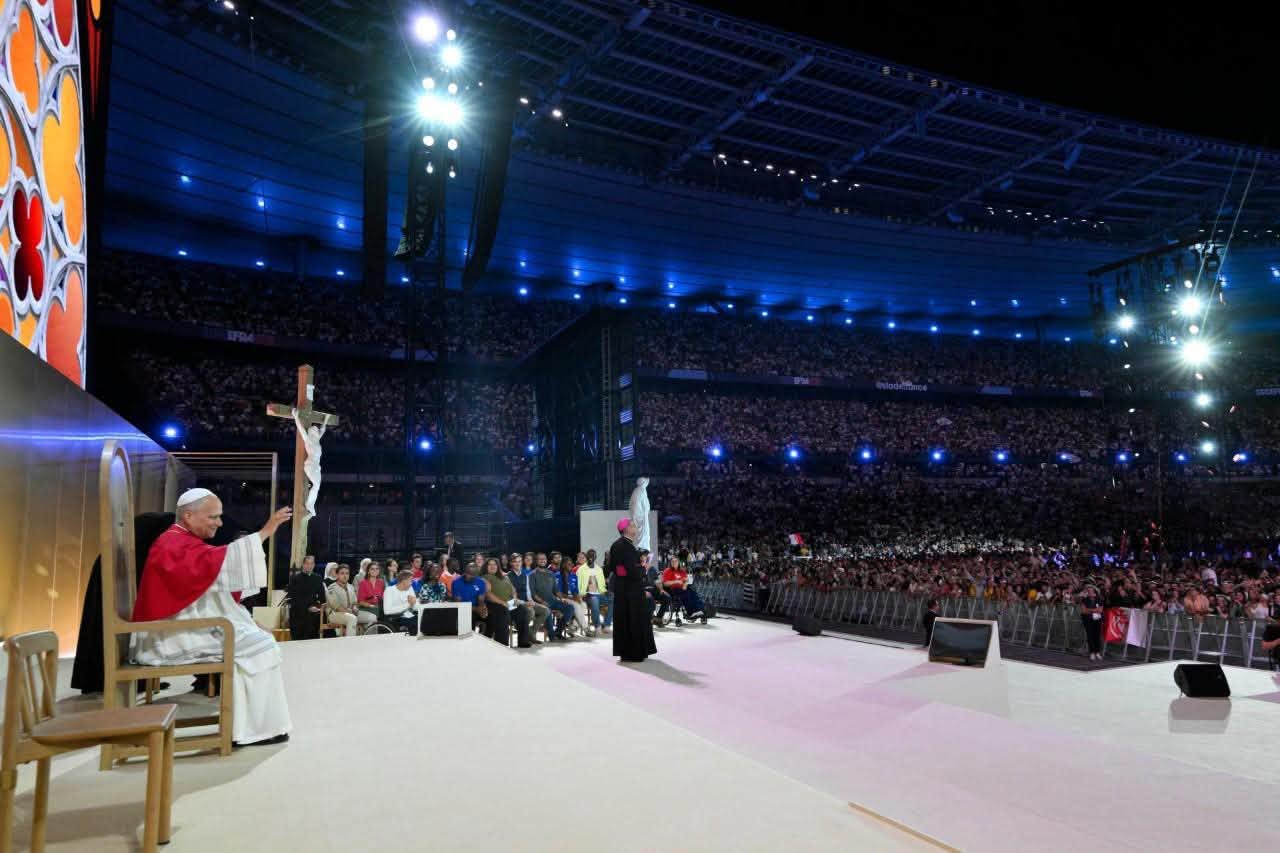
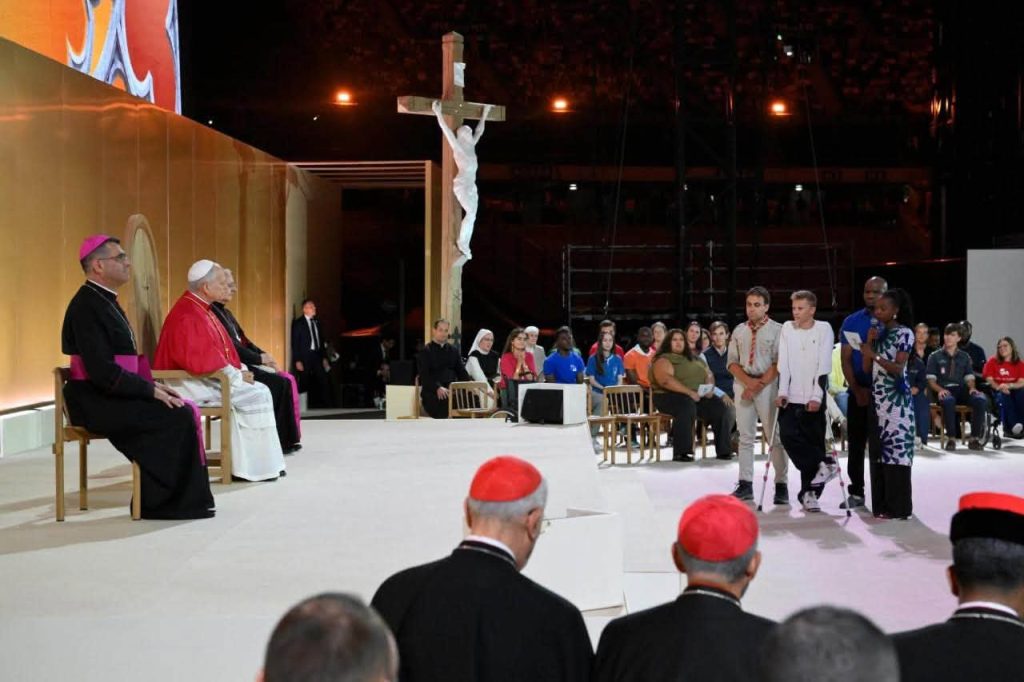
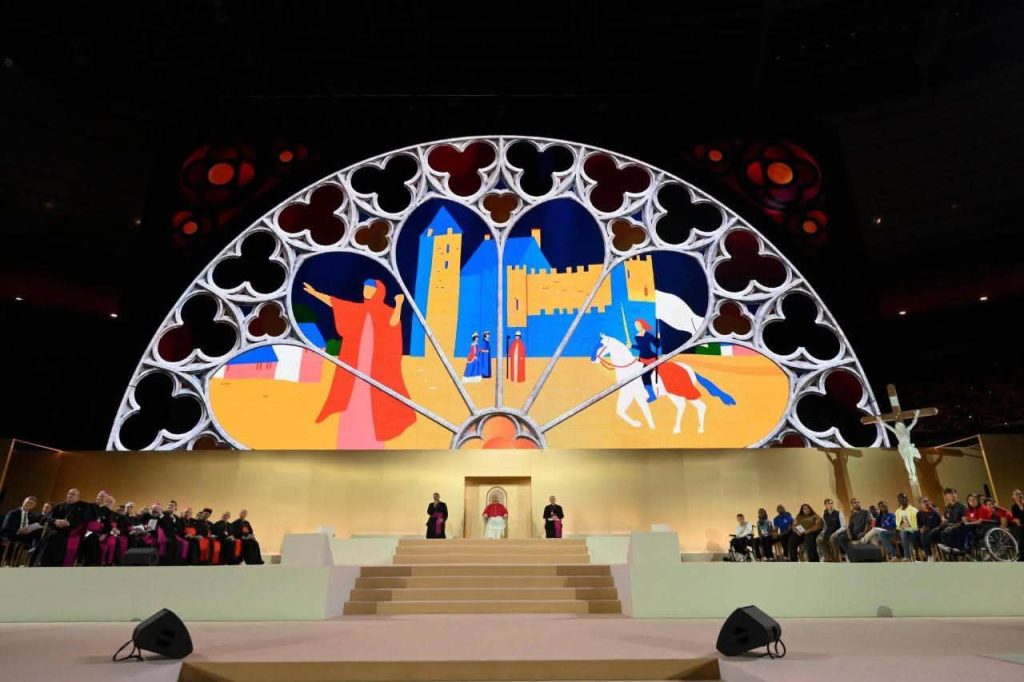
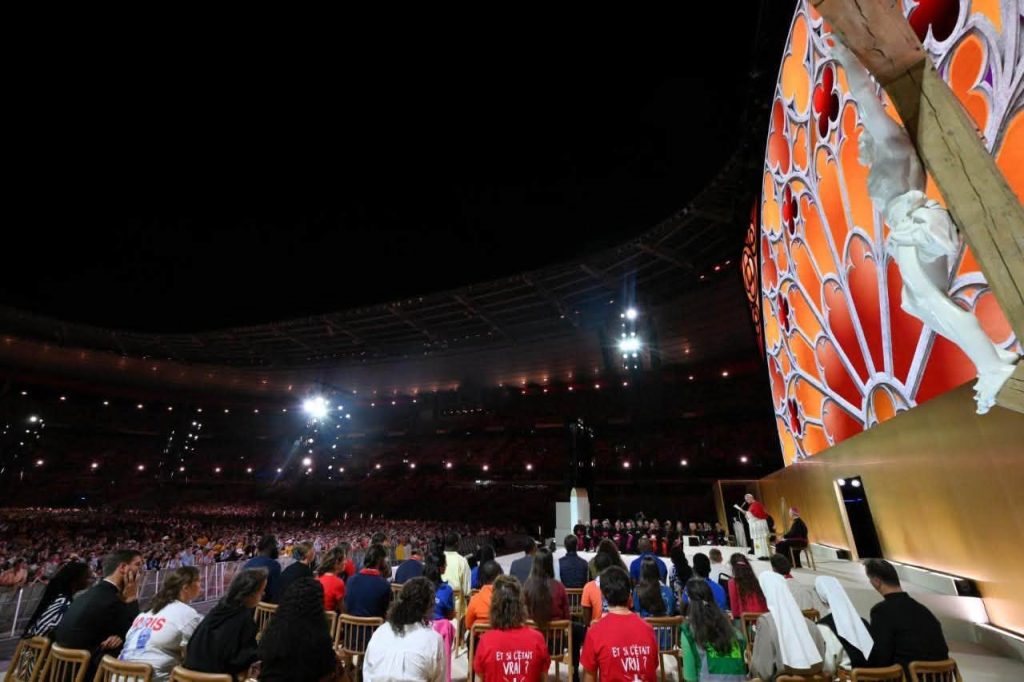
(ZENIT News / Paris, 09.25.2026).- Leo XIV concluded his first day in France with a massive gathering at the Stade de France: it was a prayer vigil attended by some 80,000 people, the vast majority of whom were young people from various French dioceses. The vigil began with a performance that traced the history of France through the lives of French saints: from the arrival of the siblings Mary Magdalene, Lazarus, and Martha, to Charles de Foucauld and Thérèse of the Child Jesus, including Martin of Tours, Joan of Arc, Louise de Marillac, Vincent de Paul, and many others. Two young people asked the Holy Father questions, and the Pope answered them. At the end, the Pope offered a reflection, which we present below, translated into English:
***
In the night the light shines all the more brightly. Thus, dear young people, we have heard together the words of Saint Paul. We want to hold them high, like a torch that illumines not only our prayers, but the whole history of the Church. The Apostle views his own time and receives divine inspiration, that is, the Holy Spirit, who always opens up bright prospects for the future. Yes, God is the Lord of history, and no matter what happens, he guides its course toward salvation. In Christ, every evil comes to an end, precisely because that end becomes the beginning of a new and eternal life.
Dear friends, in order to shed light on our times and transform the present in the light of the Spirit, let us remember first of all that, like Timothy, we are men and women of God. The expression “of God” used by Saint Paul, signifies a relationship, not possession. Whoever lives with God is free from everything that darkens life, rendering it empty and meaningless. Young people of France, you carry in your hearts an immense desire for freedom, a word that resonates loudly in your culture. But what is the source of true freedom? Jesus clearly reveals it when he tells us that it is the truth that will set us free (cf. Jn 8:32); and that he is the truth (cf. Jn 14:6). Here, then, is the source of true freedom: a living relationship with Jesus.
The Lord’s presence brings wisdom to our plans and beauty to the desires we hold in our hearts. God shines through our souls like a light, inviting us to a constant renewal, calling us to a conversion that gives full meaning to our lives, making us protagonists of a story that moves from confusion to the pursuit of truth, and from indifference to a commitment to justice. Saint Paul expresses this through three verbs that appeal to our freedom: to shun, to strive and to fight.
The Apostle writes to Timothy: first of all, “shun all this,” that is, pride, vanity, violence and greed (cf. 1 Tim 6:4, 11). These are feelings that take hold of us and possess us. The selfishness that characterizes them hides a frightening loneliness. To savor God’s closeness and human fraternity, we must reject desires that consume our relationships without giving anything in return or filling us with things that cannot nourish us. Such a lifestyle drives us to have everything, but to become no one; to receive countless “likes,” but to remain alone with ourselves.
When we decide not to follow that lifestyle, we then begin to strive toward “righteousness, godliness, faith, love, steadfastness and gentleness” (v. 11). Indeed, those who live with God strive for what is best: they are constantly growing. They seek virtue, namely that inner strength which makes us good and true. Dear friends, the dynamism that drives Christian life has a specific name: the path of holiness. It is the path that the Lord opens before each of us, accompanying us every step of the way. And how many sons and daughters of this beloved land of France have allowed themselves to be led along this path! Consider, for example, Blessed Marcel Callo, a young Frenchman, a boy scout and worker, who in the darkness of the concentration camp never ceased to strive toward the good, maintaining his interior freedom.
As we advance along this path of holiness, it becomes clear that it is not enough merely to shun evil: we must choose the good. This is not an abstract principle, nor is it a self-evident statement. Choosing the good is the proper act of freedom, by which it is realized, refined and matured. To make the right choices, remember this principle: the good gives life; it never takes it away. The good cares for others; it does not take for itself. The good is not simply a nice idea, but the radiant face of love: it is God himself. The virtues that Saint Paul indicates to us as reflections of God’s goodness include justice toward humanity, piety and faith in God, charity toward all, patience toward those who cause our suffering, and gentleness that characterizes those who seek peace with a pure heart. The principles of equality and fraternity that inspire your society find their foundation here. More than legal prescriptions, they are the radical and courageous choices of a free heart. Making these principles our own is not merely a moral commitment; it is choosing to become authentic men and women, free from every compromise.
In this regard, the Apostle gives us a third verb: to fight. Indeed, shunning evil and striving for the good implies fighting. To fight, yes, as Saint Paul did, who is often depicted with a sword in his hand, symbolizing the word of God, “the sword of the Spirit” (Eph 6:17). This verb resonates powerfully here in France, the land of Saint Joan of Arc, a young woman who knew how to fight with courage. But remember that the battle we are called to fight is that of faith, through our commitment to live according to the Gospel, as disciples of Jesus, the Son of God who makes us brothers and sisters. It is in his name that we receive the strength of the righteous to resist temptation. It is in his name that we have the perseverance of the meek to devote ourselves to doing good. Our battle is not a battle against others. It does not employ the weapons of violence, contempt or oppression. Our only weapon is that of self-giving love. Sadly, we know that there are forces that oppose our relationship with God, and powers that seek to divide individuals and peoples by pitting them against one another. These evils do not always unmask themselves in open violence, but at times appear in more insidious forms, for they promise the very thing they take away from us, namely our happiness. When we feel surrounded by their darkness, the light of the Holy Spirit enlightens us and comforts us. And so, tonight, let us choose together the virtues we must cultivate in order to follow the Lord.
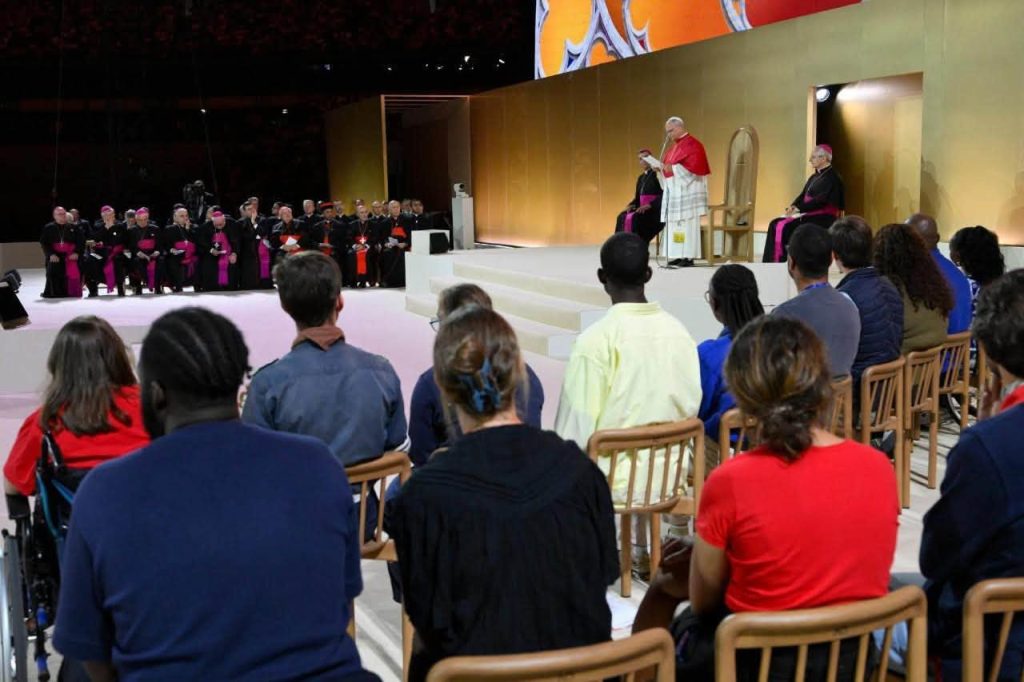
We are not alone on this path to holiness, for we walk it united with all our brothers and sisters around us. You are experiencing this yourselves tonight, as happens at great gatherings like World Youth Day. We also have the saints as our allies, supporting us in times of trial. Dear friends, when life’s choices require courage, seek the intercession of the saints and follow their example. As we have sung in the litanies, the encouragement of the saints assures us that we are never alone in prayer, and that we are never alone in the Church. In a particular way, let us now ask for their help to become peacemakers, which is the eternal desire of God for us, and humanity’s constant task. Tonight, I have mentioned some of the saints. Let us also ask Saint Thérèse of the Child Jesus to teach us her “little way” of daily love, the solid foundation of every lasting peace.
The Lord realizes this peace through the covenant that he establishes with all of us through the mediation of Jesus Christ. That is why, in pointing out the foundation of our experience of faith, Saint Paul speaks not only of what we can do in response to God, but also of what God does for us. The Apostle sums this up with an image of Jesus before Pilate, the truth of love confronting the hypocrisy of power. The “good fight” thus coincides with the “good confession” (cf. v. 12–13). This is demonstrated by the use of the same adjective kalos, which here means something well done. The work well done, the work that is good, is the redemption that Jesus accomplishes for us. Through his struggle against sin and death, Christ’s victory sets us free. He saves us from all evil and invites us to all that is good.
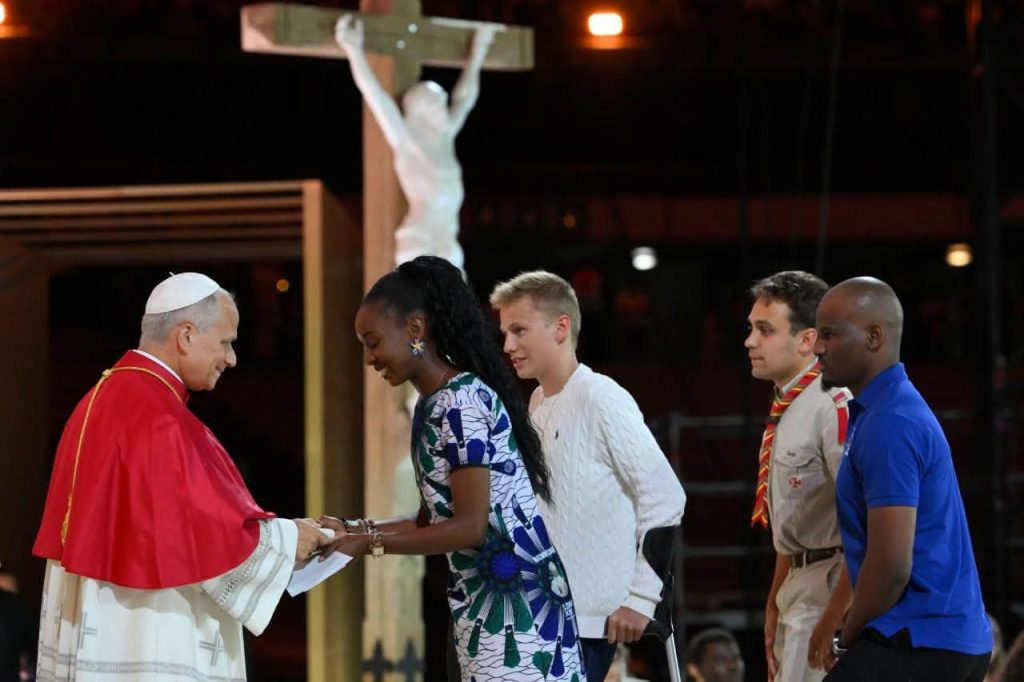
In this light, let us consider the two relics before us: the tunic and the cross. One was taken from Christ; the other was given to him. Both are signs of his passion. Jesus is stripped of his tunic so that he might clothe us in the white robe, washed “in the blood of the Lamb” (Rev 7:14). In this way, the cross, an instrument of death, becomes a sign of hope. Both the tunic and the cross, therefore, represent us as the Church, born of the life of God given to the world. Dear young people, in order to grow in holiness and improve our society, be radiant witnesses to this Gospel, to the good news that is Christ himself, our Savior: “To him be honor and eternal dominion. Amen” (1 Tim 6:16).
Thank you for reading our content. If you would like to receive ZENIT’s daily e-mail news, you can subscribe for free through this link.

Publicaciones relacionadas:
 “Reflect on the authenticity of your witness”: Pope Leo XIV to digital missionaries
 Neither the Sum of What We Have, Nor Algorithms, Nor Matter Assembled at Random: What Are We? Two Questions Posed in Pope Leo XIV’s Address to University Students
 How do you measure an athlete’s quality? León XIV’s answer
 Pope Leo XIV Breaks Records in France: In 24 Hours, Nearly 300,000 People Register for the Pope’s Visit to Paris
