

(ZENIT News / Gaza, 09.29.2026).- The Gaza Strip is a small Palestinian territory located on the eastern coast of the Mediterranean Sea, between Israel and Egypt. It is approximately 365 square kilometers long and between 6 and 12 kilometers wide. In other words, it is a very small and densely populated territory.
It is part of the Palestinian territories, alongside the West Bank and Jerusalem. Gaza shares borders with Israel to the north and east, Egypt to the south, and the Mediterranean to the west.
The war that began following the Hamas attacks on Israel on October 7, 2023, caused massive devastation in Gaza. A ceasefire ending large-scale hostilities came into effect in October 2025, yet by September 2026, that «truce» remains fragile; the United Nations reports attacks, access restrictions, and a security situation that is still highly unstable. Furthermore, the agreements intended for the disarmament of Hamas and other armed groups have not yet been fully implemented.
After nearly three years of war, a vast portion of Gaza remains destroyed or severely damaged. The United Nations notes that approximately two-thirds of the territory remains inaccessible or subject to strict access restrictions. Problems regarding housing, water, sanitation, electricity, healthcare, food, and employment persist.
Furthermore, the population has endured repeated displacement and a profound psychological impact, particularly the children. Therefore, reconstruction is not merely about erecting buildings; it means restoring basic services, education, psychological care, community ties, and a vision for the future.
And This Is Where the Catholic School Comes In
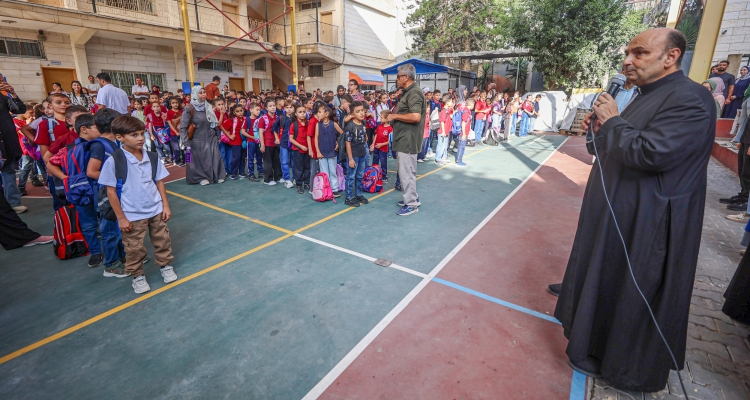
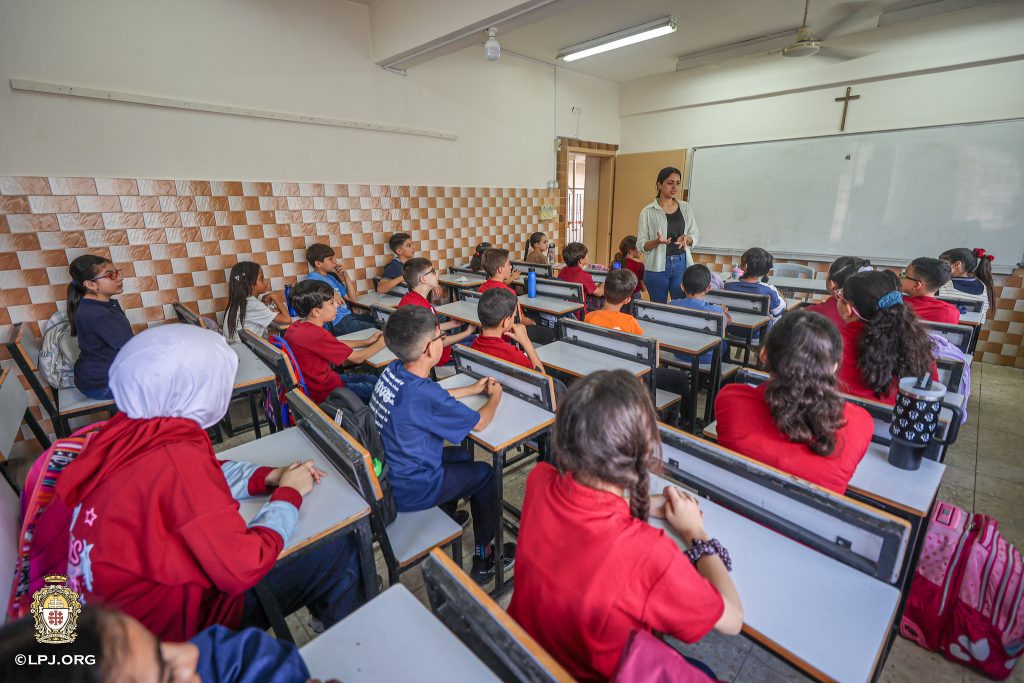
Against this backdrop, the reopening of the Latin Patriarchate of Jerusalem’s Catholic school, affiliated with the Holy Family parish, holds a significance that goes far beyond a simple return to classes.
Father Gabriel Romanelli, IVE, priest of the only Roman Catholic parish in Gaza, told Aid to the Church in Need (ACN) that the school’s reopening would be «like a light in the darkness for the local community, which has suffered so much.»
More than 450 people had been living in the school, seeking refuge from the Israeli attacks that followed the Hamas attacks; however, now that many of them have been able to return to their homes or find alternative shelter, the school can reopen its doors.
The Holy Family School serves not only the local parish but also the community at large, allowing Muslim and Christian students to learn together.
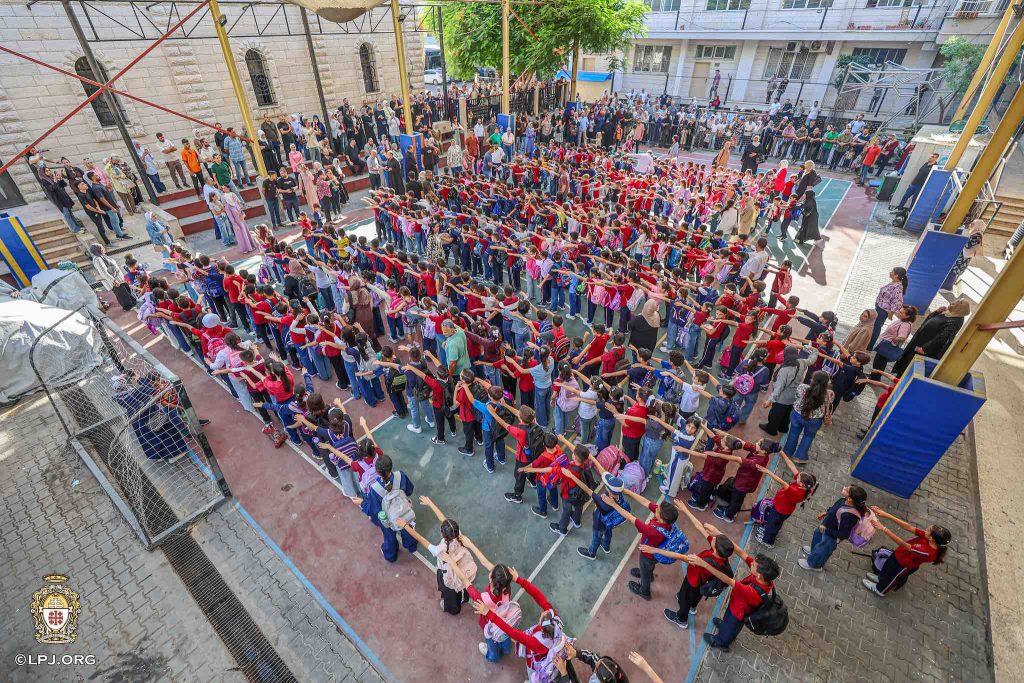
Before the war, five Christian schools operated in Gaza (three Catholic, one Orthodox, and one Evangelical), but the Holy Family School is, so far, the only one to have reopened; consequently, all Christian students, who make up about 13 percent of the student body, are attending this school.
George Akroush, Director of the Project Development Office of the Latin Patriarchate of Jerusalem, told ACN that this would create «a strong sense of community» and show the children «that the Church remains close to them, accompanying them amidst everything they are experiencing.»
Father Romanelli said: «There is practically nowhere in Gaza that hasn’t been destroyed; the destruction is everywhere. But we have worked hard to make the school a safe environment where the children, who have been through so much, can feel secure. For the students and their families, the reopening of the school will bring a certain sense of normality… even though nothing is normal in Gaza.»
He recounted that every Sunday, after the parish Mass, he takes the parishioners to the beach in Gaza City, «even though the water is full of rubble (all of Gaza is full of rubble), because we want the families to have a moment of recreation.»
Father Gabriel Romanelli also told ACN that the curriculum had to be redesigned to account for the level of trauma suffered by both students and teachers: «Many of the teachers are so traumatized that it is almost as if they were not the same people we knew before the war began. We had never included psychosocial support in the school program before, but now it will be an important part of what we do with the children and the teachers.»
The school will also remain open after classes each day for extracurricular activities, offering a refuge to children who have «nothing to do and nowhere to go.»
«When people see the 1,000 students arriving at school in their uniforms, they realize there is a future,» concluded Father Romanelli.
A United Nations report published this year states that the war has «destroyed the very essence of childhood» in Gaza, causing the deaths of at least 20,179 children and leaving 44,143 injured. The territory has the highest number of child amputees in the world.
It is heartening to see that, after nearly three years of war, a Catholic school in Gaza is reopening its doors to welcome more than a thousand children. There, Christian and Muslim children alike are finding a space once again to learn, live together, and look toward the future.
Cardinal Pierbattista Pizzaballa, Latin Patriarch of Jerusalem, has emphasized a point that perfectly captures the significance of this reopening: «Without providing education to children, how can there be hope?»

Publicaciones relacionadas:
 Convert Jew Is Baptized in Madrid While His Son Prepares for His First Communion
 Beautiful Stories of Priestly Longevity! These Are the Greatest Priests in the World
 World War II Veteran Baptized Shortly Before Turning 100
 «Entrepreneurial Nuns»: The Inspiring Creativity of Women of God That Has Changed Hundreds of Lives for the Better
