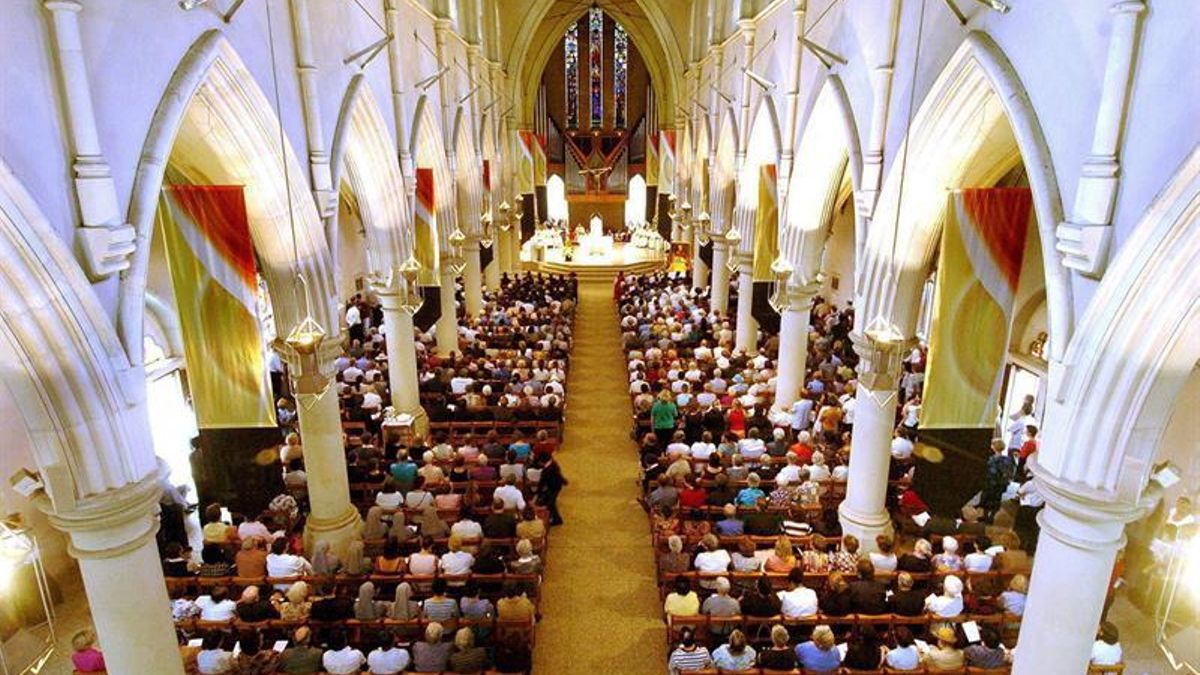
(ZENIT News / Rome, 11.11.2026).- A new study commissioned by Australia’s Catholic bishops has uncovered a significant pastoral paradox: many Catholics who rarely attend Sunday Mass remain deeply attached to their faith, pray regularly and continue to believe in central Christian teachings. The challenge for the Church, therefore, may not simply be to bring people back through the doors of its churches, but to understand why a faith that still matters to them no longer consistently shapes their weekly lives.
Published on October 7, 2026, the 176-page report, “Absent from the Table: Catholics in Australia Who Do Not Regularly Attend Sunday Mass,” draws on an online survey of 1,963 adult Catholics across seven Australian states and territories, followed by in-depth interviews with 67 volunteers. Conducted by the National Centre for Pastoral Research in Canberra, the project builds on a similar investigation published in 2007. Its authors caution that participants volunteered for the study, so the findings cannot automatically be treated as representative of all Australian Catholics.
Nevertheless, the figures offer a revealing picture of belief beyond regular church attendance. Some 65% of participants said faith was very important in their lives, while 64% prayed regularly. More than three-quarters expressed belief in Jesus as the Son of God, and 55% affirmed the Catholic teaching that Christ is truly present in the Eucharist. By contrast, 24% regarded the Eucharistic elements as symbolic, and 21% were unsure about the doctrine.
Catholic identity also continued to find expression outside Sunday worship. Forty-four percent said they sent their children to Catholic schools, 40% shared their faith with others, and the same proportion displayed religious symbols or used them in their homes. Meanwhile, 39% volunteered in the wider community and 29% served in their parishes. Irregular attendance, the findings suggest, does not necessarily amount to a rejection of Christianity or a complete withdrawal from Church life.
Yet the scale of the wider decline is difficult to ignore. According to the report’s demographic background, Catholics represented 20% of Australia’s population in the 2021 census, down from 26% in 2006. Their total number fell to 5,075,910 in 2021, reversing a century-long period of growth that had peaked at 5.4 million in 2011. The proportion of Catholics attending Mass declined from 11.8% in 2016 to 8.2% in 2021. Among those attending in 2021, 25.8% were over 70, while just 9.5% were aged between 18 and 29.
The report identifies 14 broad reasons for irregular attendance, ranging from personal circumstances to dissatisfaction with Church life. Illness, old age, transport difficulties, family responsibilities and competing priorities can all interfere with attendance. But the researchers also highlight questions about liturgical quality, relationships with priests, abuse of ecclesiastical authority, disappointment with Church leadership, feelings of exclusion and the perception that Catholicism has become disconnected from contemporary life.
Some of these concerns have become more prominent since the previous study. The effects of the COVID-19 pandemic, including changes in worship habits and a greater reliance on personal prayer, online Mass, nature and service to others, have reshaped spiritual routines. The report also identifies a desire for community that is not always being met by parish life, as well as concerns involving priests born overseas and parishes where Sunday Mass is not celebrated every week.
Australia’s Indigenous questions have introduced another source of division. Some respondents were disappointed by what they saw as a lack of unified Church support for the 2023 referendum on an Indigenous advisory body to Parliament. Views also differed over the practice of acknowledging the traditional custodians of the land before Mass: some participants felt uncomfortable with its inclusion in liturgical settings, while others were troubled when priests discouraged it, seeing that stance as inconsistent with Catholic social teaching and reconciliation.
The report does not offer a single remedy. Instead, it records requests for more convenient Mass times, shorter services, better music, clearer explanations of the liturgy and preaching that connects the Gospel with everyday experience. Participants also called for stronger relationships within parishes, more accountable leadership and a Church that is welcoming without leaving people feeling that their questions or difficulties are unwelcome.
Bishop Greg Bennet, vice-president of the Australian bishops’ conference, said the findings should encourage the Church to accompany people rather than simply label them as lost or disaffected. Archbishop Anthony Ireland of Hobart, meanwhile, posed a sharper question: Australians returned to football stadiums and tennis crowds after the pandemic, so why had Sunday Mass not regained its place in their routines? His answer was that the Church must help people rediscover the Eucharist as something worthy of being central to their lives, through meaningful catechesis, beautiful liturgy and authentic leadership.
The International Eucharistic Congress scheduled for Sydney in 2028 could provide an opportunity to respond to these concerns. Renée Köhler-Ryan, deputy vice-chancellor of the University of Notre Dame Australia, argued that a renewed emphasis on inspiring liturgy, bringing together the ancient and contemporary dimensions of belief in Christ’s Eucharistic presence, should form part of that effort.
The report ultimately exposes a tension that cannot be resolved by statistics alone. For Catholics, Sunday Mass is not merely one religious activity among many; it is the central communal celebration of the Eucharist, and the Church teaches that Catholics are obliged to attend on Sundays and holy days of obligation. The persistence of belief among irregular attendees therefore raises a question deeper than convenience: how can parishes help people reconnect their personal spirituality with the sacramental and communal life of the Church?
The findings suggest that a strategy based solely on urging people to attend more often will be insufficient. But neither do they imply that the importance of Sunday worship can simply be set aside. The challenge is to address genuine obstacles and failures of pastoral care while renewing an understanding of why the Eucharist matters. Australia’s bishops have been given a substantial body of evidence; the next test will be whether the Church can turn those voices into lasting pastoral change.
Thank you for reading our content. If you would like to receive ZENIT’s daily e-mail news, you can subscribe for free through this link.