

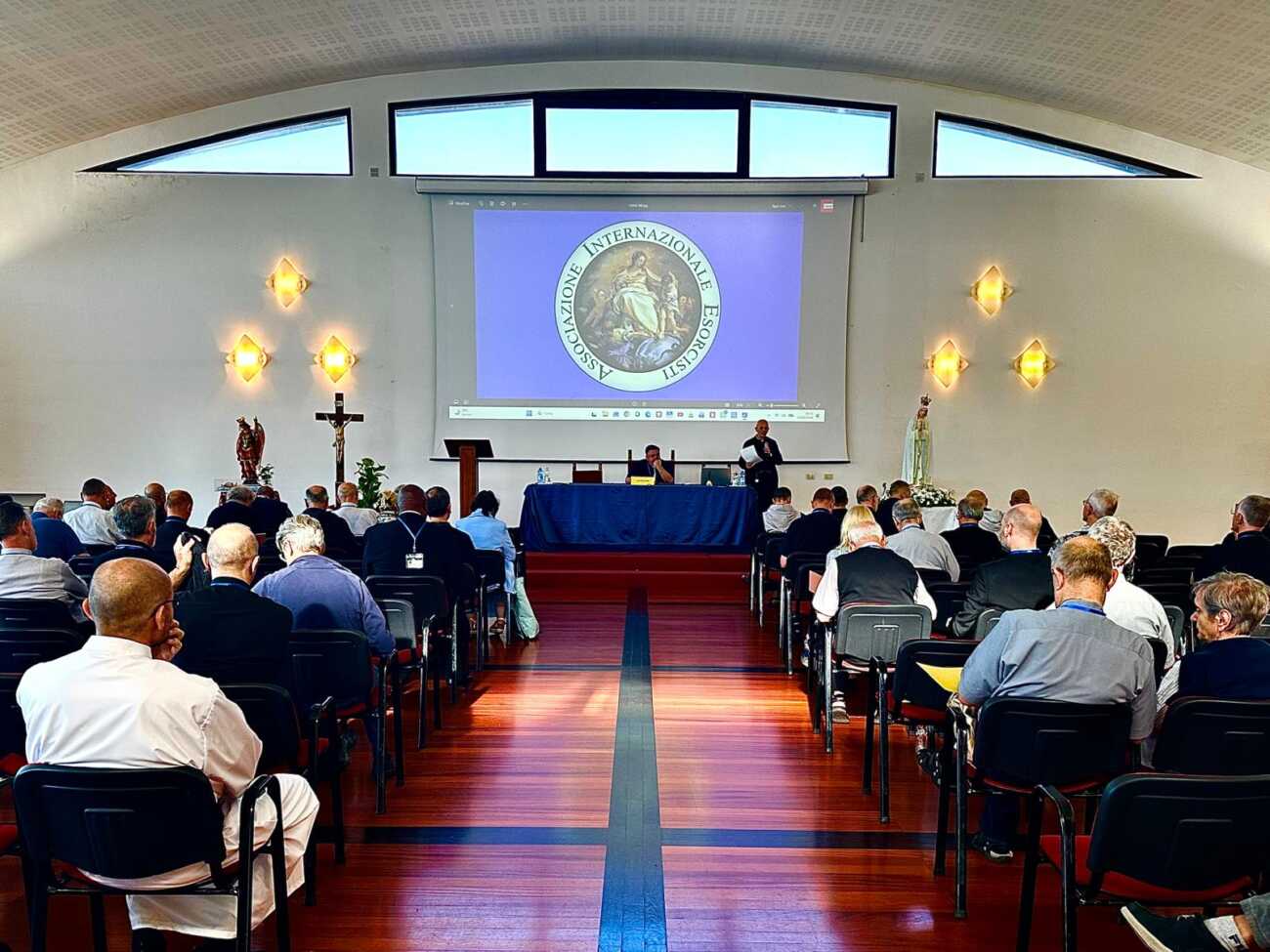
(ZENIT News / Rome, 11.10.2026).- Around 120 Catholic exorcists and priests who assist in the ministry gathered in Sacrofano, near Rome, from September 21 to 25 for the 15th Italian National Conference of the International Association of Exorcists. The meeting combined accounts of difficult pastoral cases with theological reflection on the Virgin Mary, sacred music and the spiritual formation required for a ministry that the Church considers both sensitive and demanding.
The conference, held every two years in alternation with the association’s international meeting, also marked the tenth anniversary of the death of Father Gabriele Amorth, the celebrated Roman exorcist who founded the organization. His legacy provided a recurring theme: the conviction that a priest cannot be adequately prepared for exorcism simply by receiving a bishop’s appointment and the Church’s ritual.
Father Francesco Bamonte, the association’s vice president, recalled Amorth’s insistence on continued training. Without practical experience and proper preparation, he argued, a newly appointed exorcist would resemble an inexperienced surgeon. The association’s work therefore includes ongoing formation, discernment and guidance in the use of the Church’s authorized rites.
This institutional dimension is significant because, as Father Piermario Burgo explained during the meeting, exorcism is not an informal religious practice. It is a specific ecclesiastical ministry entrusted to a priest with the bishop’s permission, and it requires the consent of the person seeking help.
Several priests presented cases that, in their interpretation, illustrated the complexity of this work. Father Benigno Palilla, an exorcist of the Archdiocese of Palermo, described a young woman who, according to his account, was freed after two and a half years of possession. The association reported that she had experienced intense hostility toward others and self-hatred, including suicidal thoughts. Palilla said that her recovery culminated on the liturgical memorial of Saint Pio of Pietrelcina and that, after committing herself fully to God, she experienced profound inner peace and a renewed desire to live.
Father Angelo Barra of the Diocese of Salerno recounted the case of another young woman who had suffered domestic abuse. After returning from a trip, she began experiencing severe physical pain that intensified during Mass. According to the association, the reading of passages from chapter 16 of the Acts of the Apostles, together with blessings and the prayers of two Catholic communities in Africa, formed part of the process that the priest understood as her liberation. The woman subsequently reported having undergone a ritual consecration by a sect at the place she had visited.
A third account, presented by Father Michele Tenzon, a former exorcist in the Sanremo-Ventimiglia diocese, concerned a South American woman whose relatives had allegedly dedicated her to spirits. Tenzon emphasized the importance of an authentic Christian life, continued priestly formation and Marian intercession.
These accounts were presented as testimonies within the association’s pastoral framework, rather than as independently verified clinical findings. The conference materials linked some cases to occult practices, spiritism and estrangement from the sacraments. Such claims reflect the participants’ religious interpretation of the experiences described; they do not establish that mental or physical suffering is necessarily evidence of demonic activity. The reference to suicidal thoughts in one case also underscores why spiritual accompaniment must not be confused with a substitute for appropriate medical or psychological care.
Beyond individual cases, the conference examined two elements that participants regard as important in Catholic spiritual life: devotion to Mary and sacred music. Father Salvatore Perrella, a Servite theologian and former dean of Rome’s Marianum theological faculty, situated the Virgin within the mystery of the Incarnation and the Church’s understanding of salvation. Mary’s importance, he argued, rests on her fidelity to God and her intercessory role, through which Christians pray for the triumph of good over evil.
Father Giuseppe Grassi, an exorcist who directs the sacred music office of the Archdiocese of Brindisi-Ostuni, discussed the use of music and singing in exorcism. He described sacred music as closely connected to the liturgy and to the Church’s anticipation of heavenly worship. The tradition ranges from the Psalms and Gregorian chant to popular hymns in honor of Mary. In this understanding, music is not a magical instrument but part of the wider prayer of the Church.
The meeting also placed exorcism within the broader theological vision of the priest’s union with Christ. Father Marcello Lanza of the Diocese of Acerra argued that the ministry must remain rooted in spiritual theology and in conformity with Christ, whom Christians understand as the liberator from evil. During a Mass, Cardinal Baldo Reina, the pope’s vicar for the Diocese of Rome, similarly described the exorcist as an instrument of God’s liberating mercy, called to accompany people in suffering.
Other presentations widened the discussion to the risks associated with occult groups and ritualized violence. Father Aldo Buonaiuto, an exorcist of the Diocese of Rome who is responsible for the anti-sect service of the Pope John XXIII Community, warned against manipulation by esoteric practitioners and the appeal of supposedly supernatural powers. He identified fascination with the occult, personal ambition and the devaluation of emotional relationships among the attitudes and circumstances he considered dangerous.
Jesuit theologian Father Mario Imperatori examined the documentary Les Survivantes (2024), directed by Pierre Barnérias, which recounts the experiences of eight women who say they suffered abuse within an international pedophilia network. He explored possible historical, cultural and theological interpretations of such phenomena. Criminologist Beatrice Ugolini, a consultant to the Italian Church’s research group on sects and new religious movements, concluded the conference with an examination of ritual violence in occult settings, including sacrificial practices and acts of initiation that may involve severe harm.
Ten years after Amorth’s death on September 16, 2016, the association he founded continues to present exorcism as a specialized pastoral responsibility rather than a spectacle. The conference’s central message was that the ministry requires ecclesiastical oversight, careful discernment, sustained formation and a clear focus on Christ. For its participants, confronting evil is inseparable from accompanying vulnerable people with prayer, responsibility and respect for their dignity.
Thank you for reading our content. If you would like to receive ZENIT’s daily e-mail news, you can subscribe for free through this link.

Publicaciones relacionadas:
 Pope Francis removes Belgian bishop convicted of abuse from the clerical state
 U.S. Survey Studies Honesty and Ethics in the Clergy
 Papua New Guinea’s Christian Nation Declaration Sparks Concern Among Catholic Leaders
 After Two Failed Attempts to Execute Christa Pike, Tennessee Bishops Ask Whether Justice Requires Another Death
