

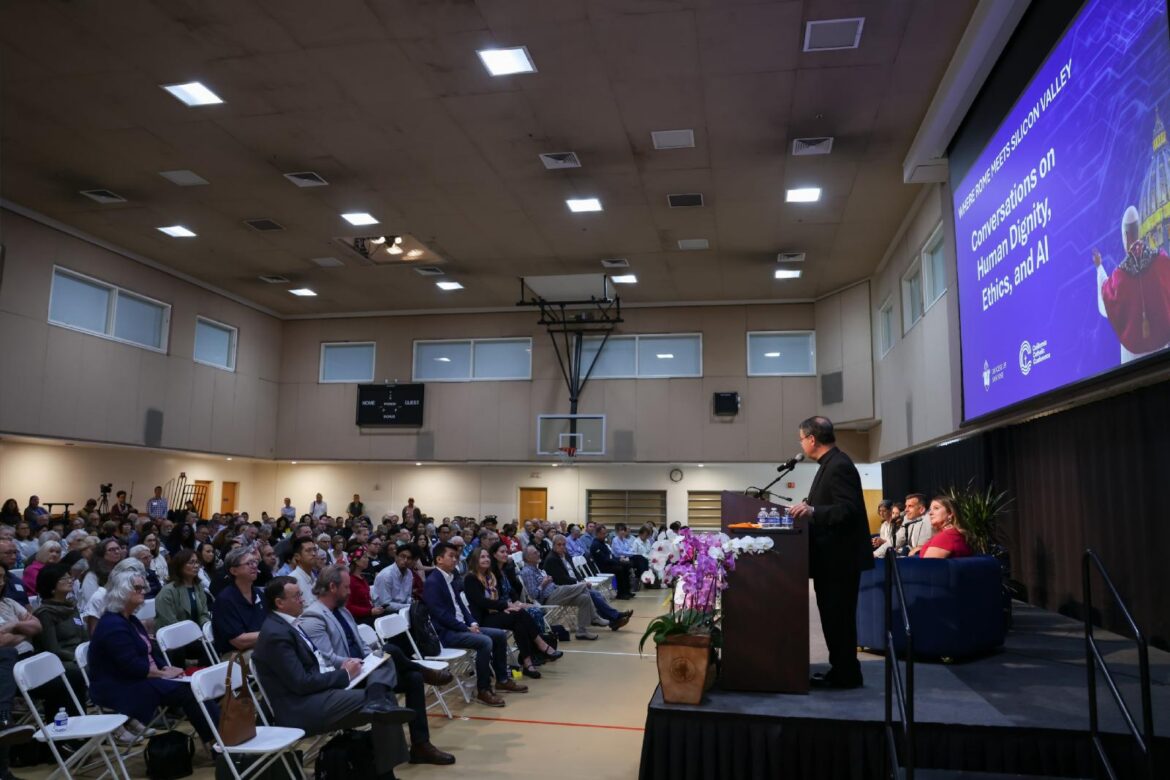
(ZENIT News / Washington, 10.21.2026).- As artificial intelligence advances from a tool for automating tasks to a force reshaping education, employment, public life and even personal relationships, Catholic bishops in the United States and Europe are pressing for a question that Silicon Valley and political leaders cannot answer through technical innovation alone: what must technology never be allowed to take away from the human person?
The parallel initiatives emerged in October on opposite sides of the Atlantic. On October 16, the United States Conference of Catholic Bishops (USCCB) announced the membership of a new task force dedicated to preserving human dignity in the age of artificial intelligence. Two days earlier, European bishops had begun their autumn plenary assembly in Brussels, held under the theme “Magnifica Humanitas: Europe, Human Dignity and the Common Good.” Their final declaration called on the European Union and its member states to ensure that AI remains at the service of humanity, the common good and peace.
Although their approaches differ, both initiatives reflect the same conviction: technological capability does not, by itself, establish moral legitimacy.
The American task force, chaired by Bishop Oscar Cantú of San José, California, brings together eight bishops and three academic consultants. Its members include Cardinal Blase J. Cupich of Chicago, Archbishop Paul D. Etienne of Seattle, Archbishop Shelton J. Fabre of Louisville, Bishop Barry C. Knestout of Richmond, Auxiliary Bishop James Massa of Brooklyn, Bishop Michael F. Olson of Fort Worth and Auxiliary Bishop Slawomir Szkredka of Los Angeles.
The three consultants are Charles Camosy, professor of moral theology and ethics at The Catholic University of America; Kim Daniels, director of Georgetown University’s Initiative on Catholic Social Thought and Public Life; and Meghan Sullivan, professor of philosophy and director of the Institute for Ethics and the Common Good and the Ethics Initiative at the University of Notre Dame.
Their mandate extends beyond the Church’s internal use of digital tools. The bishops intend to promote policies and practices that protect human dignity, religious freedom, democratic institutions, workers, families and vulnerable populations. They also plan continuing dialogue with advanced AI laboratories, research organizations, academic centers and other stakeholders across the country.
The initiative follows discussions held in September between American bishops, technology executives and AI experts. Those meetings sought to identify how the Church might contribute to the moral foundations of AI systems and encourage safeguards against their misuse, particularly through meaningful human oversight.
The wider intellectual framework comes from Pope Leo XIV’s encyclical Magnifica Humanitas, which calls for cooperation and a shared culture of responsibility in confronting the challenges posed by artificial intelligence. The bishops are thus positioning the Church neither as an opponent of technological progress nor as a passive observer of developments driven by commercial interests.
Bishop Olson has articulated the distinction particularly forcefully. “The Church participates in this dialogue as a teacher, not a spectator,” he told EWTN News, arguing that two millennia of Christian reflection on human dignity, work, relationships and truth have something substantial to contribute. The Church, he added, will listen to Silicon Valley without allowing the technology industry to determine its understanding of the human person.
For Olson, the principle becomes concrete when AI enters areas that demand trust, discretion and personal responsibility. The Diocese of Fort Worth had already adopted AI policies before the publication of Leo’s encyclical, he said. Artificial intelligence may assist human judgment, but it must not replace it—least of all in the care of souls.
Confession and spiritual direction, he insisted, must never be entered into AI tools. Homilies and pastoral counsel should emerge from a priest’s own prayer and discernment, while consequential decisions about hiring, discipline and the distribution of assistance must remain in human hands.
These restrictions address a concern that extends beyond Catholic institutions. AI systems can imitate empathy, generate persuasive advice and process enormous quantities of information, but their ability to reproduce the language of human relationships does not make them substitutes for genuine personal responsibility. In pastoral settings, where confidentiality and spiritual trust are fundamental, the distinction is especially important.
Olson has also highlighted risks affecting people with little power to challenge technological abuse: older people and those with disabilities targeted by scams, children drawn into artificial relationships with chatbots, and students who surrender intellectual work to AI systems rather than developing their own critical-thinking abilities. His warning is uncompromising: if a technology cannot be made safe for society’s most vulnerable, it is not ready for the market.
Bishop Knestout, another member of the task force, has similarly argued that Catholics have a responsibility to defend human dignity as AI becomes increasingly embedded in everyday life. The technology’s rapid development, he noted, raises fundamental questions about what it means to be human and to be created in the image of God.
Europe’s bishops have approached the challenge through a broader appeal for public policy and international governance. Their declaration recognizes AI’s potential to advance human development and the common good while warning that its expansion raises profound anthropological, ethical, social and legal questions.
The bishops urge the European Union to take a leading role in AI regulation and development, strengthening Europe’s digital capabilities and contributing to research and design that place the human person at the center. They also call for international cooperation to uphold human rights, prevent harmful applications and ensure that the benefits of AI are distributed fairly.
Their declaration establishes eight guiding principles: human dignity and personal agency must remain paramount; innovation should be directed by the common good, solidarity, subsidiarity, care for creation and justice; AI must be subject to responsibility, transparency and accountability; and it must not become a vehicle for discrimination, exclusion or manipulation.
The remaining principles address the danger of reducing people to data or commodities, the need for responsible governance of shared digital resources, the protection of democracy and the rule of law, and the obligation to make AI contribute to peace and human fraternity.
Taken together, the two initiatives expose a central tension in the AI revolution. The same systems that may improve medical services, education, communication and administrative efficiency can also magnify fraud, weaken intellectual independence, facilitate manipulation and concentrate power in institutions that are difficult for ordinary citizens to hold accountable.
The Catholic response does not require rejecting innovation. Rather, it insists that efficiency and profitability cannot be the sole measures of progress. A system that performs a task faster may still be harmful if it undermines privacy, discriminates against vulnerable people, displaces human judgment or erodes the relationships on which families and communities depend.
Thank you for reading our content. If you would like to receive ZENIT’s daily e-mail news, you can subscribe for free through this link.

Publicaciones relacionadas:
 Aparecida, the Most Important Brazilian Shrine, Suspends Placement of Rupnik’s Mosaics
 Jesuits of Nicaragua Are Left on the Street: In Addition to the University, They Are Thrown Out of Their House
 Pope’s “Gift” to Trump? Holy Father Appoints a New Archbishop for Washington, DC
 UK: Bishop Hendricks urges responsible use of artificial intelligence
