

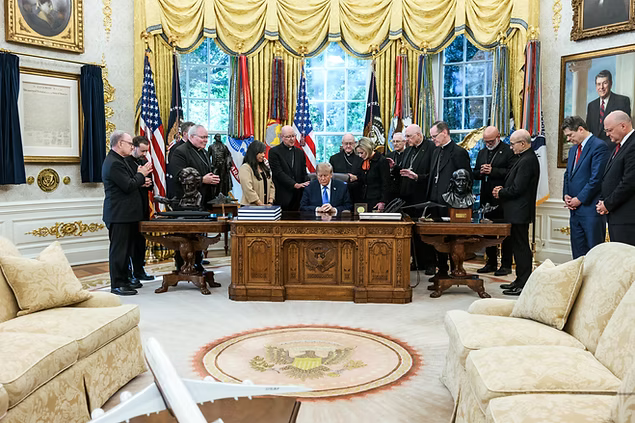
(ZENIT News / Washington, 10.26.2026).- After twelve bishops prayed with Donald Trump in the Oval Office on October 22, several participants said the White House had used the moment for partisan purposes, while Archbishop James Golka of Denver defended his decision to take part, insisting that prayer for political leaders is a pastoral duty, not an endorsement.
The controversy comes at a less than two weeks before the November 3 midterm elections. A recent Pew Research Center survey found that Trump’s approval rating among American Catholics had fallen from 47% at the beginning of his second term to 30% in October. His administration has championed policies welcomed by many conservative Catholics, including measures concerning religious liberty and the protection of unborn life, but its immigration enforcement and the president’s earlier public attacks on Pope Leo XIV have strained relations with other parts of the Catholic community.
The gathering was not organised by the U.S. Conference of Catholic Bishops (USCCB), which said it had played no role in the meeting. Rather, it followed earlier discussions involving the White House Office of Faith, where religious leaders had raised concerns about immigration, religious-worker visas and religious freedom. According to Golka, those conversations had produced working groups and some progress, giving him reason to believe that a further meeting could serve a practical purpose.
The bishops spent approximately three hours in discussions with administration officials, addressing immigration, school choice, family tax credits, religious liberty, the protection of life and visas for religious workers. The group included Archbishop Jeffrey Grob of Milwaukee, Bishop William Joensen of Des Moines and several other Latin- and Eastern-rite Catholic leaders. The participants were subsequently brought to the Oval Office, where Trump invited them to pray with him. Golka, who had become archbishop of Denver in March, was asked shortly before the encounter to lead the prayer.
What followed was far more public than some of the bishops had expected. Margo Martin, a White House communications adviser, released video of the prayer, while the administration highlighted the meeting as evidence of Trump’s support for Catholic concerns. White House religious affairs director Jenny Korn said the discussion had addressed substantive issues rather than simply providing a photo opportunity. Trump later described the encounter as a pleasant meeting in which the bishops had mainly prayed.
Archbishop Grob offered a sharply different account of how the images became public. In a statement issued by the Archdiocese of Milwaukee, he said the meeting had been intended to remain private and that the bishops had not authorised the distribution of photographs or known that video was being recorded. He described the episode as a painful example of a sacred act being manipulated for political advantage and apologised for any harm his participation had caused. He also acknowledged that he had reservations beforehand but wished he had taken them more seriously.
Bishop Joensen similarly said he had hoped to present the bishops’ perspective on aspects of the administration’s conduct that conflict with Catholic teaching. In his view, the White House had exploited the encounter for partisan purposes. Golka, meanwhile, said he understood the risk from the outset but believed that meeting with officials was an opportunity to convey the Church’s position directly to those in power.
The Denver archbishop’s defence rests on a distinction central to Catholic public life: praying for a president does not mean endorsing his policies. Christian tradition calls believers to pray for those who govern, regardless of political allegiance. The biblical injunction in 1 Timothy 2:1-2 specifically urges prayers for those in authority, and the Archdiocese of Denver reiterated that such prayer does not constitute support for a particular candidate or party.
Yet the controversy also illustrates why the bishops’ concern about appearances cannot be dismissed. A prayer can be pastoral in intention and still acquire a political meaning when a campaign-conscious administration publishes images of it. The timing, shortly before a national election, made it particularly easy to interpret the scene as a sign of ecclesiastical support. Religious leaders cannot control every political use of their presence, but they must consider whether the circumstances allow their message to be understood accurately.
That question is especially important because the bishops’ disagreements with the administration are substantial. Catholic leaders have criticised mass deportations they consider indiscriminate and have urged protections against the separation of mixed-status families, as well as safeguards for sensitive locations such as churches, schools and hospitals. Grob had previously joined Wisconsin bishops in condemning the treatment of immigrants. In Colorado, Golka noted that immigration enforcement had left many families fearful and that visa uncertainty affected priests serving in his archdiocese. He also pointed to concerns over whether Catholic families could participate in the state’s universal preschool programme.
The bishops have also raised issues involving unborn children, families, the poor, religious liberty and parental rights. Golka argued that these concerns require the Church to speak to leaders of both parties, not to align itself with one political camp. The USCCB’s longstanding position is that it neither endorses nor opposes individual candidates, instead directing Catholics to its guide, Forming Consciences for Faithful Citizenship, to help them assess political choices in light of Catholic moral teaching.
Golka has said that one meeting cannot change government policy, but that the Church must continue to bear witness to human dignity. He also expressed sorrow that the episode had caused division among Catholics. His response captures the difficult balance bishops must maintain: engaging those who hold power without becoming instruments of their political narratives.
Thank you for reading our content. If you would like to receive ZENIT’s daily e-mail news, you can subscribe for free through this link.

Publicaciones relacionadas:
 President Biden Confers on Catholic Priest the Greatest Civil Distinction of the United States
 Mozambique: mass exodus after fresh insurgent attacks
 This is what is known about the transsexual who murdered Catholic children in an attack inside a church in the USA
 Bishops of the USA: Protect the Dignity of Workers as Use of Artificial Intelligence Increases in the Workplace
