

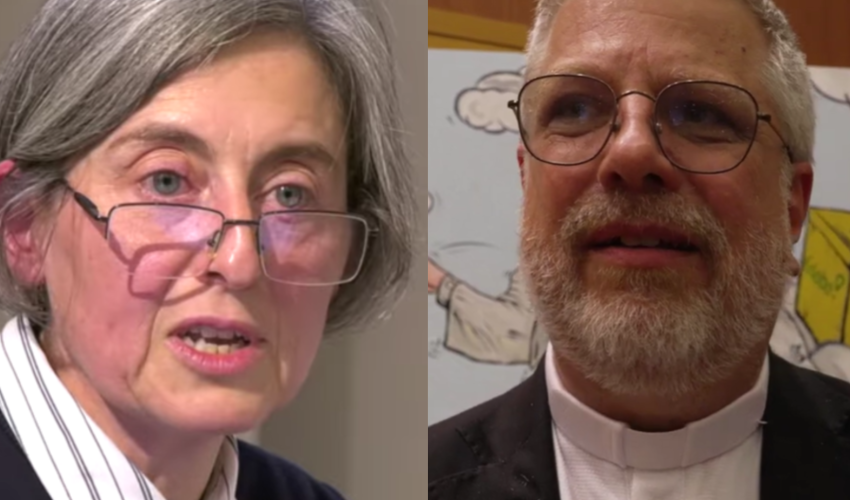
(ZENIT News / Rome, 10.31.2026).- Pope Leo XIV has reshaped the leadership of the General Secretariat of the Synod, appointing two figures with markedly different but complementary backgrounds: Jesuit priest Giacomo Costa, a sociologist deeply involved in the recent synodal assemblies, and Salesian Sister Elena Massimi, a specialist in liturgy and sacred music. Their five-year appointments come as the Church moves from the large-scale consultations and assemblies of recent years towards the more demanding task of putting synodal decisions into practice.
Announced on October 30, the appointments fill the positions previously held by Bishop Luis Marín and Sister Nathalie Becquart. Marín has moved to the leadership of the Apostolic Almoner’s Office and the Dicastery for the Service of Charity, while Becquart, appointed in February 2021, concludes a period in which she became one of the most recognizable figures of the synodal process. She made history as the first woman granted voting rights in an assembly of the Synod of Bishops.
Cardinal Mario Grech, the Synod’s secretary general, thanked both departing officials for their service during what he described as significant and demanding years. He presented the new appointments not simply as a change of personnel but as a response to the needs of the process now underway: ensuring that the convergences reached during synodal discussions produce concrete consequences in local Churches and within the Roman Curia.
Costa brings extensive institutional experience. Born in Genoa in 1967, he entered the Society of Jesus in 1992 and pursued advanced studies in political and moral sociology in Paris. He directed the Italian Jesuit journal Aggiornamenti Sociali from 2010 to 2021 and chaired Milan’s San Fedele Cultural Foundation from 2007 to 2025. His involvement in the Synod has been particularly close: he served as special secretary for the 2018 assembly on young people and for the 2021–2024 assembly on synodality itself. Until his new appointment, he was a consultant to the General Secretariat.
His experience gives him first-hand knowledge of the discussions, procedures and tensions that have shaped the synodal journey. Costa has described the appointment as an opportunity to continue a path begun under Pope Francis, recalling that listening to the experiences, hopes and difficulties of people and local Churches around the world has been among the most important lessons of the process. He said he now regards the responsibility not merely as an administrative assignment but as a vocation.
Massimi, born in Rome in 1975, brings a different kind of expertise. A member of the Daughters of Mary Help of Christians, commonly known as the Salesian Sisters, she made her perpetual profession in 2009 and holds a doctorate in theology specializing in liturgical pastoral studies. She teaches liturgy and sacramental theology at the Pontifical Salesian University in Rome, heads the Italian Association of Professors and Scholars of Liturgy, and is responsible for liturgical music at the Italian Bishops’ Conference’s National Liturgical Office.
Grech highlighted the significance of her background, observing that liturgy and music offer a particular understanding of how distinct voices can be brought into harmony without being reduced to a single note. The image is especially relevant to a synodal process that seeks to foster communion across communities with different experiences, cultures and pastoral priorities. Massimi, for her part, described the new responsibility as a delicate service requiring mutual listening, participation and a constant search for the good of the Church.
The two appointments also bring together experience in the mechanics of synodal assemblies and expertise in one of the Church’s principal expressions of communion. Their task will be to assist the secretary general in preparing and following up synodal assemblies, while supporting local Churches throughout the process.
That responsibility may prove more consequential than the assemblies themselves. Consultation can generate expectations, identify disagreements and establish areas of agreement; implementation requires decisions, pastoral judgment and the ability to translate broad principles into the daily life of dioceses and parishes. It also demands clarity about the relationship between listening and authority, participation and responsibility, and legitimate diversity and the unity of the Church.
Leo XIV is therefore entrusting the next stage to a team whose members have worked closely with the synodal process but whose professional backgrounds offer different perspectives on its challenges.
Thank you for reading our content. If you would like to receive ZENIT’s daily e-mail news, you can subscribe for free through this link.

Publicaciones relacionadas:
 First woman at apex of Vatican dicastery in Pope Leo XIV era
 Another Woman Appointed to the Dicastery for Bishops. Leo XIV Confirms Other Members
 Pope Meets with Israeli and Palestinian Women at the Vatican
 Mexican, a woman, a layperson, and former president of EWTN: this is the woman Pope Leo XIV chose as the first prefect of the Dicastery for Communication
