

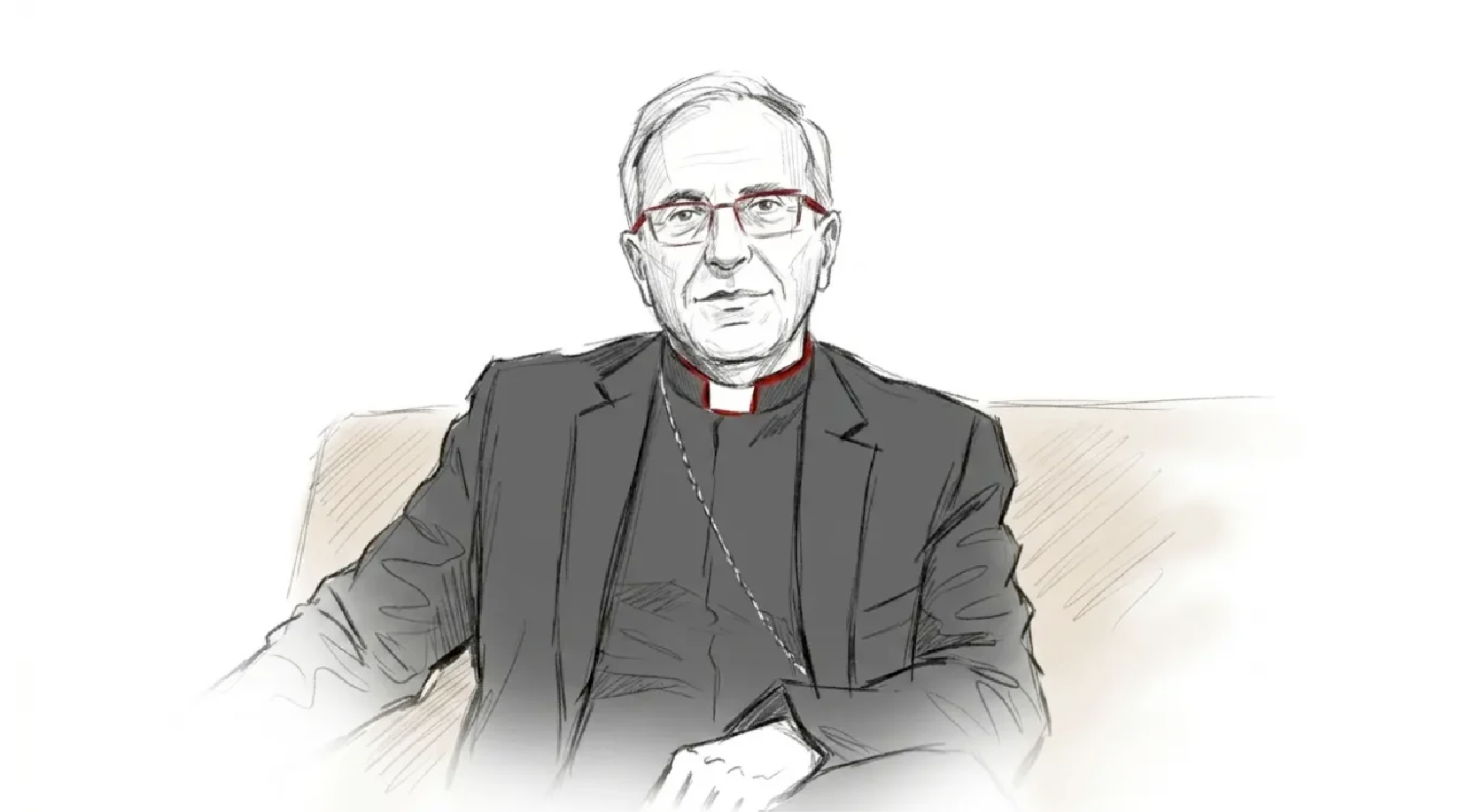
(ZENIT News – Caffe Soria / Rome, May 30, 2026) – There are viral images and videos — violence, outrages — that social media amplifies emotionally: whether to inform, outrage, incite fanaticism, or indifference. And then there are the numbers, which, in a less dramatic way, tell the same story. The latest report from the Rossing Center for Education and Dialogue documents 155 cases of violence against Christians in 2025 in East Jerusalem and Israel, a 40% increase compared to 2024. This is a systematic phenomenon combining everyday humiliations with explosive violence.
«This radicalization clearly began in 2023, a few months before the October 7th war,» explains His Excellency Archbishop Rafic Nahra, Egyptian by birth and of Lebanese heritage, who has served as Patriarchal Vicar for Israel since 2021 and as Auxiliary Bishop of Jerusalem of the Latins since 2022. «The reaction of the government and the police was weak.»
Q: An Israeli soldier smashed a crucifix with a hammer in the Christian town of Debel, in southern Lebanon. In the same town, another Israeli soldier desecrated a statue of the Virgin Mary. These incidents have made headlines around the world. It’s difficult to speak of isolated cases; it’s more of a recurring pattern. How do you interpret them, Your Excellency?
A: These are acts of religious fundamentalism. Furthermore, in each of these incidents, more than one person is involved: the one who commits the act, the one who photographs it, and the one who publishes it. Therefore, they are not isolated acts.
Those who do this perhaps think they are fulfilling a commandment, since it is written in the Bible: «You shall tear down their altars, break their pillars, cut down their sacred poles, burn the images of their gods in the fire, and blot out their names from those places» (Deuteronomy 12:3). Even in ancient and medieval rabbinic tradition, the sages had understood that, given the changed context of life, such intolerant verses should not be applied literally. All the more so in today’s pluralistic world, such action is unacceptable.
Today, all religions understand that they must be at the service of peace.
Moreover, Israel claims to want to normalize its relations with the Arab world. This normalization is being prepared by showing great respect for neighboring populations and their religions. It is clear that these soldiers do not represent the entire population of Israel, but everything necessary must be done to prevent such acts from recurring. Some justify this by saying that the soldiers’ fatigue explains this drop in vigilance regarding the moral standard demanded of them.
Perhaps there is some truth to this, but it is not a sufficient justification.
The escalation of the situation seems inevitable, and from plaster to flesh. A French nun was attacked from behind near the Cenacle in Jerusalem and then beaten while on the ground, before the indifference of most witnesses. Spitting in front of churches, threats and insults against the clergy and the faithful, and outrages during Christian ceremonies paint a picture of a widespread climate of hostility. How to define it? Religious extremism, ideology or what else?
A: This radicalization clearly began in 2023, a few months before the October 7th war: acts of vandalism in churches, destruction of tombstones in the Christian cemetery in Jerusalem, offensive graffiti about Jesus and non-Jews, spitting on Christian priests and nuns, etc. These acts multiplied during this period because the extremists felt protected, or at least tolerated, by the authorities.
In Judaism, there is no commandment to spit on Christians.
After the increase in cases of aggression, some Rabbis and Chief Rabbis condemned such acts. This is a positive step, but verbal condemnation alone is not enough: the teaching of Christianity in public and religious schools must change. Often, in schools, Christianity is presented as if it begins with the Crusaders and ends with the Holocaust. And in saying this, the Shoah is inappropriately linked to Christianity, without clearly distinguishing medieval Christian anti-Judaism from Nazi racism, which was atheist, «scientific» and anti-Christian.
In any case, little or nothing is said in schools about the origins of Christianity, so closely linked to Judaism, about the monotheism of Christians, about the universal values of Christianity, and about the radical change in the relationship with Jews brought about by the Second Vatican Council. This negative teaching leads to hostility towards Christians, as we see in the attitude of the man who attacked the nun. The hatred manifested in his attitude is frightening.
It is easy, in these cases, to fuel institutional antagonisms. Is this type of hostility more or less common to the entire Israeli population or does it belong to specific groups, and if so, which ones?
A: It’s not a widespread attitude. I was in Jerusalem from 2004 to 2021, and the situation was really not similar. In 2023, when the attacks began to increase significantly, the reaction from the government and the police was weak, almost non-existent. Today they react somewhat more, but in any case, there is a worrying radicalization, particularly in divisive rhetoric, and an increase in negative feelings toward non-Jews, including Christians.
Have voices been raised in the Jewish world in defense of Christians and freedom of worship?
A: Yes, there are voices. There is also a hotline, created by Israeli Jews, to document attacks against Christians and help the victims. For example, a collection was taken up after the destruction of the crucifix in the Christian village of Debel: they raised 18,000 shekels (about 5,000 euros), which they sent to the village to build a new crucifix. There are also university professors and several Rabbis who speak out against these acts of extremism. And I still think that the majority of the Israeli population does not want this radicalization.
It is necessary for all moderates to join hands to fight against the extremism that is developing in all religions. The violence of fundamentalists only leads to war and destruction. Do we want to hate others who are not like us, or do we want to build a better world?
Some even speak of low-intensity ethnic cleansing.
Why have Christians become increasingly targeted in recent months?
A: Several government Ministers speak of and encourage a «voluntary» exodus of the population of Gaza. This doesn’t specifically affect Christians, but all the inhabitants of the Strip. Then there are the repeated attacks against Palestinians in the West Bank: burning of houses and cars, damage to farmland and livestock, threats and assaults against people going to work in the fields. All of this is met with very weak and insufficient reactions from the authorities, and regrettably also with collusion between certain members of the Army and extremist groups.
The Army publicly acknowledges that these acts are harming Israeli society itself, and not just its reputation in the world. They are wasting the Army’s energy instead of letting it focus on external threats. The Palestinian population in the West Bank is very afraid and doesn’t feel protected, and not just the Christians.
In Bethlehem alone, the proportion of the Christian population has fallen from almost 90% in the 1950s to less than 10% today. Among young people, too, the escalation of violence and discrimination is driving them to emigrate. What does this hemorrhage of people mean for the future of Christian Churches — and for the entire region, not just Bethlehem?
A: In Nazareth, too, the number of Christians is steadily declining due to the violence in Arab-Israeli society.
Faced with such a hemorrhage, it is important that we Christians remember the meaning of our presence and our mission here in the Holy Land, so as not to abandon it too quickly.
But it is clear that the Christians of Bethlehem, unable to find work and suffering constant limitations and humiliations during their travels, decide to take any opportunity to work when they find it. It is easy to understand them. The same thing happens with the Christians of Nazareth, in Israel: when mafia families practice so-called «protection,» or «high-interest loans,» people are subjected to their blackmail, the threats extend to the whole family — siblings, cousins, uncles — and without effective police protection, it’s clear they wantto flee, and no one can tell them not to.
How to reconcile forgiveness, testimony, and denunciation?
A: Forgiveness doesn’t mean not denouncing. Forgiveness consists of purifying our hearts, so that we don’t let the evil we suffer from others contaminate them. The greatest victory of evil is when it manages to contaminate the victim, and thus we enter the vicious cycle of revenge. We don’t want that.
We must also denounce, but this doesn’t mean making statements every day, because otherwise words become ineffective. We must act effectively, wisely, and prudently, seeking to obtain results. This must also be done to show those who are suffering that someone is speaking on their behalf.
Regarding witness, our entire life must be a witness: our words, our attitudes, our courage, our patience, our refusal to despair. It’s difficult, but this is our vocation.
What would be most useful to do in this situation, and what has not yet been done?
A: What to do? Do not despair, pray, and do not run away quickly from difficulties. In difficult times, like the one we are living through, much perseverance is needed. Then, do not fall into victimhood, remembering that many suffer in the world and that we are part of that chain. Also, do not let yourself be overcome by discouragement, but always look for ways to improve the situation, and seek out people of goodwill –Christians, Muslims, and Jews — to lend them a hand. We are much stronger when we work together. It’s not a war between religions, but rather an awakening of fundamentalisms against which we must fight together.
In Europe, it’s necessary not to be swept away by polarization and simplistic hate speech. We want to be among those who reconcile, not those who spread hatred. I would add that the politicization of Universities is not a good thing. Universities must remain safe havens for learning, reflecting, and engaging in peaceful dialogue.
Translation of the Italian original into Spanish by ZENIT’s Editorial Director and, into English, by Virginia M. Forrester

Publicaciones relacionadas:
 “There is no future for you here”: the harassment of Jewish settlers against Christians in the Holy Land (and the response of Christian leaders)
 3 seminarians kidnapped and guard killed in assault on minor seminary in Nigeria
 Between Drones, Settlers and Classrooms: How Violence and Administrative Israeli Pressure Are Reshaping Palestinian Life
 Holy Land: Cardinal Pizzaballa Says Palm Sunday Mass Ban in Jerusalem Was a Misunderstanding
