

(ZENIT News / Washington, 11.17.2026).- The Catholic Church in the United States faces a challenge that goes beyond the number of people formally leaving its ranks: the steady erosion of religious practice among those who still identify as Catholic. New analysis of decades of survey data suggests that both affiliation and regular Mass attendance have declined, with younger generations increasingly disengaged despite having grown up in Catholic families, attended religious schools or participated in church life.
The figures, drawn from the General Social Survey and Pew Research Center’s Religious Landscape Study, point to a persistent gap between Catholic and Protestant retention, although the differences have narrowed among younger Americans. The most striking finding is that religious education and childhood church attendance alone do not appear sufficient to ensure that faith survives into adulthood.
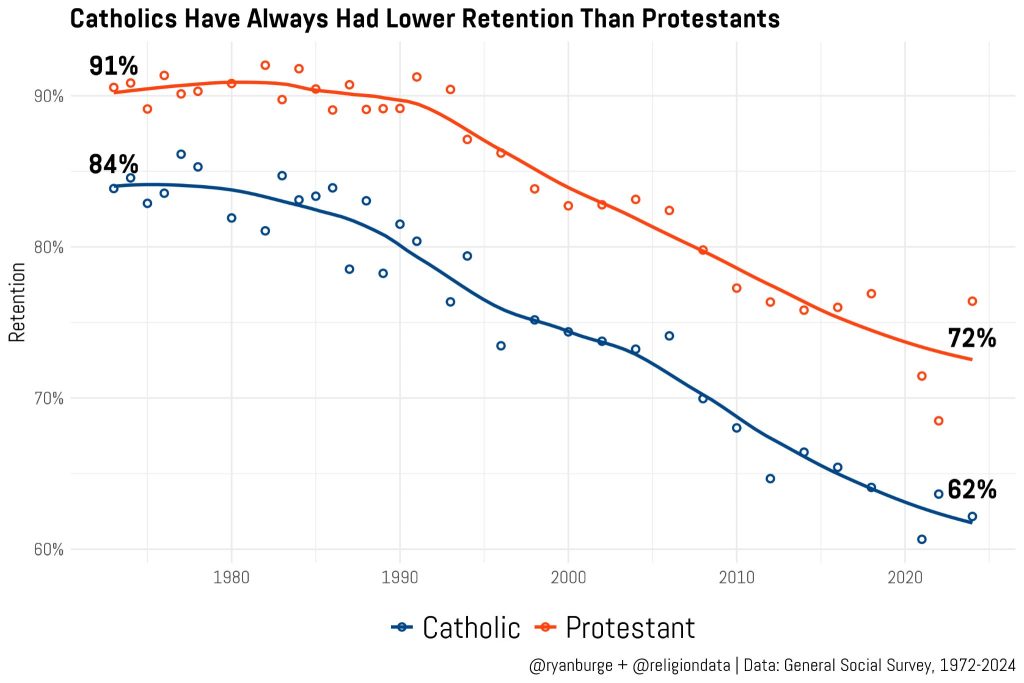
According to the 2024 Pew study, approximately 58% of Americans raised Catholic still identify as Catholic as adults. But retaining the label does not necessarily mean remaining connected to the Church. Among those brought up Catholic, only 15% attend Mass weekly, while roughly three-quarters either leave Catholicism altogether or remain affiliated but attend religious services infrequently or never. The equivalent figure for Protestants attending church weekly is approximately 28%.
That distinction between affiliation and practice is particularly revealing. The Catholic Church may retain a portion of its former members in name, but a much smaller proportion appears to sustain the regular sacramental life that traditionally defines Catholic participation.
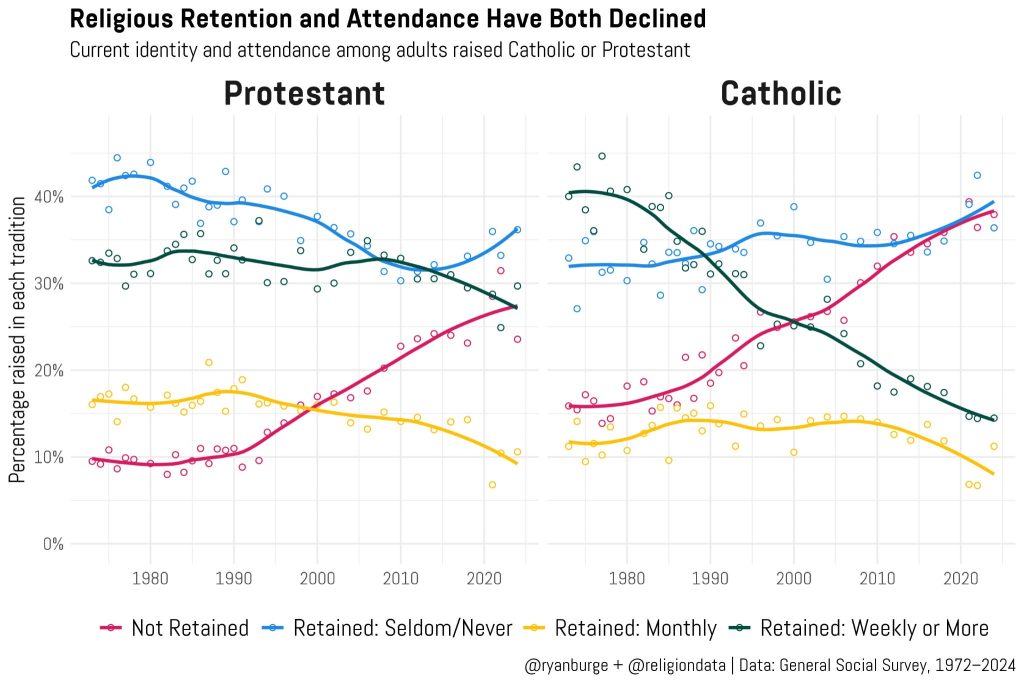
The long-term trend is hardly new. In 1973, 84% of Americans raised Catholic remained Catholic as adults, compared with 91% of those raised Protestant. By 2024, the figures had fallen to approximately 62% and 72%, respectively, according to the General Social Survey analysis. The gap has remained remarkably persistent over decades, even as religious affiliation across the country has undergone broader changes.
The decline becomes more troubling when regular participation is considered. More than 25 years ago, the proportion of Americans raised Catholic who had left the Church already exceeded those who remained Catholic and attended Mass weekly. Today, those raised in Catholicism are roughly twice as likely to abandon the faith altogether as to remain practicing Catholics who attend Mass regularly.
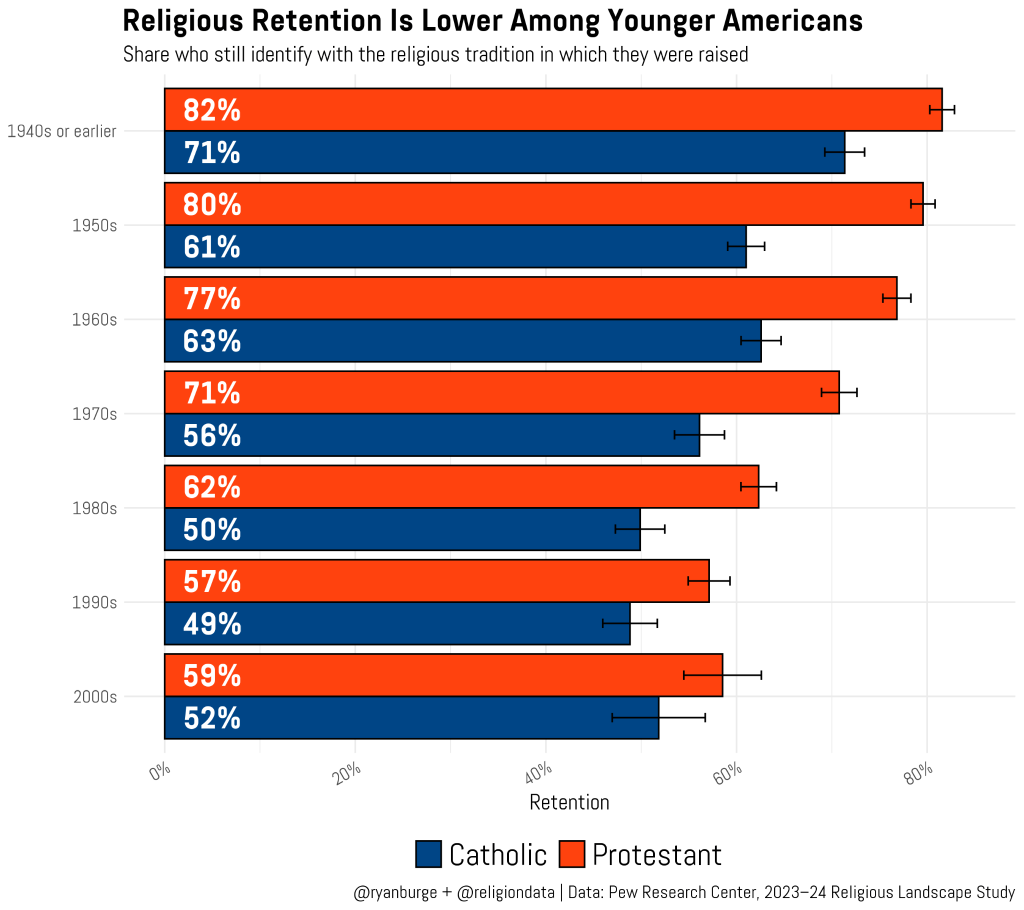
Generational differences are equally significant. Among older respondents in Pew’s Religious Landscape Study, Catholic retention reached 71%, but it fell to around 56% among those born in the 1970s and approximately 50% among those born in the 1980s and subsequent generations. The decline appears to have stabilized among younger Catholics, but at a substantially lower level than previous generations. Protestant retention has followed a similar downward trajectory, although it remains roughly ten percentage points higher among younger adults.
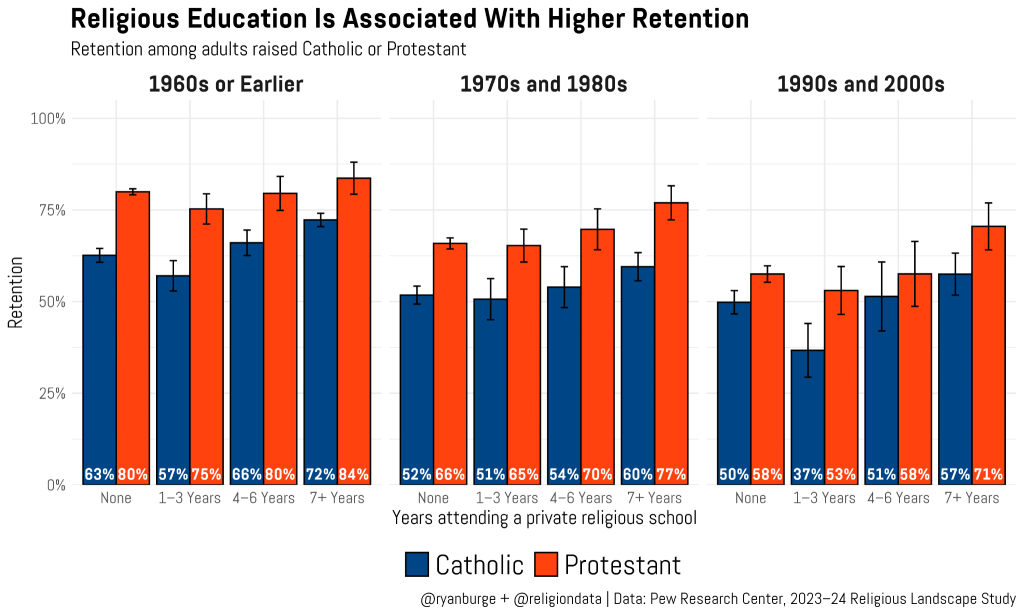
The findings challenge the assumption that Catholic schools and childhood religious formation, by themselves, can reverse the trend. Even among Catholics born in the 1990s or 2000s who attended Mass at least weekly as children and spent seven or more years in religious schools, just 57% still identified as Catholic in adulthood. Protestant retention among younger people who attended Christian private schools for at least seven years was 71%.
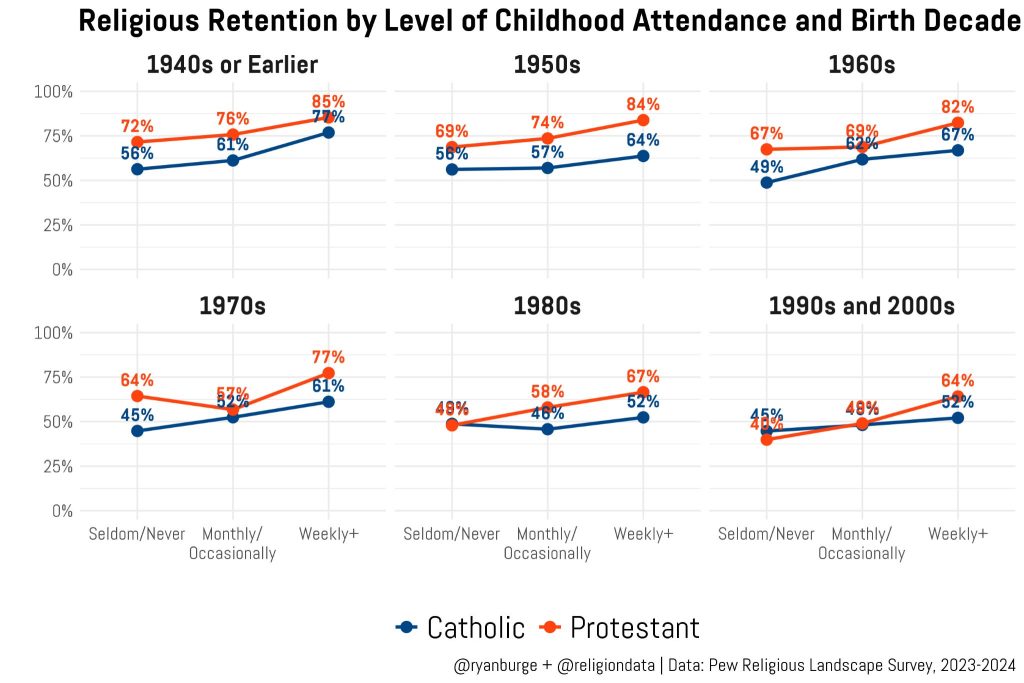
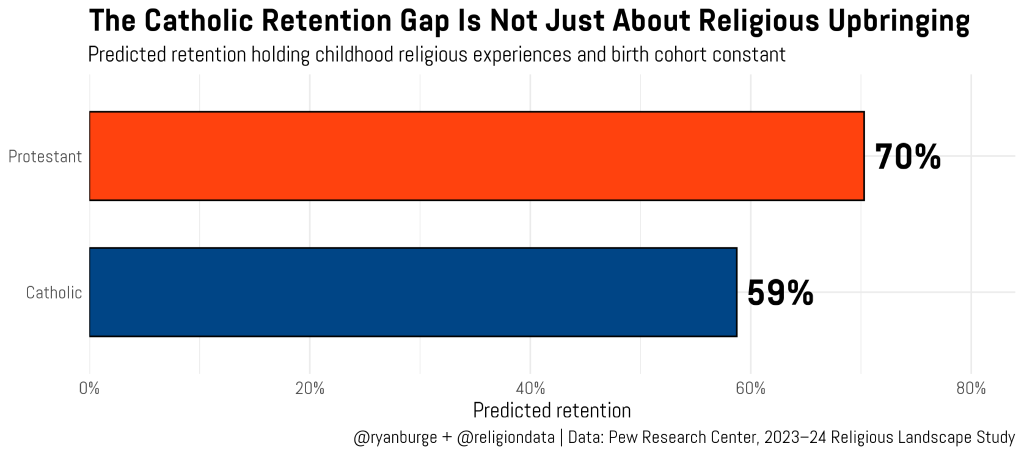
The difference persists even when researchers account for several factors, including childhood church attendance, religious schooling, the importance of religion within the family and the respondent’s age. Under broadly comparable circumstances, someone raised Catholic remains approximately 11 percentage points less likely to retain that affiliation than someone raised Protestant.
The most important predictor, however, was not the number of years spent in religious education or the frequency of childhood attendance. It was whether religion had become personally important to the individual. Those who described faith as central to their upbringing were substantially more likely to remain within their childhood religious tradition as adults.
That finding points to a deeper question for Catholic parents, schools and parishes: whether religious formation is transmitting knowledge and habits without sufficiently cultivating a personal conviction capable of surviving the pressures, choices and competing influences of adult life.
The comparison with Protestantism also requires caution. Protestant denominational boundaries are more flexible: someone raised Baptist who later becomes non-denominational, or a Methodist who joins an Episcopal congregation, may still be counted as having retained a Protestant identity. Catholicism, by contrast, is measured more categorically. Someone who leaves the Catholic Church for another Christian denomination is classified as having left, even if that person remains religious and continues attending church. This makes direct comparisons imperfect, but it does not erase the Catholic figures on declining Mass attendance.
The central problem, therefore, is not simply how many people leave the Church. It is how many grow up within it without developing a lasting relationship with its faith, sacramental life and community. The data suggest that Catholic education and family religious practice matter, but their effectiveness depends heavily on whether religion becomes personally meaningful rather than merely part of a childhood environment.
Keeping young people Catholic cannot be measured solely by baptisms, school enrollment or nominal affiliation. The more difficult task is helping them reach adulthood with a faith they regard as their own—and one they continue to practice when the structures of childhood are no longer there to sustain it.
Article based on a publication by Ryan Burge.
Thank you for reading our content. If you would like to receive ZENIT’s daily e-mail news, you can subscribe for free through this link.

Publicaciones relacionadas:
 Germany: research reveals that young clergy are conservative and opposed to ecclesiastical progressivism
 Germany: Study Shows That Young Muslims Believe More in God Than Catholics
 Surprising research data among French clergy: the younger they are, the more conservative… and happy they are
 Beyond emotion: Spanish bishops publish a critique of the emotionalism of spiritual retreats
