

(ZENIT News / Rome, 06.28.2026).- Answered by Legionary of Christ Father Edward McNamara, professor of liturgy and sacramental theology at the Pontifical Regina Apostolorum university.
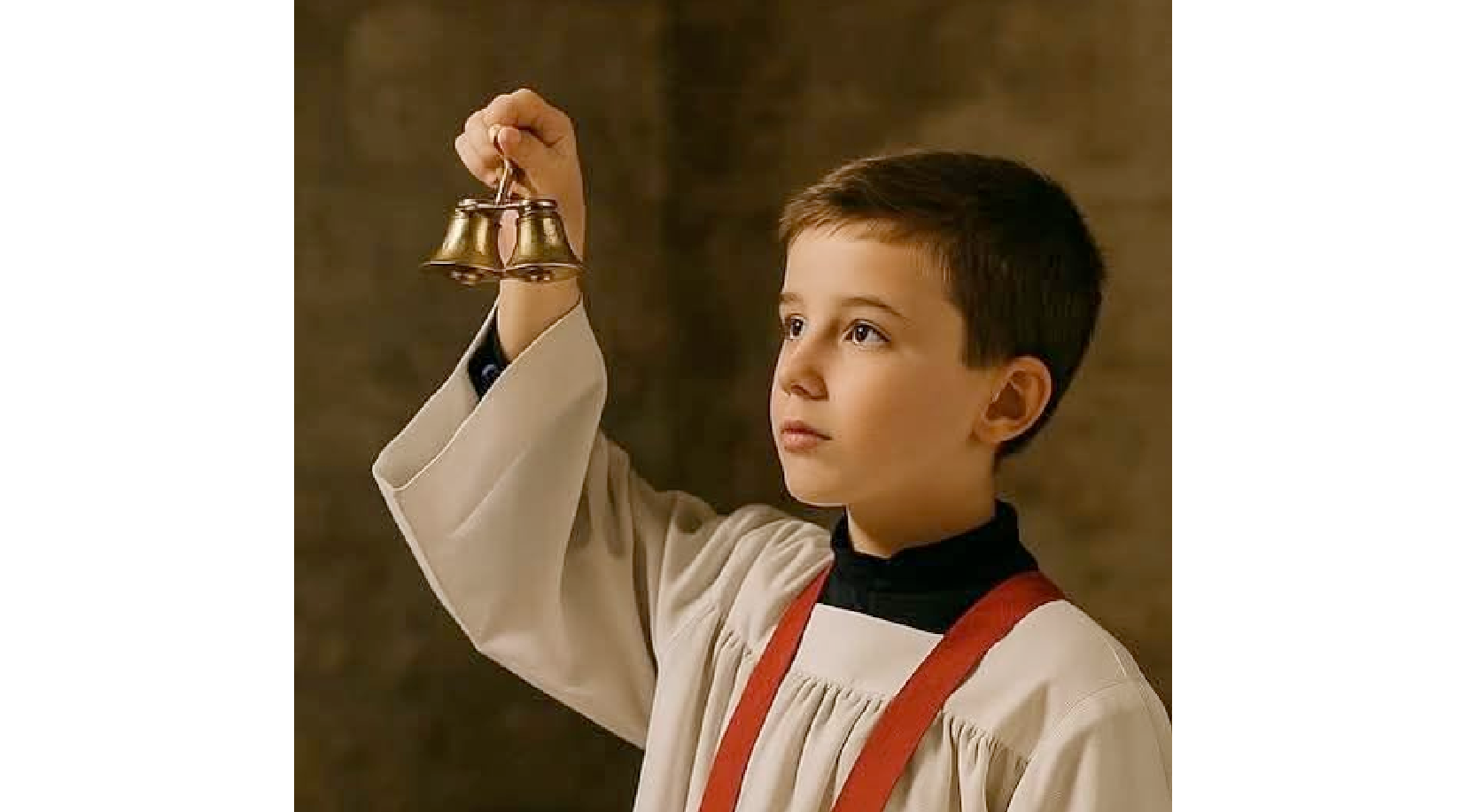
Q: Recently my parish went from ringing bells at the elevation of the elements from one single ring to three distinct rings. When I inquired about the changes, I was told that “Father wants it that way and the rubrics give him that option if he so chooses.” I understand that the presiding priest at a Mass has a lot of latitude and has the final call as to how things will be done, but can he change this rubric simply because he wants to? Am I reading GIRM 150 incorrectly in that we ring a single bell once? — R.N., San Bernardino, California
A: There is very little regarding the use of bells, especially handbells, in official documents. This is because, in general, these are questions of local uses and customs.
As mentioned by our reader, the General Instruction of the Roman Missal (GIRM) No. 150 has the following to say:
“A little before the Consecration, when appropriate, a server rings a bell as a signal to the faithful. According to local custom, the server also rings the bell as the priest shows the host and then the chalice. If incense is used, a server incenses the host and the chalice when each is shown to the people after the Consecration.”
The key expression here is “according to local custom.” This means that both the fact of ringing a bell at all, and the manner in which this bell is rung, is not strictly determined and is left to local customs. In this the pastor can give pertinent indications as to how he prefers to act on this custom.
At the same time, one should not introduce an excessive use of these into the liturgy or at times that contradict other liturgical indications.
Historically speaking, there are several reasons why the use of handbells, especially during the consecration, was introduced.
During the 11th through the 13th centuries, there was much debate regarding the precise moment of the consecration, coupled with a devotional desire on the part of the faithful to see the host. This desire led to the practice of elevating the host after the consecration and, about a century later, the elevation of the chalice.
While this practice was a generally positive development, it was mixed with occasional superstitions, such as some preachers who told people that they did not age while contemplating the host. Some young devotees in medieval European cities would run from church to church to be present at as many elevations as possible.
In some places, the large bells of parish churches were also rung during the consecration, or during Benediction of the Blessed Sacrament, so that people in the vicinity could make a brief pause for prayer and adoration.
Some centuries later, with the advent of polyphonic music at Mass, it became common that the priest would quietly recite the Sanctus and initiate the Eucharistic Prayer while the choir continued to sing the elaborate Sanctus. As the consecration approached, the acolyte would ring the bell as a sign for the choir to keep silence during the consecration. After the consecration, the bell would be rung again, and the choir would continue with the Benedictus as the second part of the Sanctus.
Today, the ringing of a small bell or bells at Mass remains a custom in many parishes although, as seen above, it is no longer required by law.
Bishop Peter J. Elliott, in his Ceremonies Explained for Servers According to the Roman Rite, a practical manual dedicated to servers, sacristans and masters of ceremonies, describes the current use of bells in Catholic practice:
“230: Bells may be rung at certain times during the Mass to draw the attention of the people to the most sacred moments of the liturgy. The times when they are rung depend on local custom, but they should be rung (a) as a ‘warning bell’, when the priest extends his hands over the gifts, just before the Consecration, (b) once or three times at each elevation or showing of the Host and Chalice, after the Consecration, (c) perhaps as a signal for Communion or to tell the people to recite the Communion verse, as soon as the priest has received the Precious Blood.
“231: Hand bells are easier to manage as you can continue to watch the priest while you ring the bell. A set of bells usually works best when rotated, not when shaken or swung in the air. New servers will need to be trained carefully in the use of the bell, how to ring it or strike it with best effect. Except in a large church, the bell should not be rung too loudly. A short sound is enough for the warning bell if used at this time. A longer sound is better to accompany the action of the elevation and showing of the Host and Chalice, and this should be carefully timed to accompany the actual moments of the raising and showing, never during the last words of Consecration.”
Some liturgists would question one point of this explanation insofar as they consider the consecratory epiclesis, when the priest extends his hands over the gifts, as being integral to the consecration itself and hence is not “just before the consecration.”
This is a valid point from a theological standpoint, but the gesture does provide a visible cue to the server to know when to ring the bell. Younger servers are not as likely to be so attentive to the texts of each Eucharistic Prayer so as to know when precisely to ring the bell.
Therefore, the final answer is the pastor can determine whether the bell is rung once or multiple times. At the same time, not being something with any special theological significance one way or the other, it is probably best for a new pastor to leave things as they are unless some exaggeration has crept in.
If he believes a change of practice is warranted, he should be able to provide reasons for his preference (even if these are legitimate personal motives such as avoiding distractions) to those members of the faithful puzzled by a change in longstanding practice. “Father wants it that way” is not exactly the best way to engage in the spirit of synodality promoted by Pope Francis and Pope Leo XIV.
* * *
Readers may send questions to zenit.liturgy@gmail.com. Please put the word «Liturgy» in the subject field. The text should include your initials, your city and your state, province or country. Father McNamara can only answer a small selection of the great number of questions that arrive.
Thank you for reading our content. If you would like to receive ZENIT’s daily e-mail news, you can subscribe for free through this link.

Publicaciones relacionadas:
 Vatican approves new lectionary for Advent in England, Wales and Scotland
 Questions about liturgy: Genuflections Toward the Tabernacle
 The traditional Latin Mass celebrated in St. Peter’s Basilica marks a new chapter under the pontificate of Pope Leo XIV
 Questions about liturgy: Adoration When There Is No Tabernacle
