

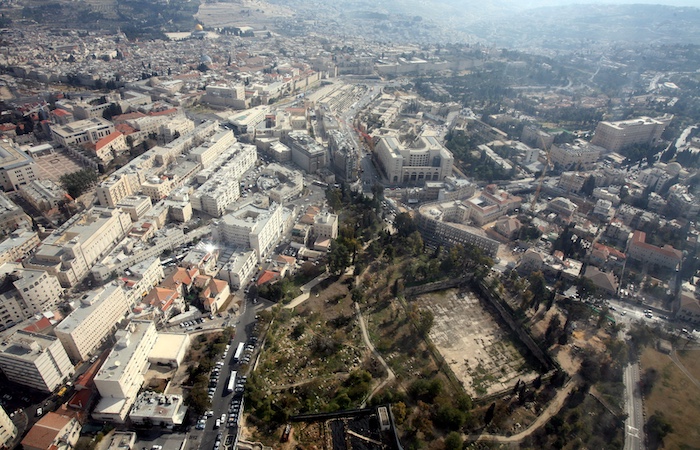
(ZENIT News – Terra Santa Net / Jerusalem, 10.08.2026).- A historic and natural site just steps away from Jerusalem’s Old City — comprising the Mamilla Cemetery and Pool –, is once again at the center of controversy. The renovation project for the large pool threatens both the pool itself and the cemetery, which contains graves from the early Islamic period, Sufi shrines, and Mamluk burials. It is a site that has already suffered decades of devastation.
The name «Mamilla» now refers to an entire area of the city. During the Byzantine and Islamic eras, the name also applied to a church dedicated to Saint Mamilla, though its origin and meaning remain uncertain. A massacre took place here in 614 during the Persian invasion. For much of the period of Islamic rule over Jerusalem, which began in 638 and was interrupted only during the Crusades, Mamilla served as the city’s main Muslim cemetery. Emirs, muftis, Sufi mystics, soldiers of Saladin, and Sheikh Ahmad al-Dajani, a high-ranking official under Suleiman the Magnificent, were buried there. It remained in continuous use until 1927.
The pool is located approximately 650 meters northwest of the Jaffa Gate; it measures 65 by 97 meters and holds more than 30,000 cubic meters of water. An underground channel connects it to Hezekiah’s Pool in the Old City’s Christian Quarter, and it was likely also fed by the Upper Aqueduct from the Pools of Solomon. As early as the 5th century, it supplied public baths near the Jaffa Gate. The Crusaders lined it with new stonework, and during the Ottoman era, residents still descended into it to collect water. Modern pumps were installed during the British Mandate, but by the 1960s, the pool served merely as a rainwater catchment basin. It is the only seasonal pool in Jerusalem — and the only one in Israel –, situated within an enclosed area.
An erosion spanning decades. Part of the cemetery has been buried beneath Independence Park (created in 1958 to commemorate the tenth anniversary of the State of Israel), roads, and parking lots. During recent work, workmen discovered human remains, as shown in photographs obtained by the newspaper Haaretz, confirming what the Palestinian population has been denouncing for years.
The culmination of this progressive encroachment was the Museum of Tolerance. In the 1960s, the Mayor of Jerusalem persuaded a qadi (an Ottoman-era magistrate) to declare part of the area non-sacred, paving the way for the park. Construction, a parking lot, and infrastructure followed, without major protests from West Jerusalem’s now-diminished Muslim community. The museum, designed by Frank Gehry and funded by over two million dollars raised primarily from US donors via the Simon Wiesenthal Center, prompted a salvage excavation in 2005.
Around a thousand burials across five layers, dating from the Ayyubid period to the modern era, were uncovered, alongside Iron Age remains and an aqueduct. A Muslim petition briefly halted the work, but in 2008, the courts, including the Supreme Court, rejected it. Only between 30 and 40 percent of the graves were methodically excavated, while the majority were dismantled and removed. The museum opened its doors in 2019.
The Current Project
For several months, the pool has remained hidden behind a tall fence covered with images: a body of water surrounded by impeccably manicured lawn. Even the promotional video does not show the tombs. After years of failed attempts, the municipality has decided to restore the structure, which dates back over 1,500 years, asserting that the pool’s importance lies in the history of Jerusalem’s water supply system.
However, as reported by Haaretz, the project would eliminate the seasonal winter pool that forms at the site and risks damaging countless tombs. Benjamin Netanyahu, who visited the site in 2025, encouraged Mayor Moshe Lion. According to the religious-Zionist news website Arutz Sheva, the Minister of Heritage, Rabbi Amichai Eliyahu, describes it as a «world-class heritage tourist attraction» and an opportunity to strengthen ties to the historical and spiritual identity of the Jewish people.
Opposition to the project comes from two fronts. Activists from the «Free Jerusalem» group have protested against the damage to the small natural ecosystem within the watershed and, above all, the additional harm to the cemetery. «This is an extremely sensitive issue regarding Jerusalem’s Palestinian and Muslim heritage. The cemetery has been subjected to abuses for a hundred years by various entities, and given this recurring pattern, we are concerned that the plan does not provide for its excavation,» they told Haaretz.
For other critics — Muslim residents of Jerusalem — transforming the cemetery into an «easily accessible central urban park» is an example of «colonial beautification,» as reported by Al Jazeera on May 10. The site is undergoing extensive redevelopment but is being stripped of its Arab-Islamic context and integrated into the Israeli tourism landscape.

Publicaciones relacionadas:
 Israeli government minister calls for construction of synagogue on Temple Mount (where Muslim mosque now stands)
 The last historic Christian village in the Holy Land, threatened with annexation by the Jewish state of Israel
 Lebanon, Gaza and the Holy Land: Christians Caught Between War, Humanitarian Collapse and a Struggle for Religious Freedom
 Israel Declares the Only Entirely Christian City in the Holy Land a “Closed Military Zone”
