

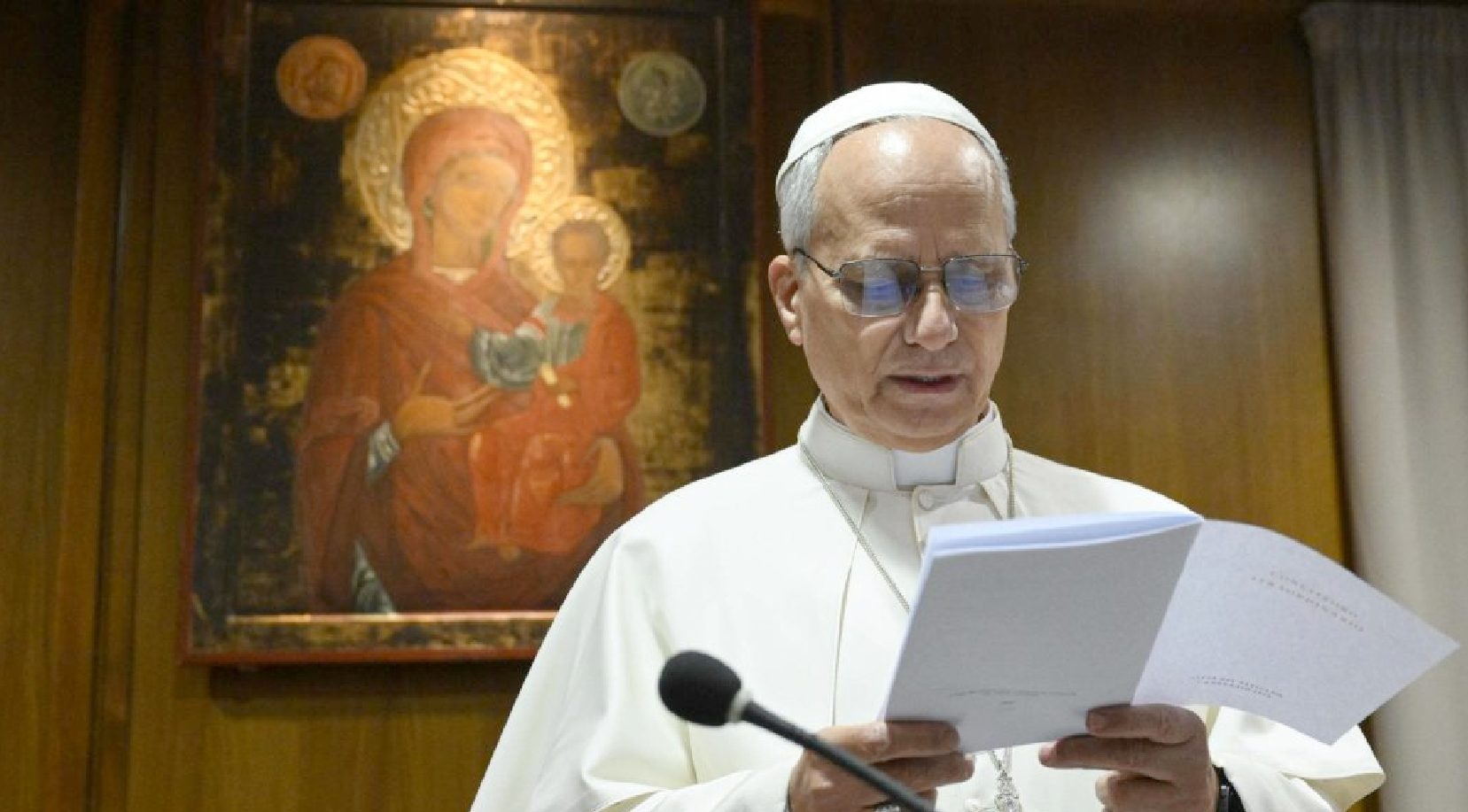
(ZENIT News / Rome-Lourdes, 03.25.2026).- As the French bishops gathered in Lourdes for their spring plenary assembly from March 24 to 26, two of the most sensitive fault lines within contemporary Catholicism were placed squarely on the table: the enduring trauma of clerical abuse and the deepening tensions surrounding the traditional Latin liturgy. Into this charged atmosphere came a message from Pope Leo XIV, transmitted through Cardinal Pietro Parolin, which sought neither to minimize these crises nor to resolve them with formulaic answers, but rather to reframe them within a broader ecclesial vision of unity, accountability, and hope.
The Pope’s intervention reveals a dual concern: healing wounds without erasing truth, and preserving unity without suppressing legitimate diversity. Nowhere is this more evident than in his approach to the question of the Vetus Ordo—the pre-conciliar form of the Roman rite, often associated with the Tridentine Mass. While acknowledging the “painful wound” that continues to divide Catholics over liturgical practice, Leo XIV calls for “concrete solutions” capable of integrating those who remain sincerely attached to this form of worship. His language avoids both polemic and nostalgia, instead proposing what he describes as a renewed ecclesial gaze—one that recognizes diversity not as a threat, but as a potential source of enrichment within the unity of faith.
This perspective was echoed at the opening of the assembly by Cardinal Jean-Marc Aveline, who underscored the need to situate current debates within the continuity of the Church’s tradition, including the legacy of the Second Vatican Council. The bishops’ discussions on “Liturgy and Tradition” are expected to grapple with a tangible reality: the steady growth of communities attached to the older rite, alongside the tensions that such growth has generated within diocesan life.
If the liturgical question touches on identity and belonging, the issue of abuse strikes at the moral credibility of the Church itself. Here, Leo XIV adopts a tone that is both sober and forward-looking. After years marked by what he calls “painful crises,” he urges the French episcopate to persevere in prevention efforts and to continue the path of accountability and reparation. At the same time, he insists on a dimension often difficult to articulate in public discourse: mercy must extend to all, including those priests found guilty of abuse, who should not be excluded from the Church’s pastoral concern.
This delicate balance—justice for victims, mercy for perpetrators—reflects a framework that resists simplification. It also intersects with practical decisions facing the bishops, notably the future of the Independent National Authority for Recognition and Reparation (INIRR), established in the wake of the landmark Ciase report on abuse. With its mandate set to expire in August 2026, the assembly must determine whether to extend its work or replace it with a more permanent structure, ensuring that the process of recognition and compensation does not lose momentum.
Beyond these internal challenges, the Pope’s message broadens the horizon to include education, another priority on the bishops’ agenda. In a context where Catholic institutions increasingly encounter cultural and political resistance, Leo XIV encourages a clear reaffirmation of their Christian identity. Drawing on the legacy of Pope Francis, he emphasizes that education is not merely a social service but a constitutive dimension of the Church’s mission, one that would lose its meaning if detached from its reference to Christ.
The Lourdes assembly also unfolds against a backdrop of global instability. The escalation of violence in the Middle East, described by Cardinal Aveline as a “war without mercy,” looms over the deliberations, reminding participants that ecclesial debates do not occur in a vacuum. Likewise, the memory of the Tibhirine martyrs—Trappist monks killed during Algeria’s civil war—serves as a stark witness to the cost of faith lived in extreme conditions. Their legacy acquires renewed relevance ahead of the Pope’s announced visit to Algeria in mid-April.
Taken together, the Pope’s message outlines a demanding path for the Church in France: to confront its wounds without becoming defined by them, to hold together justice and mercy, and to navigate internal diversity without fracturing communion.
Thank you for reading our content. If you would like to receive ZENIT’s daily e-mail news, you can subscribe for free through this link.

Publicaciones relacionadas:
 Pope confirms new Custos of the Catholic Church for the Holy Places in the Holy Land
 Pope Leo XIV avoids schism, ends mission of bishop in liturgical dispute in India
 It’s for Real: Church in Spain Launches Website About Pope’s Visit and Announces Working Teams for Barcelona.
 Did Pope Leo XIV speak out against the Spanish party Vox, which is aligned with the Trump administration?
