

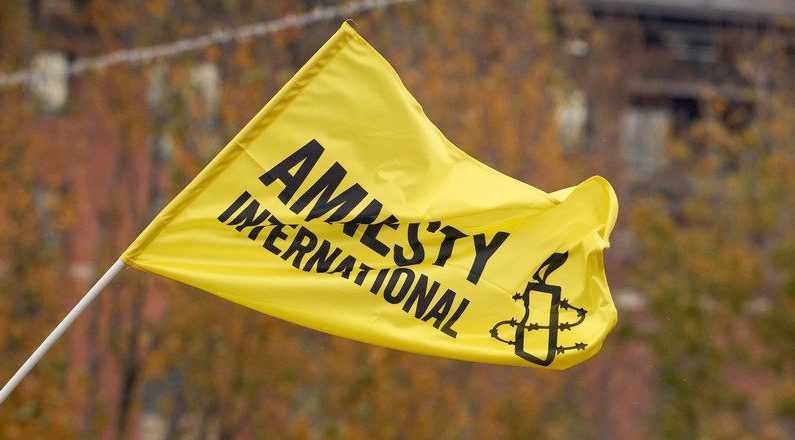
(ZENIT News / London, 07.18.2026).- The sudden withdrawal of a controversial Amnesty International UK report has reopened one of the most polarizing debates in contemporary British society: the clash between gender‑identity activism and those who defend biological sex as a legitimate basis for law, policy and safeguarding. The episode has also placed the Catholic Church, several Christian charities, and even J.K. Rowling’s women‑only support centre at the centre of an unexpected storm.
Amnesty’s document, briefly published on 8 July before being removed within hours, catalogued 117 organisations as part of an alleged “anti‑rights movement”. Among them were the Catholic Bishops’ Conference of England and Wales, Right to Life UK, the Catholic Herald, the Catholic Medical Association, and numerous crisis‑pregnancy centres. The report claimed these groups collectively spent £144 million between 2019 and 2024 — a 47% increase — and portrayed their advocacy for the unborn, for women‑only spaces, or for traditional marriage as a threat to human rights.
The backlash was immediate. Catholic leaders defended their mission as one rooted in the dignity of every human person, from conception to natural death. They reminded critics that the Church’s social teaching has long championed refugees, victims of trafficking, prisoners of conscience and religious freedom — a point often forgotten in public debates that reduce Catholic engagement to a handful of contested moral issues. Their statement echoed a principle central to Vatican II’s Dignitatis humanae: that authentic human rights flow from the inherent worth of the human person, not from shifting ideological trends.
J.K. Rowling, whose women’s centre Beira’s Place was also listed, reacted forcefully. The centre, founded in Edinburgh in 2022, provides specialised support exclusively to women who have survived sexual violence — a model fully compliant with the UK’s Equality Act 2010. For Rowling, the report’s implication that such a service is “anti‑rights” illustrates a troubling tendency to delegitimise anyone who questions gender‑identity dogma. Her public criticism amplified the issue, prompting Amnesty to acknowledge that the report had bypassed internal review processes and that its language “did not reflect” the organisation’s official stance.
The controversy also highlighted inconsistencies that many observers found difficult to ignore. Not a single Islamic organisation appeared on Amnesty’s list, despite the fact that traditional Islamic teaching on sexuality and gender diverges sharply from contemporary LGBT+ activism. Meanwhile, Catholic institutions — including those with long histories of defending prisoners of conscience — were prominently featured. The irony was not lost on commentators familiar with Amnesty’s origins: its founder, Peter Benenson, was a Catholic convert whose outrage over persecuted dissidents inspired the organisation’s creation in 1961.
Beyond institutional reputations, the withdrawn report touched a deeper cultural nerve. In recent years, the UK has witnessed intense disputes over whether transgender people should access spaces and services reserved for biological females. Legal battles, such as those led by For Women Scotland — which successfully argued before the Supreme Court that “woman” in equality law refers to biological sex — have further sharpened the divide. Amnesty’s report framed such victories as part of a “concerning rollback” of LGBT+ rights, while critics saw the report itself as evidence of an ideological drift within the organisation.
The episode raises broader questions about the future of human‑rights advocacy. Can organisations remain credible if they appear to conflate disagreement with hostility? How should societies balance the rights of different groups when those rights seem to collide? And what happens when long‑standing defenders of conscience and life are recast as adversaries?
For the Catholic Church, the affair underscores the importance of articulating its positions with clarity and charity, especially in a climate where moral language is easily weaponised. For women’s organisations like Beira’s Place, it reaffirms the need to defend sex‑based protections without apology. For Amnesty International reminds that that the defence of human dignity requires precision, fairness and a willingness to engage with complexity — not lists that flatten nuanced debates into ideological binaries.
The withdrawn report may never reappear, but the questions it raised will continue to shape the UK’s cultural landscape for years to come.
Thank you for reading our content. If you would like to receive ZENIT’s daily e-mail news, you can subscribe for free through this link.

Publicaciones relacionadas:
 USA: Bishops Thomas and Barron Applaud Move to Defund Abortion and “Gender Transition” Industries, Call for Authentic Health Care
 Germany: bishop responsible for queer ministry calls for changes in Church doctrine
 No Sin is Beyond God’s Unfathomable Mercy, says Bishop Thomas on the Anniversary of Roe v. Wade
 The leading advocate for abortion and gender ideology who works for the UN presents her report
