

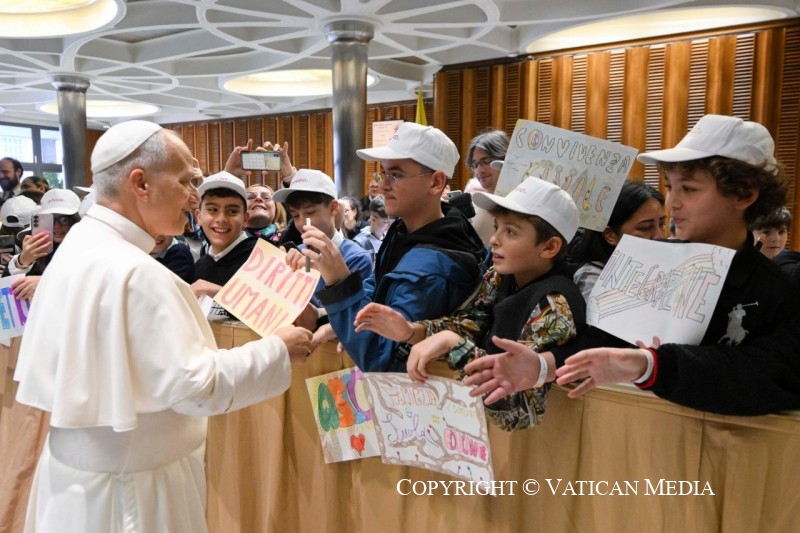
(ZENIT News / Roma, 11.20.2025).- For years, church leaders and sociologists have speculated about the spiritual lives of young American Catholics. Are they drifting away from parishes? Losing interest in doctrine? Quietly reshaping the faith they inherited? A new nationwide survey suggests a different story — one in which young adult Catholics remain not only active in their Church, but also surprisingly attuned to its social and moral teachings.
Commissioned by the National Catholic Reporter and the Wittcoff Foundation, the study offers a detailed portrait of 401 Catholic undergraduates between ages 18 and 23. Conducted by Mercury Analytics, it aims to understand not just religious behaviors but the deeper currents shaping political attitudes, media habits, and ethical priorities. With a margin of error of 4.89%, the report adds nuance to the narrative of a generation often labeled disengaged or spiritually indifferent.
What emerges instead is a cohort for whom Catholic identity remains both present and consequential.
A Church Still in Their Lives
An overwhelming majority — 8 out of 10 — describe themselves as currently involved in the Church, most often by attending Mass. Their commitment is not merely nostalgic or cultural; many say faith plays an active role in how they interpret the world around them. And despite the pressures of academic life, young Catholics appear to maintain a spiritual grounding that distinguishes them from broader trends of religious disaffiliation.
The Influence of Catholic Social Teaching
If there is one finding that surprised the survey’s researchers, it is the depth of engagement with Catholic social teaching. Nearly two-thirds of respondents say they are at least somewhat familiar with it, and among those who understand these principles, an astonishing 91% consider them influential in their approach to social and political questions.
This influence remains remarkably consistent regardless of the institution students attend. Whether enrolled in Catholic universities or secular ones, familiarity with these teachings — dignity of the poor, care for the vulnerable, defense of life, the demands of justice — correlates strongly with their political and ethical orientations.
Even when the researchers broadened the question to include all respondents, including those less confident in their understanding, a clear majority (59%) still said Catholic social teaching shapes their views on society.
A Diverse Generation with Shared Commitments
The respondents reflect the growing demographic diversity of the U.S. Church: 56% white, 35% Latino, 15% Black, and 8% Asian or Pacific Islander. They come from all corners of the country, with the South supplying the largest share.
Despite these differences, their concerns coalesce around similar pressures: rising living costs, housing insecurity, student debt, access to healthcare, and mental health challenges. Two-thirds list the cost of living as their top issue. Others identify gun violence, immigration, and the environment as urgent national priorities.
Interestingly, concerns about reproductive rights and abortion place lower in the overall list (44%), though Catholic college students rank them more highly (48%), suggesting that institutional context still shapes the moral lens through which students view national debates.
Voting and Public Engagement
In a year when voter turnout is widely scrutinized, the survey reveals mixed habits. Fewer than half say they vote always or almost always in general elections. Still, faith remains a factor in political decision-making: 60% say Catholicism influences their vote, a figure that climbs to 73% among students at Catholic universities.
This interplay between faith and civic life runs counter to the assumption that younger generations divorce religion from public engagement. Instead, many appear to carry their Catholic worldview into the ballot box — though not always with predictable partisan implications.
Listening to the Popes
Another layer of the study examines how much attention young Catholics pay to papal leadership. The results reflect both continuity and change.
Pope Francis remains a defining spiritual figure: 62% say he has had a significant impact on their own Catholicism. His emphasis on mercy, openness, and pastoral accompaniment resonates strongly with a generation navigating questions of belonging and identity. One student cited his now-famous phrase — “Who am I to judge?” — as emblematic of a Church capable of embracing the divorced, the remarried, and LGBTQ+ persons with compassion.
Surprisingly, the newly elected Pope Leo XIV has already gained notable traction. More than half of respondents say he influences their faith, despite his short time in office. Several students noted that his American background and commitment to expanding the Church’s outreach to diverse communities make Catholicism feel closer and more relatable.
Catholic Campuses vs. Secular Ones
Students attending Catholic colleges tend to participate more actively in sacramental and communal life: 41% say they receive the sacraments regularly, compared with 25% of those in non-Catholic institutions. They are also more likely to follow papal teaching or engage in service activities.
Yet when it comes to the broader influence of Catholic social teaching, the divide nearly disappears. Awareness, not institutional affiliation, seems to be the determining factor. Wherever they study, students who know the Church’s social tradition overwhelmingly describe it as shaping their worldview.
A Generation Rooted, Yet Not Predictable
Taken as a whole, the survey depicts young Catholics as both grounded and dynamic: rooted in liturgy, engaged with doctrine, but also responsive to contemporary moral issues. They are not uniformly traditional or uniformly progressive; instead, they interpret their faith through a lens shaped by economic pressures, cultural diversity, and global social concerns.
They are, in other words, authentically Catholic — but in a distinctly 21st-century key.
Thank you for reading our content. If you would like to receive ZENIT’s daily e-mail news, you can subscribe for free through this link.

Publicaciones relacionadas:
 Germany: research reveals that young clergy are conservative and opposed to ecclesiastical progressivism
 Germany: Study Shows That Young Muslims Believe More in God Than Catholics
 Surprising research data among French clergy: the younger they are, the more conservative… and happy they are
 Beyond emotion: Spanish bishops publish a critique of the emotionalism of spiritual retreats
