

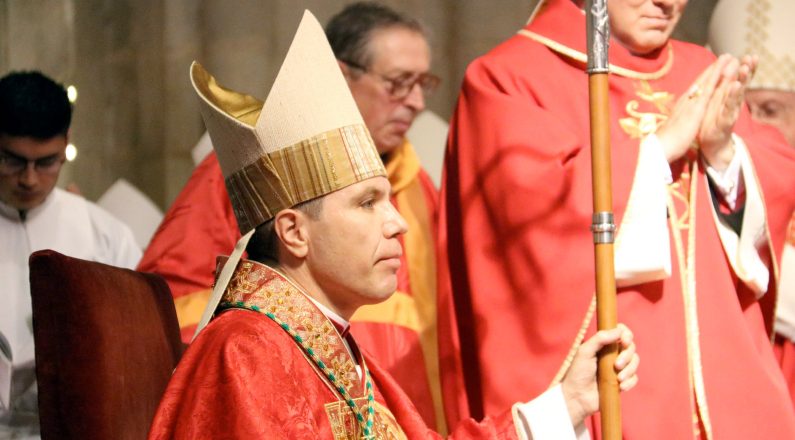
(ZENIT News / Andorra, 09.26.2025).- In Andorra, one of Europe’s smallest and most unusual states, the centuries-old balance between secular governance and ecclesiastical authority is being tested once again—this time over the issue of abortion.
Josep-Lluis Serrano Pentinat, the recently installed bishop of Urgell and, by virtue of that role, co-prince of Andorra, now finds himself at the center of an unfolding political and moral drama. A bill expected to pass through the Andorran parliament this November would decriminalize abortion, removing penalties for women who undergo the procedure and for doctors who perform it. Although the law would stop short of authorizing abortions on Andorran soil, it marks a turning point in a country where the influence of the Catholic Church has long shaped public policy.
Ordinarily, in Andorra’s diarchic system, only one of the two co-princes must sign legislation for it to become law. Historically, it has been the French head of state—currently Emmanuel Macron—who has assumed that responsibility whenever controversial social legislation reached the head of state’s desk. It was this mechanism that allowed civil unions for same-sex couples and assisted reproduction laws to pass without ecclesiastical endorsement.
But the Vatican’s behind-the-scenes role in negotiating the current proposal has raised the possibility, however remote, that Serrano himself might affix his name to the bill. That prospect would represent a striking departure from the stance of his predecessor, Joan-Enric Vives, who went so far as to threaten abdication rather than sign legislation he viewed as incompatible with Catholic doctrine.
The shift has been gradual but unmistakable. Reports in Catalan media suggest that discussions between Andorran officials and the Holy See have been underway for several years. Cardinal Pietro Parolin, the Vatican’s Secretary of State, visited Andorra in 2023 amid speculation about a potential constitutional crisis over abortion. At the time, Parolin called the matter “very delicate, very complex,” stressing the need for prudence and discretion. Local outlets later claimed that Pope Francis himself had tacitly approved the plan to decriminalize abortion in principle, a claim neither confirmed nor denied by the Holy See.
Serrano, for his part, has struck a different tone since his installation as bishop earlier this year. In his first public remarks, he emphasized the importance of “dialogue and support for those who suffer—especially women in difficult situations.” Observers noted the contrast with Vives’ «uncompromising rhetoric», suggesting that Rome’s influence and Serrano’s diplomatic background may open the door to a more pragmatic approach.
Indeed, Serrano’s career has often placed him at the intersection of diplomacy and controversy. A former secretary at the Apostolic Nunciature in Mozambique, he later worked closely with Archbishop Edgar Peña Parra in the Vatican Secretariat of State. His name also appeared in connection with London 60 SA Limited, a Vatican-controlled company at the center of the financial scandal that resulted in the recent landmark trial.
The Andorran government, meanwhile, is preparing a complementary measure that would preserve the country’s ban on performing abortions while providing state funding for women who seek the procedure abroad in neighboring France or Spain. Prime Minister Xavier Espot has framed the policy as a pragmatic compromise, one negotiated “discreetly” with Vatican officials to balance Andorra’s Catholic heritage with the realities of women’s health needs.
With a population of just 80,000, Andorra may appear an unlikely stage for an international debate. Yet the country’s dual sovereignty, enshrined in a medieval pact between the Bishop of Urgell and the French crown, ensures that questions of moral doctrine, diplomacy, and national identity remain inseparably entwined.
Thank you for reading our content. If you would like to receive ZENIT’s daily e-mail news, you can subscribe for free through this link.

Publicaciones relacionadas:
 Pope’s Secretary of State visits Brazilian President and presides over opening of Brazilian Episcopate Assembly
 Who is the person appointed bishop by the Pope who also becomes prince of a country?
 China recognizes first bishop appointed by Pope Leo XIV for a Chinese diocese
 Iraqi Cardinal Warns Against Regime Change in Iran: «It Only Makes Things Worse»
