

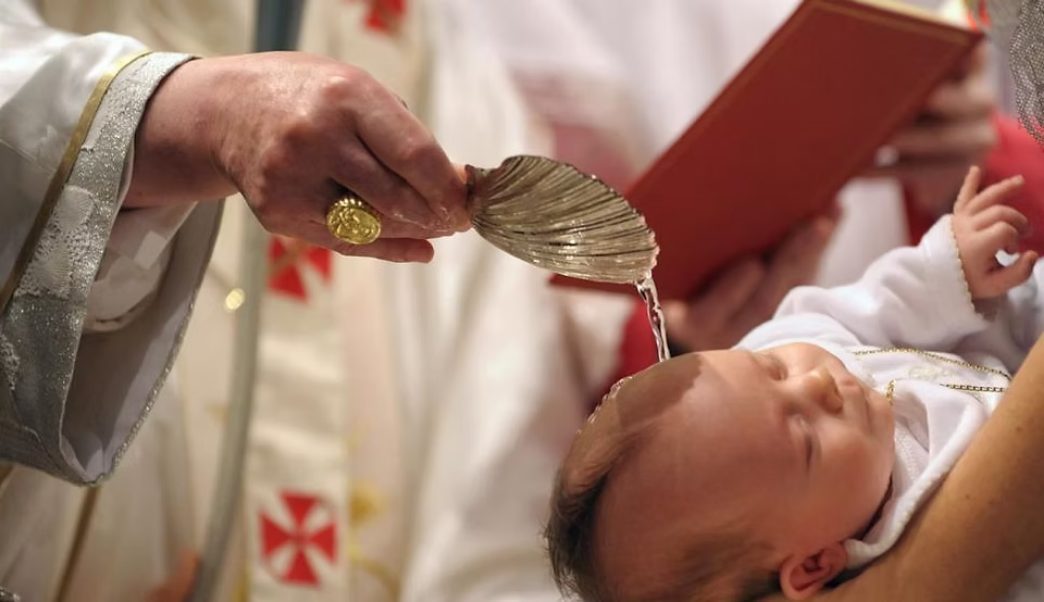
(ZENIT News / Augsburg, 08.22.2026).- A wealthy German businessman wanted to make it easier for families to bring their children to the baptismal font. His answer was unusually direct: €500 for every child baptized in participating Catholic parishes around Lake Starnberg. The Diocese of Augsburg, however, has warned that generosity can become problematic when money and the sacraments become too closely connected.
The initiative, known as “Starnberg Guardian Angel,” was launched by entrepreneur Peter Löw with an explicitly charitable purpose. In one of Germany’s most expensive regions, the financial burden associated with raising children and organizing family celebrations can be significant. Löw has made €20,000 available this year, enough to support up to 40 baptisms, and in several cases the money has already been handed over following the ceremonies. Families are under no obligation in return.
The intention, therefore, is not difficult to understand. Nor is the underlying social concern. If economic pressure is genuinely making families hesitate over a religious celebration, helping parents with the costs of family life can be a meaningful act of generosity.
Yet the Diocese of Augsburg has chosen to distance itself from the scheme, identifying a question that goes deeper than the amount of money involved.
In a statement, the diocese acknowledged that individuals are entirely free to give gifts to others. But when financial considerations become directly associated with receiving a sacrament, it said, an unavoidable unease arises from the Church’s perspective.
That distinction matters because baptism is not a commercial service, nor is it a reward for fulfilling a religious requirement. For Catholics, it is a sacrament through which a person is incorporated into the life of the Church. Linking its celebration too closely to a financial incentive risks creating precisely the wrong impression: that participation in the Church can be encouraged through material benefit.
There is also a more practical concern. The diocese stresses that the celebration of the sacrament itself is completely free. Catholics who meet the necessary conditions have the right to receive the sacraments, while Catholic parents have a responsibility to have their children baptized and to raise them in the Christian faith.
That makes the €500 payment particularly delicate. A donation intended to help a family in need is one thing; money that arrives because a particular sacrament has taken place is another.
The controversy has not been confined to diocesan offices. Andreas Jall, pastor of Starnberg, said some parishioners believed the initiative was damaging the reputation of the Church, even while acknowledging the unusually high cost of living in the region and the financial pressures facing families.
A potentially better solution would be to separate the two issues altogether: rather than rewarding baptisms, charitable funds could assist families experiencing genuine financial hardship, regardless of whether they are preparing for a baptism. That would preserve the philanthropic purpose without placing a price tag, however unintended, next to a sacramental act.
The diocese has also raised an ecumenical question. If the intention is to help Christian families, why should such assistance be restricted to one denomination? Baptism is administered in different Christian communities, and the Catholic Church recognizes valid baptism with water in the name of the Father, Son and Holy Spirit.
The episode ultimately illustrates a tension that churches frequently encounter: how to support families materially without allowing material assistance to obscure the meaning of faith.
Löw’s proposal appears to have emerged from a desire to help rather than from any stated attempt to commercialize religion. But the Church’s caution is understandable. Charity can pay a family’s bills; it should not determine the value attached to a sacrament.
Thank you for reading our content. If you would like to receive ZENIT’s daily e-mail news, you can subscribe for free through this link.

Publicaciones relacionadas:
 Argentina: In the Era of President Milei, the Catholic Church Gives Up State Funds
 The number of priestly ordinations in Catholic Poland is plummeting: here are the figures for 2026
 Catholicism Is in Decline in Argentina Despite Having a Pope from That Country: Findings from a Study by the University of Buenos Aires
 South Korean government passes laws ahead of World Youth Day. A television broadcast agreement is also signed
