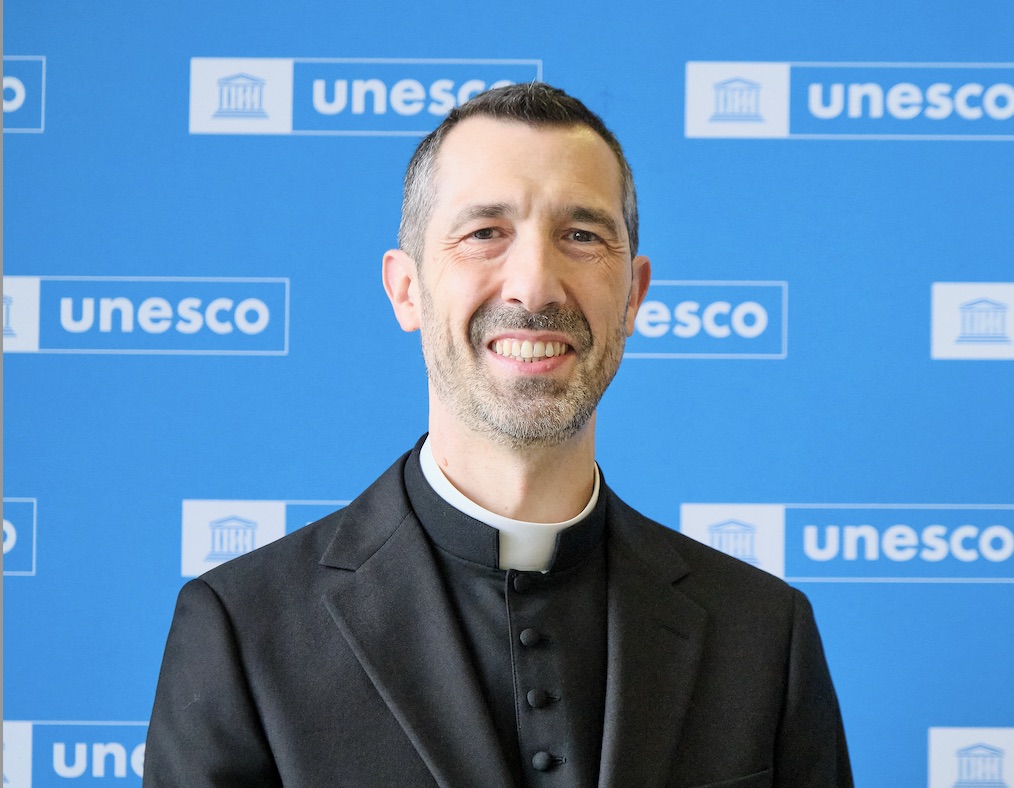
(ZENIT News / Paris, 09.08.2026).- Italian diplomat and canon lawyer Archbishop Roberto Campisi has served as the Holy See’s Permanent Observer to UNESCO, the United Nations Educational, Scientific and Cultural Organization, since last September. In this capacity, he will welcome Pope Leo XIV on September 25 at the institution’s headquarters in Paris.
The Permanent Observer to UNESCO is responsible for continuously representing the Holy See. He acts as the voice of the Church, and his mission is to uphold ethics and respect for the dignity of the human person. His work also seeks to promote peace and dialogue among peoples, as well as the preservation of universal religious heritage.
* * *
ZENIT: Pope Leo XIV will be at UNESCO headquarters on Friday, September 25. Why do you consider this visit particularly important?
Msgr. Roberto Campisi: It is important, first and foremost, for its historical significance. Forty-six years after Saint John Paul II’s 1980 address, Leo XIV will be the second Pope to visit UNESCO headquarters. He will address an institution that unites peoples around areas essential to humanity’s future: education, culture, science, communication, and the protection of heritage.
Furthermore, this visit aligns with the priorities the Holy Father has championed since the beginning of his pontificate. Peace, human dignity, the education of young people, and human responsibility regarding new technologies are fundamental pillars of his teaching. UNESCO offers a privileged platform for sharing these convictions with the international community, transcending political, cultural, and religious differences.
Ultimately, this visit demonstrates the importance the Holy See attaches to multilateral dialogue. At a time when trust between nations is fragile, the Pope’s presence reminds us that international cooperation remains essential. The great challenges of our time demand a shared will and constant dialogue among States, something no single entity can spearhead on its own.
ZENIT: Can we say, then, that the Pope’s priorities closely align with those of UNESCO regarding human dignity and care for the most vulnerable?
Msgr. Campisi: From his very first words on the day of his election, Pope Francis advocated for a peace that is “unarmed and disarming,” humble and persevering. This entails renouncing the logic of domination, disarming words, behaviors, and consciences, and rebuilding trust among people and nations.
From that perspective, there is, therefore, a profound convergence with UNESCO’s mission. The Holy See and UNESCO share the conviction that true peace is built over time and depends on how we educate young people, respect cultures, and uphold human dignity.
This convergence is also evident in the attention paid to the most vulnerable: children deprived of education, populations affected by conflict, migrants, victims of discrimination or the digital divide, as well as communities whose heritage and memory are under threat.
ZENIT: What aspect of the Permanent Mission’s current work would you like to share with the Holy Father during his visit?
Msgr. Campisi: The Holy See closely follows the activities of the Permanent Mission. Our role is to oversee the Organization’s work and convey the Holy See’s contribution, reminding everyone that the decisions taken must always take into account their concrete consequences for the human person.
Artificial intelligence now plays a fundamental role in our work. We strive to promote an approach that harnesses the opportunities offered by innovation while upholding human responsibility, freedom, justice, and the protection of the most vulnerable. Likewise, we closely follow debates on bioethics and ecology, always with a view toward integral human development.
The Holy Father’s visit will therefore provide an opportunity to highlight this daily work. It will serve as a reminder that the Holy See’s commitment to UNESCO is part of a constant, long-standing presence centered on dialogue.
ZENIT: Last April, you warned about the destruction of places of worship and cultural heritage sites in various countries. Might the Pope’s visit reinforce this urgent call for the protection of universal religious heritage?
Msgr. Campisi: I sincerely hope so. The destruction of a place of worship, a monument, a library, or an archaeological site affects far more than just a building: it strikes at the memory of a people, their religious freedom, and often the very conditions necessary for future reconciliation.
In various contemporary conflicts, cultural and religious heritage has become a target. Its destruction can be used to erase a community’s historical presence, deny its identity, or hinder its recovery. Therefore, its protection should not be viewed as a secondary matter, as heritage is an integral part of community life and the right to pass on one’s history to future generations.
The Pope’s words could lend greater moral authority to this appeal and underscore the universal nature of religious heritage. A church, mosque, synagogue, monastery, or cemetery may belong to a specific community, but its cultural and spiritual value concerns all of humanity.
I also hope that this visit strengthens the international community’s commitment to respecting existing conventions, preventing destruction, combating the illicit trafficking of cultural property, and documenting attacks on heritage. Furthermore, it can serve as a reminder that no military, political, or ideological consideration justifies erasing a people’s memory and identity.
ZENIT: Do you personally feel that international bodies listen to you during meetings? And in what concrete ways do you manage to instill Gospel values in the Member States?
Msgr. Campisi: Yes, I feel heard, I almost consider it a small diplomatic miracle! The Holy See is undoubtedly the only delegation whose voice carries weight without the need to vote or defend a specific agreement. Our presence is valuable because it seeks to foster dialogue and offer reflections free from any national, economic, or strategic interests, even when they differ from positions expressed within the Organization.
In concrete terms, we participate in debates, negotiations, and meetings with representatives of Member States and UNESCO officials. We seek to remind everyone that, behind technical formulations, norms, and programs, there are always human beings.
The Holy See’s contribution, therefore, consists of raising certain essential questions: Is this progress at the service of the whole person and of all peoples? Does it protect the most vulnerable? Does it respect freedom and conscience? Does it promote justice, fraternity, and peace? The values we defend have their roots in the Gospel, but they also resonate with what every great humanist and spiritual tradition recognizes: the dignity of each person, care for the most vulnerable, and fraternity. They are defined less by words than by a way of engaging in dialogue, listening, and seeking the common good, with an emphasis on building relationships and the conviction that every person and every people has its place.
ZENIT: Finally, what concrete progress might we expect following the Pope’s visit to UNESCO headquarters?
Msgr. Campisi: This progress could be summed up in one word: mobilization! The Pope’s visit does not aim to replace the patient work of the institutions themselves; rather, it propels that work forward, allows for the reaffirmation of principles, offers guidance, and opens up new avenues for collaboration. I hope this visit fosters lasting alliances in the fields of education, culture, the ethics of artificial intelligence, and heritage protection.

Publicaciones relacionadas:
 Do I need healing? Human wounds and healing ministry in the Church. Interview with Father Miguel Guerra, LC (Part I)
 Archbishop Georg Gänswein Reveals that Pope Francis’ Liturgical Reform “Hit Hard” Benedict XVI’s Heart
 The Papal Court and the Future of the Church
 Fr Sliman: As war affects daily life in Kuwait, the Church responds to the uncertainty