

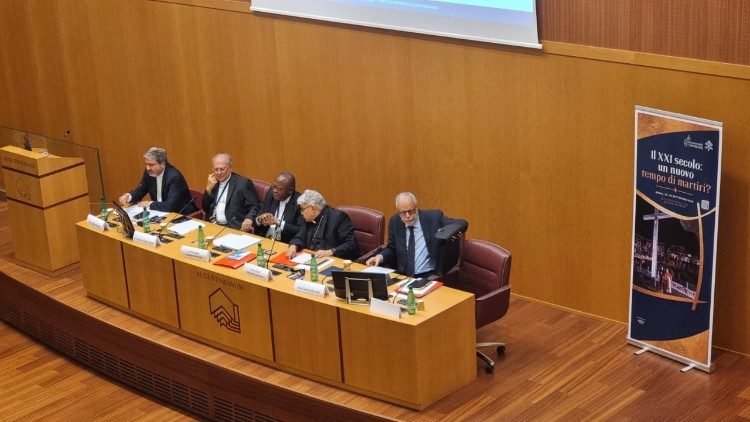
(ZENIT News / Rome, 09.19.2026).- The 21st century is already leaving behind a Christian memorial written not in documents, but in blood. More than 1,700 Christians who died because of their faith have now been recorded by a Vatican commission, with another 100 to 150 names added during 2026. The list crosses continents and, significantly, crosses confessional boundaries: the dead being remembered are not only Catholics, but Christians of other traditions who were killed for bearing witness to Christ.
The figures emerged during a two-day international conference in Rome on September 15-16, organized by the Commission for New Martyrs – Witnesses of the Faith under the Dicastery for the Causes of Saints. Created by Pope Francis in July 2023, the commission has been charged with gathering evidence about Christians who have died because of the Gospel and compiling a catalogue that preserves their memory even when no formal canonization process follows.
That distinction is essential. The Vatican is not producing a new list of saints by administrative decree. Cardinal Marcello Semeraro, prefect of the Dicastery, stressed that the Church does not simply “create” saints. Canonization is a formal ecclesial judgment subject to specific requirements, while the catalogue has a wider purpose: to recover the testimony of people whose deaths may never lead to beatification or canonization.
In other words, Rome is trying to make sure that the absence of a canonical process does not become a second death—the disappearance of a Christian’s witness from collective memory.
The commission’s work also challenges a familiar assumption about martyrdom. It is not confined to spectacular episodes of religious persecution or to Christians killed explicitly during acts of worship. In South America alone, the Vatican has documented 304 martyrs from the beginning of the century. According to Semeraro, many were missionaries and lay faithful murdered in circumstances connected with drug trafficking, deforestation or resistance to the exploitation of natural resources. Their Christian commitment made them an obstacle to illicit interests.
Africa remains another major focus. The congress examined countries including Nigeria, Mozambique and Burkina Faso, while Cardinal Fridolin Ambongo of Kinshasa addressed the situation in the Democratic Republic of Congo, where the Islamic State recently claimed responsibility for the killing of 130 Christians in August. The commission is also examining cases from the Holy Land, Europe and Asia, illustrating the geographical breadth of contemporary Christian persecution.
Andrea Riccardi, historian and vice president of the commission, therefore argued that the language of a “new age of martyrs” should not be treated as merely symbolic. In his assessment, martyrdom remains a defining reality of the present century.
Yet the Vatican’s initiative is about more than persecution statistics. At the heart of Semeraro’s closing address was a different question: what does martyrdom reveal about the human person?
For the cardinal, the martyr is not someone who glorifies suffering. Rather, martyrdom becomes intelligible as a radical expression of love, truth and fidelity. The witnesses remembered by the Church are people who placed truth before falsehood, justice before violence, fidelity before opportunism and the dignity of conscience before compromise. Their importance therefore extends beyond ecclesial history: they demonstrate what human beings can be capable of when conviction is stronger than the instinct for self-preservation. This is also why the commission deliberately looks beyond Catholicism.
The Vatican’s recognition of a shared Christian martyrdom has a striking ecumenical dimension. The inclusion of 21 Coptic Christians in the Roman Martyrology in 2023 already provided a powerful example of how Christians from different traditions can be remembered together. The commission now speaks of a “common martyrdom” among the baptized, concentrating on those who shed their blood in confession of Christ rather than on the denominational boundaries separating Christian communities.
Semeraro described this as an “ecumenism of blood”: a form of Christian unity that can precede theological agreement. Christians who may still face divisions in doctrine or ecclesial structures can nevertheless find themselves united at the point where fidelity to Christ demands the ultimate sacrifice.
That idea gives the Vatican catalogue an unusual character. It is neither a substitute for the Church’s official Martyrology nor simply a historical database. It is intended to preserve a broader field of Christian testimony, including hidden and anonymous forms of holiness that might otherwise disappear from public memory.
The concept also explains why the commission’s work is not simply backward-looking. Semeraro recalled the Christian tradition’s insistence on the “high standard of ordinary Christian life” and the idea, emphasized in recent decades, of holiness found close at hand. Martyrdom is the most dramatic form of witness, but the catalogue points toward a larger reality: sanctity can remain largely invisible while still belonging to the living heritage of the Church.
That perspective matters in an age in which freedom is often understood principally as the absence of constraint and happiness as the attainment of material well-being. The martyrs pose a more demanding question. Are there truths, relationships and moral commitments that a person considers so fundamental that abandoning them would mean losing something essential about himself?
For the Vatican, the answer is written into the lives of those now being documented.
The catalogue’s growing list—already exceeding 1,700 names and still expanding—thus serves two purposes at once. It remembers Christians whose lives were violently cut short, while challenging those who remain to consider what their own faith means when it encounters pressure, injustice or fear.
The striking paradox is that a catalogue devoted to death ultimately speaks about life. The martyrs are remembered not because suffering is itself valuable, but because their deaths are understood as the final testimony of lives ordered toward Christ, truth, justice and human dignity.
Thank you for reading our content. If you would like to receive ZENIT’s daily e-mail news, you can subscribe for free through this link.

Publicaciones relacionadas:
 Pope Leo XIV to publish new document on Catholic education and declare Newman co-patron of Catholic education
 Mystical Phenomena and Holiness Explained by Pope Leo XIV
 From Oxford to the Catholic Liturgical Calendar: Vatican gives St. John Henry Newman a place in the Catholic Church’s daily prayer
 A Cause Halted, A Legacy Questioned: The Vatican Freezes Jorge Novak’s Path to the Altars
