

(ZENIT News / Washington, 10.29.2026).- Claims of a religious revival among young Americans have attracted growing attention over the past year. Yet new analyses by the Pew Research Center suggest that the reality is considerably more nuanced: some of the youngest adults appear unusually active in religious services, but the broader picture remains one of long-term stability, with no clear evidence of a nationwide spiritual awakening.
The most striking finding comes from a report published on October 28. Among Americans born between 2004 and 2008, now aged 18 to 22, 41% said they attend religious services at least once a month. That is higher than the national average of 33% and exceeds the figure for every other age group except those born before 1950, among whom attendance reaches 43%.
For Chip Rotolo, a senior researcher on Pew’s Religion and Public Life team, the result was surprisingly high. But he cautioned against interpreting it as proof of a generational transformation. The survey included just 443 people in this age bracket, leaving a margin of error of approximately six percentage points. Moreover, the figures contrast sharply with those for Americans aged 23 to 26, who emerge as the least religious group across several measures.
Only 27% of those born between 2000 and 2003 attend religious services monthly, while 26% pray daily, 27% consider religion very important in their lives and 50% identify with a religious tradition. The younger cohort, despite its comparatively strong church attendance, does not display equally high levels of religious commitment in other areas: 34% pray daily and 59% identify with a religion.
This distinction matters. Regular attendance does not necessarily indicate a deeper revival of belief, just as religious identification does not automatically translate into participation in worship or prayer. The figures suggest that the youngest adults may be returning to religious spaces without yet demonstrating a comparable change across the full range of religious practices.
The gender findings add another unexpected dimension. Among 18- to 22-year-olds, 47% of men reported attending religious services at least monthly, compared with 35% of women. Rotolo noted that this is the first time Pew has observed young men appearing more religious than young women on certain measures. However, the increase in attendance was not confined to men: it was also visible among women and among both Republicans and Democrats. The researcher therefore warned against reducing the phenomenon to a single political or demographic explanation.
Other surveys had already raised the possibility of a shift. In September 2025, Barna Group reported that Generation Z churchgoers attended services an average of 1.9 times per month, slightly more often than millennials, at 1.8 times. Gallup data published in April 2026 also suggested that 42% of men aged 18 to 29 considered religion very important, compared with 28% in 2022–2023. Meanwhile, research by the Public Religion Research Institute found that young women were more likely than young men to identify with no religion. Taken together, these results point to changing patterns, but they do not yet establish a consistent generational reversal.
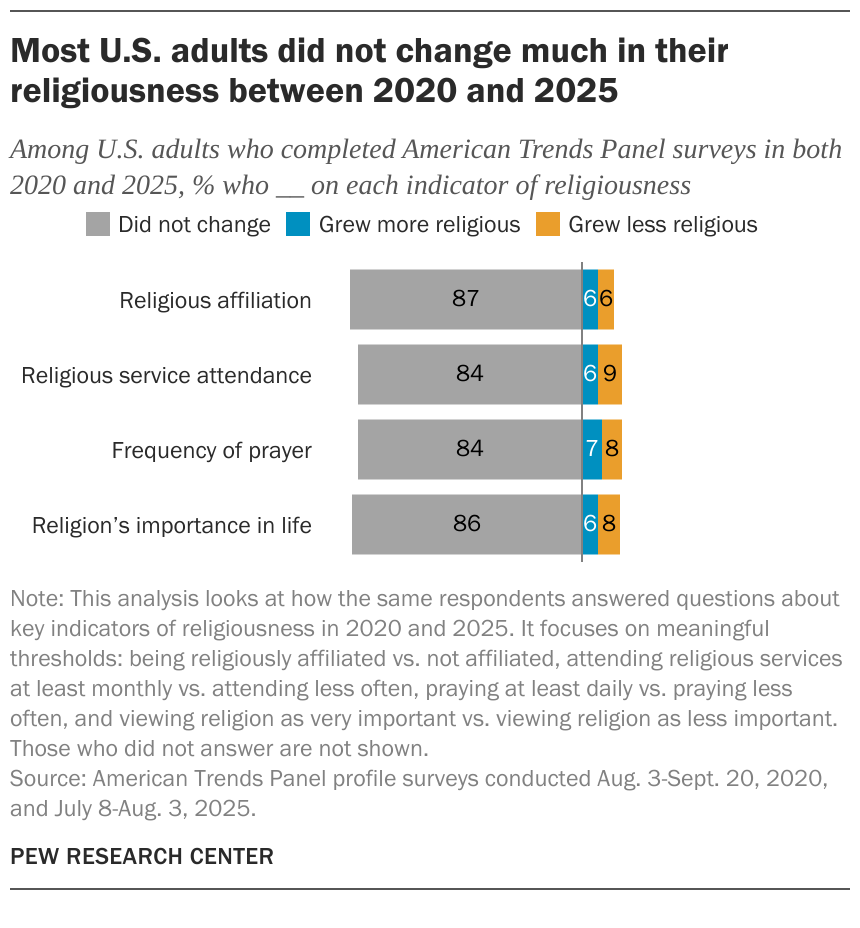
A second Pew analysis, based on a different methodology, helps put the debate into perspective. Rather than comparing different age groups at one moment, researchers followed the same 5,835 American adults who completed surveys in both 2020 and 2025. This longitudinal approach makes it possible to see whether individuals actually changed their religious habits and affiliations over time.
The central conclusion was strikingly stable. Between 84% and 86% of respondents gave the same answers in 2025 as they had five years earlier on three key measures: monthly religious attendance, daily prayer and the importance of religion in their lives. In terms of religious affiliation, 87% remained in the same position, either continuing to identify with a religion or remaining unaffiliated. Six percent moved from having no religious affiliation to identifying with one, while another 6% moved in the opposite direction.
The modest changes that did occur leaned slightly toward disengagement. Attendance at religious services declined on balance by three percentage points, while the share considering religion very important fell by two points. These movements, however, were too limited to support claims of either a major religious collapse or a substantial revival.
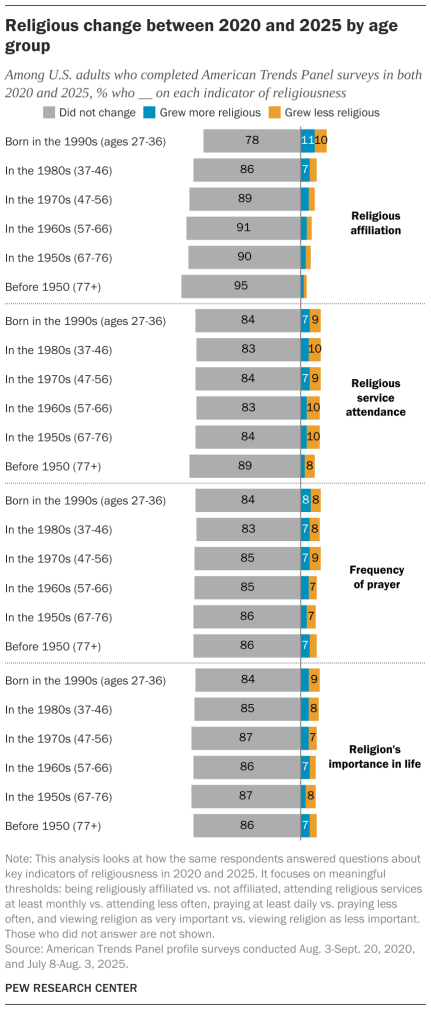
The pattern of relative stability extended across age groups, genders and political affiliations. Younger adults were more likely than older people to change their religious identity: 78% of those born in the 1990s retained the same affiliation between 2020 and 2025, compared with 95% of those born before 1950. Yet within the younger group, movement in both directions was broadly comparable, with some embracing a religious identity and others abandoning one. The study could not assess today’s youngest adults, since too few people born in the 2000s were old enough to participate in the 2020 survey.
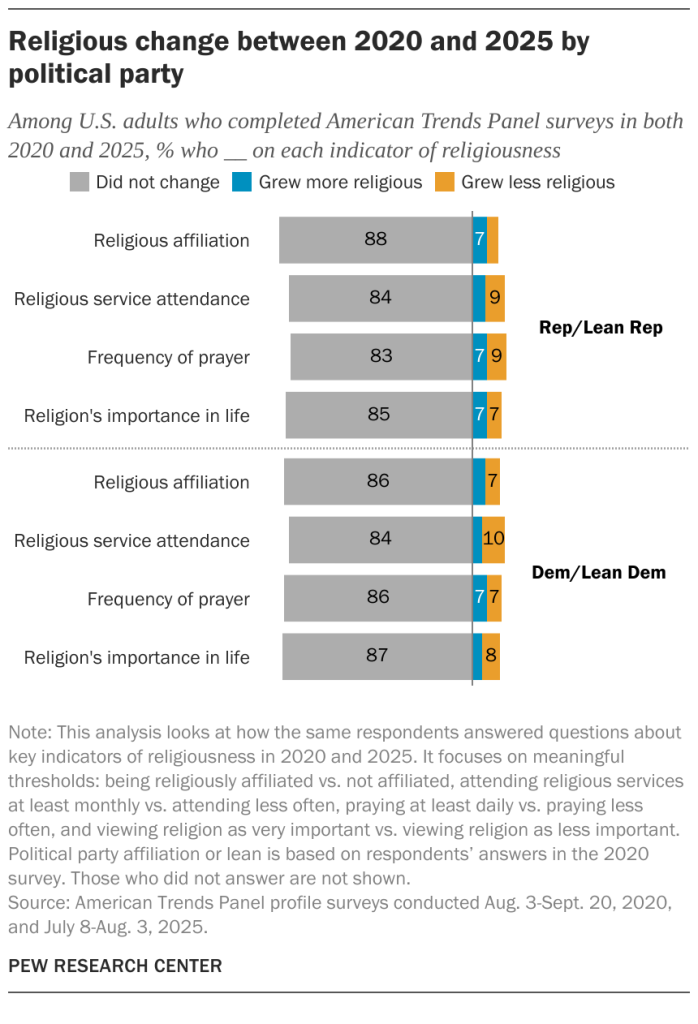
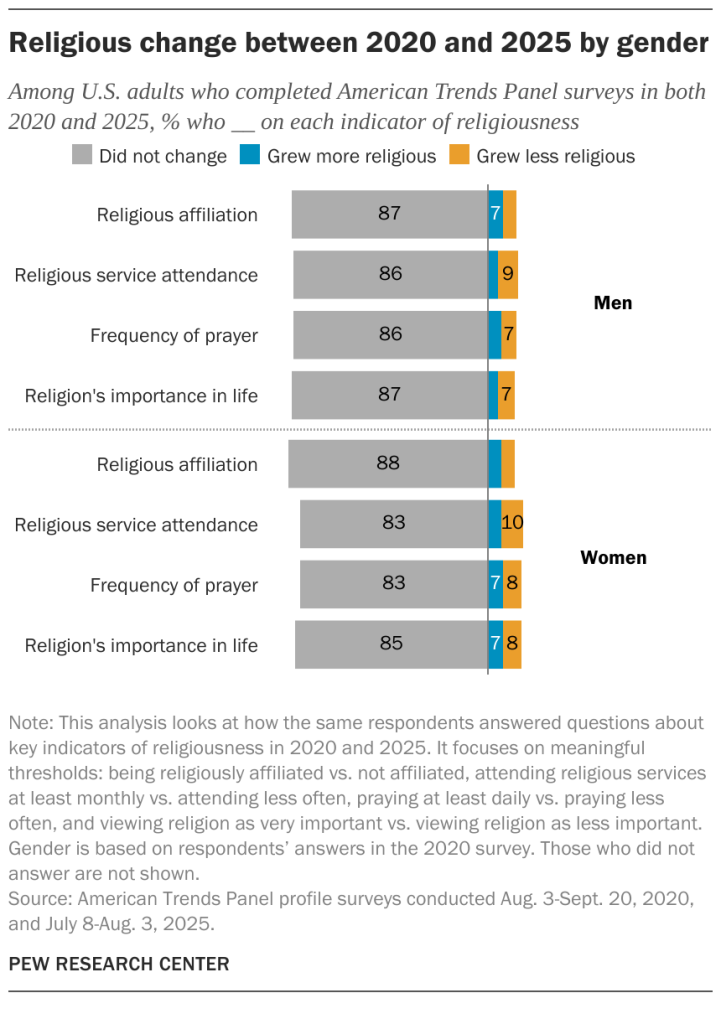
There was also a small net decline in monthly attendance among both men and women. Nine percent of men stopped attending at least monthly, while 5% began doing so. Among women, the corresponding figures were 10% and 6%. Neither major political camp escaped the same general tendency.
The two reports measure different things and should not be treated as direct contradictions. One identifies an unusually high level of attendance among a relatively small group of 18- to 22-year-olds; the other tracks individual changes over five years but cannot adequately represent that youngest generation. Together, however, they offer a useful warning against turning isolated statistics into sweeping cultural narratives.
For communities, the findings present both an opportunity and a challenge. A willingness among some young adults to enter churches and attend services deserves attention, but attendance alone cannot be mistaken for lasting conversion or mature religious commitment. The deeper question is whether these encounters lead to a sustained relationship with faith, prayer, community and the moral responsibilities that religious traditions seek to cultivate.
Thank you for reading our content. If you would like to receive ZENIT’s daily e-mail news, you can subscribe for free through this link.