

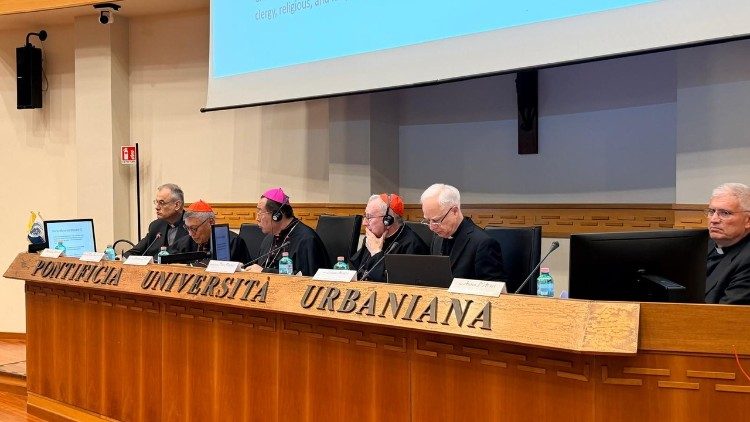
(ZENIT News / Rome, 11.05.2026).- A century after the first six Chinese bishops were consecrated in Rome, the Catholic Church is once again confronting a question that has shaped its history in China: how can a Church rooted in a particular culture remain fully united with a universal authority beyond the reach of the state? At an international conference in Rome, senior Vatican officials and Chinese bishops presented sharply consequential perspectives on the relationship between Catholic identity, national culture and political authority, exposing both the possibilities and the tensions surrounding the Vatican’s engagement with Beijing.
The meeting, held on November 5 at the Pontifical Urbaniana University, commemorated the consecration of the first six Chinese bishops by Pope Pius XI in St Peter’s Basilica on October 28, 1926. It brought together Cardinal Pietro Parolin, the Vatican Secretary of State, Cardinal Stephen Chow of Hong Kong and two mainland Chinese prelates: Archbishop Joseph Li Shan of Beijing and Bishop Ignatius Ding Zuyao of Haimen. Pope Leo XIV addressed participants in a video message, recalling the journey made by the six bishops from Shanghai to Rome as a powerful expression of communion with the Successor of Peter.
For Leo, that historic journey remains relevant to a world fractured by conflict and war. The unity of each bishop with the Bishop of Rome, he said, is an indispensable sign of ecclesial communion and a source of goodness and peace. His message placed the anniversary within a distinctly universal vision of the Church, one in which the diversity of peoples and cultures does not diminish the bonds that unite Catholics across national boundaries.
That emphasis on communion was also central to Parolin’s address. The Pope’s primacy, he argued, should not be understood as an external political authority imposed upon local Churches. Rather, the ministry of Peter and the mission of individual bishops belong to the same ecclesial reality. The universal Church and local Churches are not competing structures but intimately connected dimensions of the one Church of Christ. Parolin expressed the hope that the communion already existing between the Pope and the bishops in mainland China would find increasingly concrete ways to develop and become stronger.
Yet the conference also brought into focus a more difficult dimension of the relationship: the Chinese government’s policy of religious sinicization, which seeks to align religious life with Chinese culture, national priorities and the ideology of the Communist Party. The distinction between genuine cultural integration and political control is therefore central to the future of Catholicism in the country.
Archbishop Li Shan defended sinicization as an essential part of the Church’s Catholic identity, not an attempt to create a different form of Catholicism detached from its tradition. He argued that Christianity must take root in the society in which it lives and that the Chinese Church should be governed and served by its own clergy. In his view, the development of a genuinely local Church is not a concession to the state but a necessary expression of the universal character of Catholicism.
There is substantial historical ground behind part of that argument. The movement to establish a Chinese clergy and reduce the Church’s dependence on foreign missionaries long predates the Communist government. The 1924 Council of Shanghai, convened by Archbishop Celso Costantini, called for the formation of local priests and the development of a Church no longer identified with Western political interests. Pope Benedict XV had already urged the formation of indigenous clergy in his 1919 apostolic letter Maximum illud. The Jesuit Matteo Ricci, who established himself in Beijing in 1601, had likewise understood that the Gospel could not take root in China without a serious engagement with its intellectual and cultural traditions.
The obstacles were considerable. The first Chinese bishop, Luo Wenzao, faced decades of resistance before his consecration in 1685. Even in the early twentieth century, foreign missionaries continued to dominate Church governance: before the establishment of the People’s Republic of China, only 28 of the country’s 137 ecclesiastical jurisdictions had Chinese bishops, while just three of its 20 archbishops were Chinese. The six bishops consecrated in Rome in 1926 represented a decisive step towards local leadership, although they did not immediately end foreign control.
Li presented the subsequent development of the Chinese Church as a continuation of that process. He said that more than 80 bishops now exercise pastoral ministry in China and described the Church as increasingly committed to local responsibility, the formation of clergy and the renewal of ecclesiastical discipline. He also compared the collective management of Church affairs in China with the recent Catholic emphasis on synodality, arguing that clergy, religious women and lay faithful participate together in the life of the local Church.
But Li’s defence of sinicization went beyond cultural adaptation. He maintained that obedience to Chinese state laws should be understood as a natural expression of Christian faith, invoking Christ’s instruction to give Caesar what belongs to Caesar and God what belongs to God. In his presentation, state legislation establishes the legitimate limits of religious activity while safeguarding the normal exercise of evangelization and pastoral care. Church law, he argued, complements those provisions by guiding the moral life of believers.
This is precisely where the debate becomes more delicate. The Chinese government’s approach to religion is not limited to encouraging local languages, customs or forms of expression. Under President Xi Jinping, sinicization has been applied across religious communities as part of a wider effort to align them with socialist values, patriotic expectations and the political direction of the Communist Party. Cardinal Chow acknowledged this broader context, noting that the policy affects all religions in China and reflects the authorities’ concern that religious institutions might become channels for foreign influence.
Chow nevertheless sought to frame the process in terms of inculturation and what he called interculturality: a reciprocal encounter in which the Gospel transforms a culture while the culture contributes to the way faith is understood and lived. The challenge, he said, is for Chinese Catholics to remain loyal both to their country and to their faith. Such an encounter requires genuine dialogue, attentive listening and a willingness to recognize differences rather than simply impose one side’s understanding on the other.
The distinction is crucial. Inculturation is a longstanding principle of Catholic missionary activity: the Church does not require every people to adopt a foreign cultural identity in order to embrace Christianity. But cultural adaptation cannot mean that political authorities acquire the right to determine the content of Catholic belief, the Church’s internal governance or its communion with the Pope. The Catholic Church’s universality rests precisely on the conviction that no national government can become the ultimate authority over its faith and doctrine.
Developments in China underline the importance of that distinction. Regulations introduced in 2025 by the National Religious Affairs Administration prohibited foreigners from participating in common worship with Chinese citizens and required foreign visitors engaged in religious activities to respect the principle of religious independence and self-management under Chinese government supervision. Liturgies must take place in officially authorized venues and be presided over by approved Chinese ministers, with only limited exceptions requiring official permission. These restrictions raise questions about the practical meaning of religious freedom and the extent to which the Church can maintain its international bonds.
Hong Kong provides another reminder that the pressures surrounding Catholic life in China extend beyond the mainland. Although the diocese is not covered by the 2018 Vatican-Beijing agreement, Chow’s predecessor, Cardinal Joseph Zen, was arrested in 2022 under national security legislation in connection with a fund supporting protesters. He was ultimately convicted over the fund’s failure to meet registration requirements. More recently, local clergy have reported increased pressure on Catholic officials in the territory.
Against this background, the provisional agreement between the Holy See and Beijing remains a central instrument of Vatican diplomacy. Signed on September 22, 2018, and renewed most recently in 2024 for a further four years, it addresses primarily the appointment of bishops, one of the most persistent sources of conflict between Rome and the Chinese authorities. It helped create a framework for overcoming the division between the state-backed Catholic Patriotic Association and communities that had remained outside official structures. But it has not resolved the deeper question of how ecclesiastical authority and state power should coexist.
Parolin, who has been one of the principal architects and defenders of the agreement, made no attempt to portray it as a perfect arrangement. All agreements, he observed, have imperfections, particularly when negotiated under such complex circumstances. The important thing, he insisted, is to continue working to improve what remains incomplete. His presence alongside Chinese bishops in Rome was itself, he suggested, a sign that the process of reconciliation and communion remains open.
The anniversary thus offered more than an occasion to celebrate the emergence of a Chinese episcopate. It exposed the competing meanings that can be attached to the idea of a Church rooted in its own country. For the Vatican, the development of local Churches must strengthen, not weaken, their communion with Rome. For Chinese authorities, religious sinicization is also a means of ensuring that religious institutions operate within the political and ideological framework established by the state.
The two objectives can coexist only if the distinction between legitimate national sovereignty and the Church’s freedom to govern its spiritual life is respected. A Catholic Church that takes Chinese culture seriously need not become a political instrument of the Chinese state. The achievement of the six bishops consecrated in 1926 was to demonstrate that Catholicism could be genuinely Chinese without ceasing to be universal. One hundred years later, that remains the essential test.
Thank you for reading our content. If you would like to receive ZENIT’s daily e-mail news, you can subscribe for free through this link.

Publicaciones relacionadas:
 Canada: Trudeau Against Religious Freedom Under Bias of “Hate Speech”
 Chinese Government Poses Problems for the Catholic Church in Hong Kong Over the Secret of Confession
 Religious Freedom Gains Momentum Across the United States, New Survey Reveals
 This is what the 2026 Annual Report on Religious Freedom in Latin America states
