

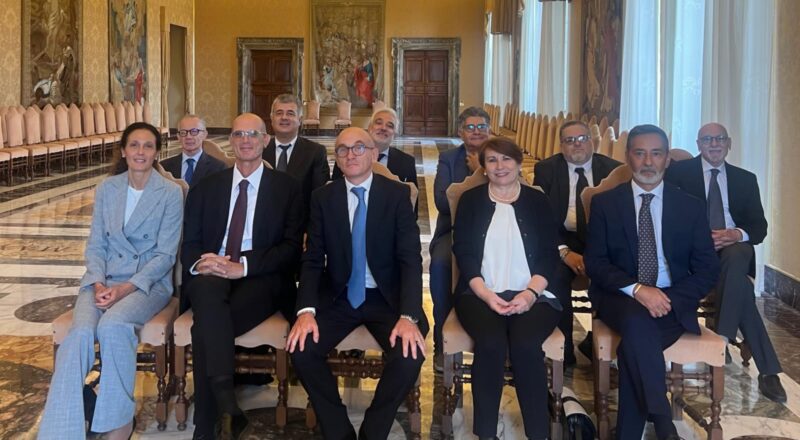
(ZENIT News / Vatican City, 10.05.2026).- Pope Leo XIV has placed the dignity of work and the treatment of employees at the center of a significant meeting with Vatican lay workers, calling for a workplace culture in which dialogue replaces confrontation and no employee is treated as expendable.
Speaking on October 5 in the Consistory Hall of the Apostolic Palace, Leo XIV received representatives of the Association of Lay Employees of the Vatican and the Association of Women in the Vatican. The meeting brought together two organizations with different histories and purposes but a common place of work: the Holy See.
The Pope’s starting point was broader than labor policy. He urged those present to keep “awake the attention” to the irreplaceable centrality of the human person and to the inalienable dignity of work. Work, he said, is not merely a mechanism for earning a living or keeping an institution functioning. Through work, people develop their abilities, contribute to society and the common good, improve the world around them and accomplish things that no individual could achieve alone.
That emphasis gives the encounter a distinctly social dimension. For Leo, the Vatican’s mission cannot be separated from the way people who work for the Holy See are treated. An institution that speaks publicly about human dignity must also embody that principle in its own working relationships.
The Pope gave particular attention to the contribution of women, saying that their growing presence in the Vatican should be increasingly recognized and valued. He pointed not only to their professional and intellectual abilities but also to what he described as a particular sensitivity to people and relationships.
He encouraged the Association of Women in the Vatican to use its creativity, professional competence and capacity for discernment to strengthen a culture of cooperation, mutual listening and attention to people facing difficulties.
Yet the most consequential part of the meeting may have concerned the relationship between employees and those responsible for governing the Holy See. Leo recalled that previous popes, when addressing the nature of work at the Apostolic See, had placed two ideas at its center: community and unity.
His proposed instrument for achieving them was dialogue.
The Pope described dialogue as a “master path,” both for coexistence and for confronting disagreements. That language is particularly relevant to the Association of Lay Employees of the Vatican, an organization founded in 1979 that has sought to represent employees and promote what it regards as greater justice in working conditions.
The association’s representatives emerged expressing satisfaction and a desire to respond to Leo’s invitation. Its executive secretary, Paola Monaco, said the organization intends to pursue dialogue with all parties concerned and described the papal meeting as a valuable opportunity.
The association also hopes to begin what it characterized as a sustained, constructive and sincere process of discussion. It wants to be regarded as a resource in the service of the Pope’s mission while awaiting approval of a new statute and recognition of its legal personality.
That aspiration has a complicated background. The association is effectively a workers’ representative organization, and it has for years pursued disputes involving the Holy See over employment conditions. It does not have formal recognition from the Holy See as a trade union, since unions are not permitted there.
The significance of Leo’s invitation therefore lies partly in what it does not say. He did not announce recognition of a Vatican trade union, nor did he endorse any particular labor dispute or demand. Instead, he placed the relationship between employees and the institution within a framework of human dignity, participation and dialogue.
That distinction could prove important. Dialogue does not automatically resolve disagreements over contracts, working conditions, representation or institutional authority. But it can create a different setting in which those disagreements are addressed.
The Association of Lay Employees of the Vatican has linked its mission to Catholic social teaching and to the increasingly active role of the laity in the life of the Church. Its representatives invoked a trajectory running from Leo XIII’s social teaching through the Second Vatican Council’s teaching on the laity and the reform of the Roman Curia to more recent developments in the Church’s social and administrative vision.
Leo’s words also suggest that he sees workplace relationships as part of the credibility of the Vatican’s broader mission. His final appeal was particularly direct: he called for a working community in which people are neither “used nor left behind,” in which colleagues help one another, and in which each person’s value and competence are recognized.
For a Vatican bureaucracy facing the ordinary pressures of any large institution — differing responsibilities, competing expectations and disputes over working conditions — that is more than a message about courtesy. It is a proposition about how authority should function.
Thank you for reading our content. If you would like to receive ZENIT’s daily e-mail news, you can subscribe for free through this link.

Publicaciones relacionadas:
 Pope Francis Institutes Vatican’s Investments Committee Headed by Cardinal Kevin Farrell
 Pope Announces that Two Women Will Assist Him in the Dicastery that Chooses the Bishops from Around the World
 Becciu case: Vatican appeal trial enters uncharted waters amid questions about the role of the prosecution
 Leo XIV overturns Pope Francis’ decision and restructures Vatican finances under one principle: shared responsibility
