

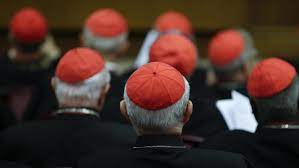
(ZENIT News / Rome, 01.20.2026).- At a moment of acute international tension, three Catholic cardinals in the United States have stepped into the foreign-policy debate with an intervention that is both rare and carefully calibrated. On 19 January 2026, Cardinals Blase J. Cupich of Chicago, Robert W. McElroy of Washington, and Joseph W. Tobin of Newark released a joint statement urging the Trump administration to recover what they describe as a moral vision capable of guiding American power in a fractured world.
Their appeal comes as Washington faces criticism on multiple fronts: a controversial U.S. military operation in Venezuela that led to the removal and prosecution of President Nicolás Maduro; renewed threats to take control of Greenland, a resource-rich, semi-autonomous territory within the Kingdom of Denmark and a NATO ally; and sweeping cuts to U.S. foreign assistance following the dismantling of much of the U.S. Agency for International Development in 2025. To the three cardinals, these developments are not isolated policy choices but symptoms of a deeper crisis in moral reasoning.
In their assessment, the United States has entered its most divisive debate over the ethical foundations of foreign policy since the end of the Cold War. Venezuela, Ukraine, and Greenland, they argue, have reopened fundamental questions about the legitimate use of military force and the meaning of peace in a post–Second World War international order built on respect for borders and multilateral cooperation. Without a coherent moral framework, Cardinal McElroy warned in remarks to The Associated Press, the discussion risks collapsing into polarization, partisan reflexes, and narrow economic or social interests. “Much of the United States and much of the world,” he said, “is morally adrift on foreign policy,” even as American decisions continue to exert enormous global influence.
What gives the statement particular weight is its explicit grounding in the teaching of Pope Leo XIV. On 9 January, barely ten days earlier, the first U.S.-born pope addressed the diplomatic corps accredited to the Holy See in a nearly 45-minute speech delivered largely in English. Without naming specific countries, Leo XIV offered his most sustained critique to date of contemporary power politics, warning that nations are once again treating war as an acceptable instrument of policy and undermining the legal and moral architecture erected after 1945 to prevent precisely that outcome.
The cardinals make no attempt to disguise the context. Leo’s address was delivered against the backdrop of the U.S. operation in Venezuela, Washington’s rhetoric regarding Greenland, and Russia’s ongoing war in Ukraine. In their statement, Cupich, McElroy, and Tobin cite these same cases, arguing that they expose a growing tendency to equate peace with dominance and security with coercion. The pope’s diagnosis, they suggest, offers an “enduring ethical compass” for evaluating American conduct abroad.
Central to that compass is a rejection of war as a routine policy tool. The three prelates insist that military action must be considered only as a last resort in extreme circumstances, not as a normal expression of national interest. Cardinal Cupich, while acknowledging that holding leaders accountable for grave wrongdoing can be legitimate, criticized the manner in which Maduro was removed from power. Acting on the logic of “because we can, we will,” he argued, erodes respect for the rule of law and ultimately destabilizes the international system the United States claims to defend.
Equally significant is their emphasis on foreign assistance. Drawing directly from Leo XIV’s warnings, the cardinals lament the retreat of wealthy nations from humanitarian aid and development programs. Cardinal Tobin, who served for years as superior general of the Redemptorist order and ministered in more than 70 countries, stressed that U.S. aid has tangible effects on hunger relief, health care, and basic human dignity. Cutting such assistance, he suggested, contradicts any credible claim to moral leadership.
The statement also pushes back against the reduction of foreign policy to a calculus of individual rights or national advantage. “My prosperity cannot be built on the inhumane treatment of others,” Tobin said, summarizing what the cardinals describe as a Catholic vision oriented toward the common good. Protecting the right to life, safeguarding religious freedom, and upholding human dignity, they argue, are inseparable from how a nation exercises power beyond its borders.
The intervention is notable not only for its content but for its limits. The three cardinals are widely identified with the more progressive wing of the U.S. Church, and they are careful to insist that they do not endorse any political party or movement. Numerically, they represent a minority voice: the United States currently has nine cardinal electors and a total of sixteen cardinals when non-electors are included. Only one-third of the electors—and roughly one-sixth of U.S. cardinals overall—signed the statement. As such, it does not constitute an official position of the U.S. Conference of Catholic Bishops, nor a consensus of the American hierarchy.
Yet the stature of the signatories gives the document resonance. Cupich leads the Archdiocese of Chicago, one of the largest in the country, serving approximately two million Catholics through an extensive network of parishes, schools, and social services. McElroy heads the Archdiocese of Washington, with more than 600,000 faithful in the nation’s capital and surrounding Maryland communities. Tobin shepherds around 1.3 million Catholics in northern New Jersey. Collectively, their pastoral reach extends to nearly five million Catholics.
Their decision to speak now was shaped, they say, by conversations in Rome during the extraordinary consistory held on 7 and 8 January, where cardinals from around the world expressed alarm at recent U.S. actions. Leo XIV’s subsequent address provided the language—and the authority—they felt was needed to elevate the debate beyond partisan categories.
Whether their call will influence policy in Washington remains uncertain. What is clear is that the statement marks a new moment in the evolving relationship between the American Church and the Trump administration. By framing foreign policy as a question of moral orientation rather than tactical success, the three cardinals have signaled their intention to preach, teach, and advocate for a higher standard of public reasoning—one they believe is essential if American power is to serve peace rather than deepen global fracture.
Thank you for reading our content. If you would like to receive ZENIT’s daily e-mail news, you can subscribe for free through this link.

Publicaciones relacionadas:
 Four German Bishops Formally Disassociate Themselves from the German Synodal Path to Remain in the Catholic Church
 Pope Francis’ confessor dies in Argentina at age 98
 Media obsession with ‘wicked nuns’ upended by Irish report on Tuam mother and baby home
 U.S. Catholic priests write to Pope asking for just canonical process when they receive accusations
