


(ZENIT News / Rome, 06.10.2026).- Five years after headlines around the world announced the discovery of the remains of 215 Indigenous children at the former Kamloops Residential School, Canada finds itself confronting an uncomfortable question: what happens when a narrative embraced by politicians, media outlets, and public institutions moves faster than the evidence?
The question returned to the forefront after The Globe and Mail, one of Canada’s most influential newspapers, published a remarkable editorial acknowledging what it described as a journalistic failure in its coverage of the Kamloops story. The newspaper admitted that media organizations, including its own newsroom, largely failed to scrutinize early claims that ground-penetrating radar surveys had confirmed the presence of children’s remains.
The editorial did not deny the documented suffering endured by Indigenous children within Canada’s residential school system, nor did it minimize historical injustices. It argued that the existence of those injustices should never have exempted extraordinary claims from rigorous verification.
According to the newspaper, the initial announcement by the Tk’emlúps te Secwépemc First Nation in 2021 referred to the «confirmation» of the remains of 215 children based on underground anomalies detected by radar technology. Yet, five years later, no public confirmation of human remains has been produced at the Kamloops site.
The admission is significant because the original reports quickly became one of the most influential stories in modern Canadian public life. Political leaders reacted immediately. Then-Prime Minister Justin Trudeau ordered Canadian flags on federal buildings to be lowered to half-staff, where they remained for more than five months. Public discourse increasingly adopted terms such as «mass graves» and «unmarked graves,» often before any forensic verification had taken place.
As subsequent investigations progressed, certainty gradually gave way to ambiguity. By 2025, after approximately eight million Canadian dollars had reportedly been spent on investigations and searches, authorities had still not publicly confirmed the discovery of human remains at Kamloops.
The consequences of the original reporting extended far beyond journalism.
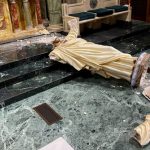
Beginning in 2021, a wave of attacks targeted Christian places of worship across Canada. More than 120 churches—most of them Catholic, though some Protestant churches and synagogues were also affected—were burned, vandalized, or desecrated. Many of the destroyed churches served Indigenous communities themselves, creating a painful irony: institutions that had become part of local Indigenous spiritual and cultural life were among the victims of the backlash.
Several of these crimes remain unsolved. One of the most dramatic recent examples occurred in February 2026, when Montreal’s historic St. Paul Catholic Church was largely destroyed by fire. Investigators have yet to determine the cause.
Frustration over the lack of answers has now prompted action outside government circles. The Democracy Fund, a Canadian legal organization focused on civil liberties and democratic accountability, has launched what it describes as the first independent forensic investigation into more than 120 attacks on churches and synagogues since 2021.
The initiative seeks to examine whether law enforcement agencies properly investigated the incidents, whether patterns suggest ideological or organized targeting, and whether public authorities responded adequately. Investigators are expected to review approximately one hundred fire investigation reports and ultimately publish their findings.
The controversy has also fueled a broader debate about free speech and the boundaries of acceptable public discussion.
Earlier this month, Canada’s Senate approved Bill C-9, legislation designed to strengthen penalties against hate crimes and hate propaganda. The bill now returns to the House of Commons because of amendments adopted during the Senate process.
Among the most contentious provisions is the removal of a longstanding protection within Canada’s Criminal Code that shielded the good-faith expression of religious beliefs based on sacred texts. Critics argue that eliminating this safeguard could expose pastors, priests, rabbis, and other religious leaders to legal risks for preaching traditional religious teachings on morally sensitive issues.
Supporters of the legislation insist it is necessary to combat hatred and protect vulnerable communities. Opponents counter that its language is overly broad and could chill legitimate religious expression.
The debate has united an unusual coalition of critics. Pro-life organizations, religious liberty advocates, constitutional scholars, provincial political leaders, Catholic bishops, and Cardinal Frank Leo of Toronto have all raised concerns. While acknowledging the need to combat genuine hatred, they argue that freedom of religion and freedom of expression should not become collateral damage.
Particularly striking was the Senate’s rejection of a proposed amendment that would have criminalized denial of the residential school system. Supporters viewed the amendment as a defense against historical revisionism. Critics warned that criminal law should not become a tool for enforcing historical interpretations, especially when aspects of the residential school narrative remain subjects of ongoing investigation and scholarly debate.
The broader challenge facing Canada today is not whether historical wrongs occurred. On that point, there is little serious disagreement. The residential school system caused profound suffering, family separation, cultural loss, and lasting trauma for many Indigenous communities.
Rather, the emerging debate concerns how democratic societies pursue truth and reconciliation. Can historical injustices be addressed without abandoning standards of evidence? Can governments combat hatred without weakening fundamental freedoms? Can reconciliation flourish when public trust in institutions is eroded?
Those questions now extend far beyond the original events at Kamloops.
For many Canadians, the controversy has become a cautionary tale about the responsibilities of journalism, the dangers of political overreach, and the fragility of religious liberty in an increasingly polarized society. The willingness of major media organizations to revisit their own reporting may be an important step toward restoring public confidence.
Thank you for reading our content. If you would like to receive ZENIT’s daily e-mail news, you can subscribe for free through this link.

Publicaciones relacionadas:
 USA: 300th Catholic Church Attacked Since 2020
 After 112 vandalized churches, Canada ends funding for research on Catholic school tombs
 500 Attacks on U.S. Catholic Churches since May 2020 to 2025
 American missiles, persecuted Christians, and a country that cannot protect them: why did Trump bomb part of Nigeria?
