

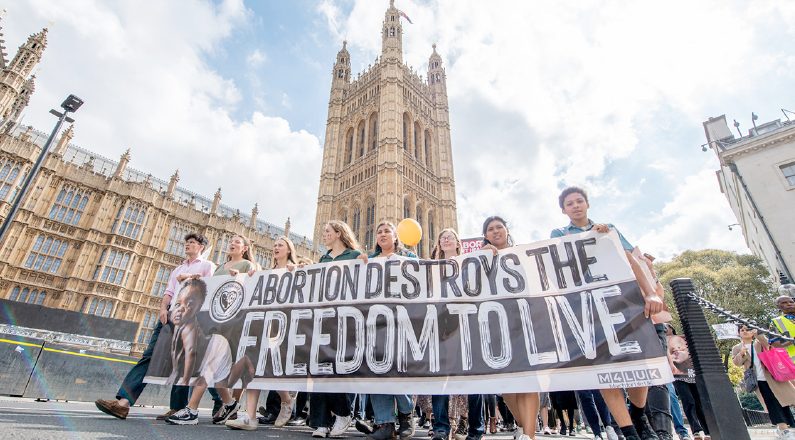
(ZENIT News / London, 10.22.2025).- In a surprising paradox, England and Wales are witnessing a historic divergence between youth attitudes and national abortion statistics. While the total number of abortions in 2022 reached its highest level since the procedure was legalized in 1967, the number of minors—girls under 18—seeking abortions has dropped nearly by half over the past decade.
Data from the Office for National Statistics shows that the abortion rate for women under 18 fell from 12.8 per 1,000 in 2012 to just 7.6 per 1,000 in 2022, representing a striking 41 percent decrease. The broader decline in adolescent conception rates—from 30.9 per 1,000 in 2011 to 13.2 in 2021—appears linked to a combination of delayed sexual activity among teenagers and expanded access to contraception.
Yet this encouraging trend among minors contrasts sharply with the overall rise in abortions. In 2022, the total number of terminations rose 17 percent compared to the previous year, setting a new historical peak. Experts suggest that the increase is driven largely by adult women seeking abortions later in life, highlighting a generational and demographic divide in reproductive choices.
At the same time, the UK government has imposed unprecedented restrictions on pro-life advocacy. The 2023 Public Order Act introduced a new offense for activities occurring within 150 meters of abortion facilities. Government guidance explicitly restricts “silent prayer” and vigil gatherings, measures that many have denounced as a “thought crime.” Despite these constraints, the pro-life movement has gained momentum. This year’s March for Life in London drew over 10,000 participants, a stark rise from the mere hundreds who attended a decade ago.
Public opinion surveys suggest that the cultural shift is most pronounced among the young. Ipsos polling indicates that women aged 16 to 34 are twice as likely to support significant abortion restrictions as their older counterparts. Twenty-six percent of young women surveyed believe abortion should be illegal in all or most cases, compared to only 13 percent among women aged 55 to 75. The generational gap among men is even more striking: just 46 percent of males aged 16 to 35 support abortion, while 82 percent of men aged 55 to 75 endorse it.
These findings reveal a unique cultural tension: a society with some of the most permissive abortion laws globally—allowing abortion on request up to 24 weeks and, in cases of disability, until birth—is simultaneously experiencing a surge in pro-life sentiment among its youth. Analysts argue that this divergence could have long-term political implications.
Although the current Labour government remains pro-abortion, it faces waning popularity and trails the populist Reform UK party by more than ten points in recent polls. While Reform UK does not officially champion a pro-life platform, its leadership, including Nigel Farage, has openly criticized the UK’s liberal abortion provisions as “absolutely absurd” and “entirely outdated,” signaling potential legislative receptivity if political tides shift.
The convergence of generational values, shifting public opinion, and an evolving political landscape may position the UK, the first Western European nation to legalize abortion on broad social and medical grounds, as a surprising battleground for future pro-life advocacy. What emerges is a complex portrait: a society where abortion numbers climb yet cultural sentiment among young people increasingly leans toward life, creating the conditions for a potential transformation in both law and public discourse in the coming decade.
Thank you for reading our content. If you would like to receive ZENIT’s daily e-mail news, you can subscribe for free through this link.

Publicaciones relacionadas:
 France Sees Historic Surge in Adult Baptisms. Young People Lead Spiritual Revival
 ProLife Europe Honored at 19th Mystery of Life Awards in Seoul Global
 Monaco reaffirms its Catholic identity by halting abortion reform: Prince refuses to enact the law
 Carmelite friar who prays the Rosary online at 4 a.m. becomes Brazil’s most-watched streamer in 2025
