

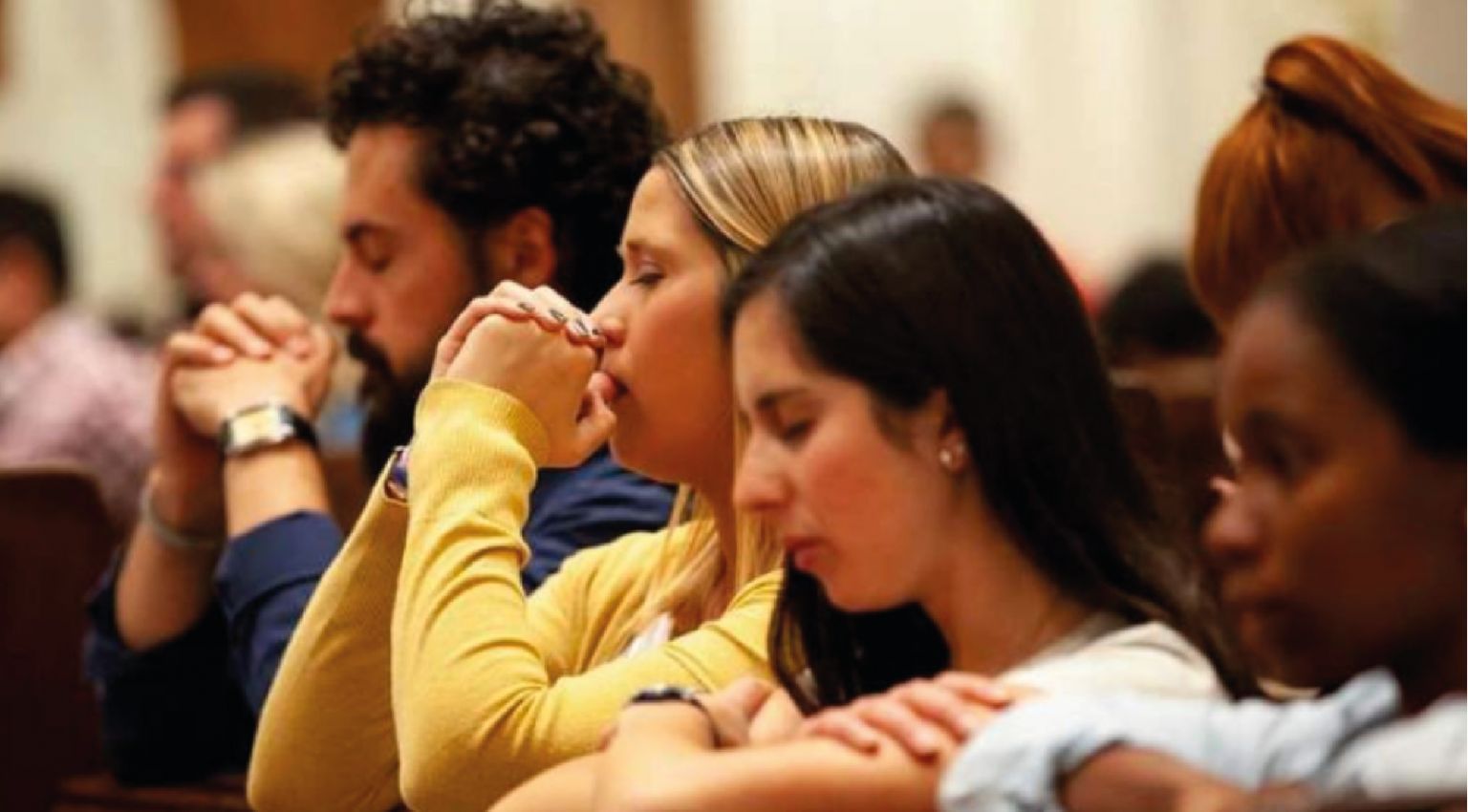
(ZENIT News / Roma, 01.04.2026).- For years, Britain’s youngest adults have been portrayed as the most secular generation in the country’s modern history: disengaged from churches, wary of doctrine, and distant from traditional language about God. New research suggests that picture may be incomplete. Beneath the headline figures about religious disaffiliation, a quieter shift appears to be taking place—one marked less by formal belonging than by gratitude, wonder, and renewed openness to transcendence.
A report commissioned by the Policy Institute at King’s College London and published on Christmas Eve 2025 draws on a nationwide survey conducted by Opinium among 2,050 UK adults in October. Its findings point to comparatively high levels of belief, spiritual experience, and existential reflection among those aged 18 to 34, often exceeding those reported by older generations.
Rather than asking only whether respondents belonged to a religion, the survey probed experiences that sit at the border between spirituality and everyday life. Feelings of awe, gratitude, and connection emerged as particularly strong among younger adults. More than a third of respondents in this age group said they experienced a deep sense of admiration or wonder at the universe or nature at least once a week, a higher proportion than in any older cohort. Only a small minority of young adults said they had never felt such emotions.
The same pattern appeared in questions about connection. Almost one in four respondents overall said they regularly felt connected to all people or living beings, but among younger adults the proportion who said they had never experienced this feeling fell sharply. A majority of respondents also reported having felt guided or watched over by “something or someone” at some point in their lives, with disbelief most concentrated among those who identified with no religion.
Perhaps most striking was the sense of purpose reported by young adults. Nearly seven in ten said they believed there was an overarching purpose in life, including their own, a figure far higher than among older respondents. One in five young adults also reported sudden and intense feelings of gratitude simply for being alive, occurring at least weekly.
Gratitude itself proved to be a revealing lens. Asked who or what they felt grateful to, respondents most often cited nature, other people, and themselves. God ranked fourth overall, but among 18- to 34-year-olds it rose sharply: more than four in ten in this group said they felt grateful to God, roughly double the rate seen among older adults.
At the same time, the data resist any simplistic narrative of religious revival. A clear majority of respondents said belief in God or a higher power was not essential in order to feel grateful for life. Even among younger adults, spirituality often appears detached from institutional frameworks and doctrinal claims.
The report itself acknowledges these tensions and adopts a cautious tone. A dedicated commentary questions whether younger people are truly becoming more religious or whether the results reflect methodological effects. Online surveys, it notes, may overrepresent young adults who are already inclined toward belief or spiritual exploration.
That caution is reinforced by comparisons with other large-scale studies. In the Opinium survey, just over half of young adults said they believed in God to some degree. Yet the World Values Survey conducted in the UK in 2022 recorded significantly lower levels of belief in life after death and heaven among the same age group. Meanwhile, the 2024 British Social Attitudes survey found that more than 60 percent of people aged 18 to 34 described themselves as having no religion—the highest proportion of any generation.
Rather than dismissing the newer findings, the report situates them within a more complex social landscape. Younger generations in Britain are more ethnically and religiously diverse than their predecessors, and that diversity alone may be reshaping aggregate results. The authors also note that changes in survey outcomes have occurred rapidly, raising questions that cannot be answered by sampling bias alone.
Church leaders, for their part, see in the data confirmation of what they say they are witnessing on the ground. The Bishop of Birmingham, Michael Volland, spoke of “signs of a new openness to faith,” particularly among younger people. He described churches encountering young adults who arrive not out of habit, but with a desire to explore life’s deepest questions and to find hope and belonging within a community shaped by the Gospel.
Similar observations were shared by Debbie Clinton, who oversees Vision and Strategy for the Church of England (anglican). She pointed to reports from parishes across traditions of young adults seeking baptism and confirmation, often after long periods of spiritual searching. In her account, gratitude, wonder, and curiosity are not peripheral emotions but central pathways through which faith is being rediscovered.
External observers echo that assessment. A spokesperson for the Bible Society described the Opinium data as consistent with other recent research pointing to increased openness among young adults, not only toward organized religion but toward broader forms of spirituality and transcendence. From this perspective, methodological differences matter, but they do not erase the overall direction of travel.
Even the Policy Institute, while openly skeptical of strong conclusions, concedes that it seems unlikely such changes can be explained solely by who chooses to join online survey panels. Multiple datasets suggest that something is shifting, even if its contours remain unclear.
What emerges, then, is not a straightforward return to pews or creeds, but a generation less dismissive of God-language than expected, more willing to speak about purpose, gratitude, and wonder, and more open to faith as a serious option rather than a relic of the past. In a society long accustomed to measuring secularization by institutional decline, the inner lives of young adults may be telling a more complicated—and more intriguing—story.
Thank you for reading our content. If you would like to receive ZENIT’s daily e-mail news, you can subscribe for free through this link.

Publicaciones relacionadas:
 Scientific Study Warns of Risks of «Gender Change» in Children
 How Parenting and Self-control Mediate the Link Between Social Media Use and Youth Mental Health
 Research Shows that Catholics Are the Fourth Group That Most Attends Religious Services in the USA
 UN Uses AI to Target Adolescents on Controversial Issues
