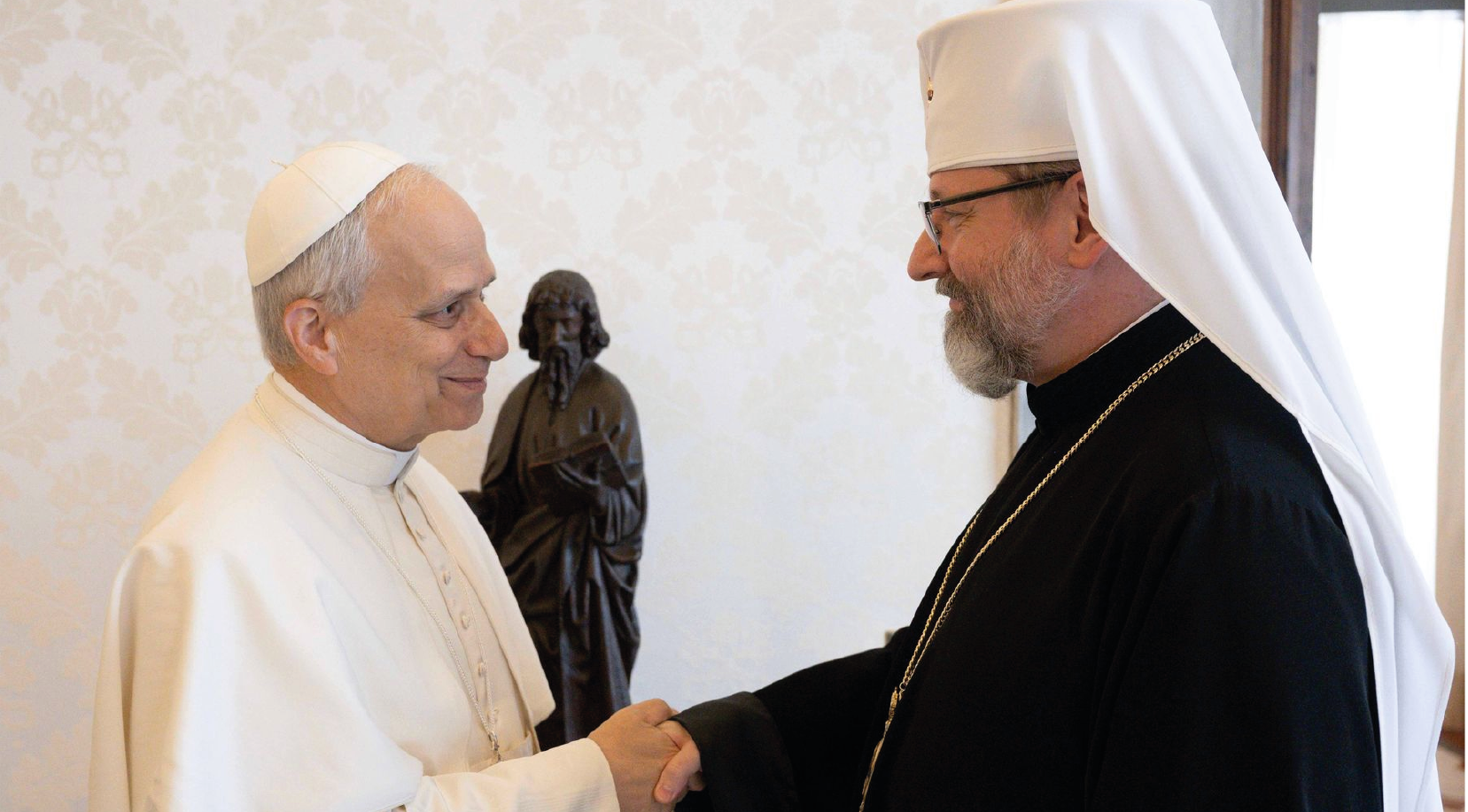
(ZENIT News / Rome, 03.11.2026) – On February 12, Pope Leo XIV received the Head of the Ukrainian Greek-Catholic Church, His Beatitude Sviatoslav Shevchuk, at the Apostolic Palace in the Vatican. According to a Holy See press release, the Archbishop thanked the Pope for his solidarity and support for Ukraine, as well as the Vatican’s diplomatic efforts to achieve a just and lasting peace in the country during these four years of war.
The Major Archbishop of Kyiv told the Holy Father, «I am happy to be able to come and visit you.» During the meeting, special attention was given to the current life of the Ukrainian Greek-Catholic Church and the global dimension of its service. Shevchuk emphasized that the Ukrainian Greek Catholic Church is both a particular and a global Church, present in every continent of the world: «Our particular Church, the Christian community of Kyiv, is of Ukrainian origin, but it is not a Church only for Ukrainians; rather, it is open to the proclamation of the Gospel to all peoples, precisely thanks to the visible communion with the Successor of the Apostle Peter,» he said to the Pope.
Following the start of the Russian invasion of Ukraine, the conflict has changed its face: from fighting with tanks to swarms of technologically advanced vehicles. The conflict is devastating the people with the rapidly growing arms industry, while the sacrifice of people does not diminish.
The casualty figures for both sides are being concealed. The Center for Strategic and International Studies (CSIS) estimates the deaths and injuries on both sides are close to two million people. Russia is estimated to have 1,250,000 dead, wounded, and missing, and Ukraine is estimated to have over 100,000. The CSIS calculates that Russia is losing more than a thousand soldiers a day in deaths and injuries, gaining between 20 and 70 meters of ground each day. For its part, Ukraine has officially acknowledged 55,000 soldiers killed and a high number missing.
Russia controls 20% of Ukrainian territory, including Crimea and Donbas. In 2025, the bloodiest year of the conflict, Putin’s army gained between 4,000 and 5,000 square kilometers, equivalent to 1% of Ukrainian territory. The Ukrainian advance on Ukrainian soil is insignificant in its defensive war against the ongoing attacks. Another notable aspect is the displacement of people: Ukraine has registered seven million refugees, three and a half million internally displaced persons. There are twelve and a half million people who depend on external humanitarian aid. Four million Ukrainian children have dropped out of school. The healthcare system is overwhelmed and the energy system is under constant Russian attack with its eternal ally: General Winter. Furthermore, resentment is growing, with no end in sight.
In an interview with Vatican News, His Beatitude Sviatoslav Shevchuk commented: «It is a tragic anniversary. No one ever imagined a war in Europe that would last four years. And when we speak of four years, we are referring only to the large-scale Russian invasion. In fact, the war began in 2014 with the occupation of Crimea and part of the eastern Donbas. We are facing a true tragedy which, in recent months, has worsened even further. The number of dead and wounded civilians continues to rise. I can say that even at the beginning of the invasion, in 2012, the situation was not as dramatic as it is today, especially during this winter, particularly in the Ukrainian capital.»
Regarding daily life in Kyiv, the Archbishop explained: «This winter is the most severe of the last decade: the temperature in Kyiv has dropped to 15 degrees below zero. The Russians are methodically destroying the vital infrastructure of Ukrainian cities, particularly the capital. Kyiv, one of the largest capitals in Europe, has almost four million inhabitants. The heating and electricity system is centralized: each neighbourhood has its own central plant that supplies electricity and hot water to the buildings. In our neighbourhood there is no gas: we cook with electricity, which is also needed to pump drinking water to the nine- or twenty-story buildings. This winter, many power plants, built in the Soviet era and whose plans were known to the authorities, were demolished. When the temperature dropped to twenty degrees, it was no longer possible to supply electricity and hot water; the pipes froze and burst, and the sanitary systems also suffered serious damage. Imagine a building with three thousand people: everything is frozen in the apartments, the indoor temperature is barely higher than the outdoor temperature, the bathrooms are unusable. Many are trapped in their homes and don’t know where to go. Probably, priests and men religious continue to feel a deep empathy, especially because they themselves have experienced grief in their own families.”
Regarding the loss of family members, His Beatitude Shevchuk expressed: “A psychotherapist told me, ‘When Kyiv is bombed, you also suffer being in Rome?” It’s a sign of trauma. That’s why we accompany our priests through a ‘healing of wounds’ program: those who have lived through and overcome their own suffering become ‘wounded doctors,’ able to understand those who suffer and guide them toward healing, including psychological and mental healing. Mental and spiritual health is at the heart of our commitment. We are gaining unprecedented experience, which can become a treasure for other Churches that have not experienced a similar tragedy, in order to help people draw closer to God, to Christ, the source of salvation and health — not only spiritual, but also mental and physical.”
The Church in Ukraine has experienced the solidarity of the universal Church in various ways, and His Beatitude stated: “Over these four years, we have received much solidarity from the entire universal Church, encouraged above all by the Holy Father Francis, of blessed memory, and now by Pope Leo. We are very grateful to the Holy Father and to all our brothers and sisters in Christ, to all people of good will who have expressed their closeness. This solidarity has had its ups and downs. I remember the first days of the war, when humanitarian aid arrived in large quantities from different European countries and from all over the world. Last year, in 2025, the aid had almost disappeared. It was becoming increasingly difficult to obtain approval for projects intended for those who had no means of survival. At the beginning of 2025, it was estimated that around five million people in Ukraine had food insecurity, but that only 2.5 million could benefit from the aid. This winter, tragic because of the cold and the hardships, the images of people suffering and trying to resist have rekindled international solidarity, recalling February-March 2022.»
And he added: «I’d like to recount a specific episode. After each bombing in Kiev, I usually share information with my friends. I sent about ten people a picture of the aftermath of an attack accompanied by a short comment: ‘We survived another hellish night in Kyiv. Temperature of minus twenty degrees.'» The struggle for life, humanity, and solidarity continues.» Among the recipients was Cardinal Grzegorz Ryś, Archbishop of Kraków, who responded immediately with a gesture of solidarity. The following Sunday, he announced a collection for Kyiv, making my message public. Three days later, he wrote to us saying that one million zlotys had already been deposited into Caritas’s account, which also organized humanitarian aid collections and contributed. Today we are experiencing a wave of solidarity that goes beyond financial support: for us, it is important that all European parishes speak of the suffering in Kyiv, because Christian memory and prayer have touched consciences and hearts. We are deeply grateful to all who have contributed to saving lives in Ukraine.”